A robot needs to hear the click. NEURA introduces AI with touch and memory
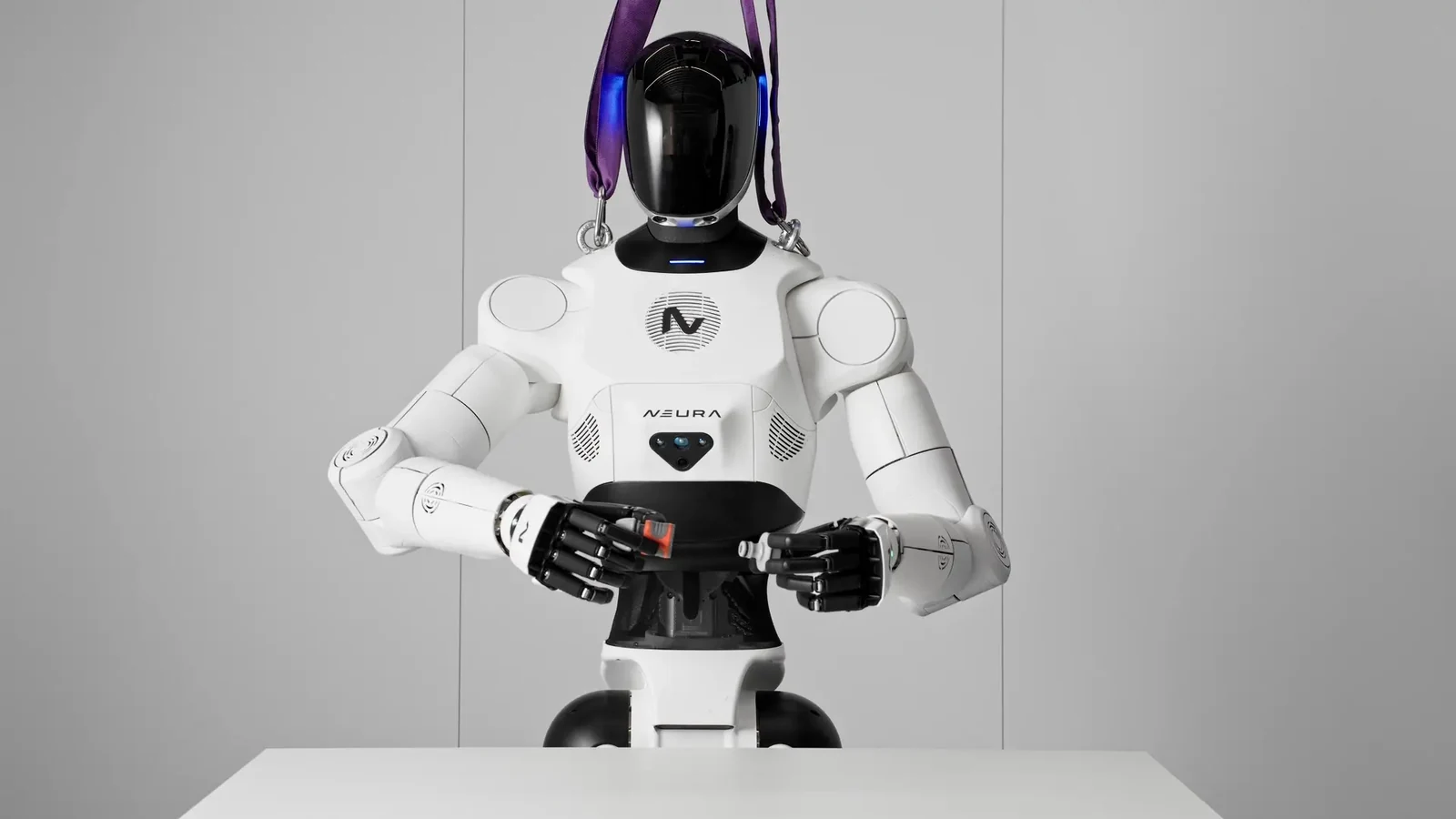
When connecting two components, a quiet click can be the decisive signal. A robot that misses it may see the parts in the correct position and still lack confirmation that the connection succeeded. That is a useful starting point for Neuron AI, NEURA's model combining different senses with a memory of earlier actions.
The Metzingen company announced the model on 14 October. It presents Neuron AI as its own Physical AI system for controlling robots. Vision, touch, audio and continuity sit at the centre of the presentation: the next decision should reflect what the robot has already done. NEURA's 14 October announcement.
What the robot's new “brain” means
NEURA calls the architecture PLA, short for Perception-Language-Action. The product page describes inputs from 3D vision, touch and force, audio, robot state and language, with decisions running locally on the device. It identifies five NEURA robot platforms with different hands and grippers. Neuron AI product description.
The acronym alone does not establish performance. The practical question is whether the robot can resolve a situation in which different signals disagree. A camera might suggest that a component is in place while resistance indicates an obstruction. A useful system should adjust or pause the task before proceeding.
That also affects how a demonstration should be evaluated. An additional sensor earns its place when its information improves the outcome. Comparing the same task with and without that signal, under similar conditions, would help establish its contribution. This would help distinguish the architecture from careful setup.
What to watch in the video
In the complete presentation, NEURA's team explains sensor integration and memory. Confirming a component connection through contact and sound is one of its examples. The speakers describe the intended operation; the video does not include a public set of comparative benchmark results. Official NEURA Robotics video.
The most revealing question while watching is: how does the robot know a step is complete? Moving to a specified position is only part of many tasks. There must also be a decision about whether to continue. That transition is where combining several senses could produce a useful advantage.
Memory matters between movements
Imagine a robot putting a component in a container, turning to collect another and then returning to the earlier task. Its situation depends on history: where it left the part, what it has already checked and which location is occupied. Looking only at the current scene could lead to unnecessary repetition.
This example also suggests a practical way to examine memory. Obscure an object after the first step, or change the order of the instructions, and observe whether the robot retains the relevant context. This is our proposed evaluation approach, not a description of a published Neuron AI benchmark.
Updating that memory after a failure is equally important. If a part falls from the gripper, the robot needs to revise its assumptions. Remembering an incorrect state could be as troublesome as forgetting the state altogether. An industrial customer will therefore need evidence of failure detection and recovery as well as successful execution.
Berlin's eleven-minute laundry sequence is still ahead
NEURA has scheduled a 4NE1 demonstration at NVIDIA GTC Berlin on 20–22 October. The planned sequence includes sorting clothes, loading and reopening a washing machine, unloading it and moving the laundry to a dryer. Eleven minutes refers to handling and task coordination, rather than a complete wash-and-dry cycle. As of 18 October, this remains an upcoming demonstration. Scope and dates of the planned event.
A multistep scenario makes sense as a test of continuity. Each stage changes the conditions for the next: the contents of a container, the arrangement of fabrics or the state of a door. A complete recording, repeated attempts and a record of interventions would make the result more informative. They would show how behaviour holds up beyond one successful sequence.
What deployment could mean in Poland and Europe
NEURA says Neuron AI is now available through Neuraverse. The company describes customer-specific fine-tuning and the deployment and updating of robot skills through that platform. It has not published a complete package price for a Polish customer or a retail purchase date for a domestic 4NE1 with these capabilities. Delivery scope needs to be agreed for the specific task and hardware. Manufacturer's availability announcement · Fine-tuning and deployment description.
It is worth taking a measurable objective into that conversation. How many correctly connected components should be completed during a shift? How many attempts need rework, and how often is a person required? Those questions establish whether better perception addresses an expensive problem in the customer's process.
Our NEURA 4NE1 profile provides hardware context, while our analysis of German robotics and Physical AI looks at the wider market. The guide to humanoids that can actually be bought or ordered helps distinguish offer status. Neuron AI is interesting because it targets a concrete requirement: a robot should recognise the result of its work before making its next move.
Image: NEURA Robotics — official still from the Neuron AI webpage. A robot at a demonstration station, with safety straps visible. This is not footage of the upcoming GTC Berlin event.
Sources
NEURA launch announcement, 14 October 2026 · Official Neuron AI product page · Official video presentation. Checked on 18 October 2026. The Berlin demonstration is scheduled for 20–22 October.