Humanoids go to the gym. Inside NEURA’s bet on robot skills
A robot can have hands, cameras and powerful motors and still struggle with a slightly crushed cardboard box. That gap — between an impressive machine and a useful skill — is where NEURA Robotics sees a business opportunity. Its “humanoid gyms” are not about building muscle. They are about learning to work.
A Forbes feature published on 18 October 2026 examines the strategy and reports a valuation of around $7 billion, citing people familiar with the transaction. According to David Reger’s account in the article, the facility at Munich Airport is already operating. That is an interview-based report, not the result of a RoboMorrow site visit. [1]
Watch the TUM RoboGym concept
TUM RoboGym video from the 3 April 2026 publication by motion-capture supplier MANUS. Archival project material, not a RoboMorrow test. Open the video on YouTube · MANUS source publication [4].
What does a humanoid actually practise?
Imagine a packing station. A person picks up a box, opens it, folds its flaps and puts it down. To an observer, that is one simple action. For a robotics project, it helps to break it into questions: where should the machine grasp the material, how should it respond to resistance, when should it adjust its grip and what happens after a failed attempt? This is an explanatory example, not a measured NEURA deployment.
NEURA Gym is offered as infrastructure for training, validating and preparing robots for a partner’s tasks. Instead of a conventional demonstration room, the proposal is a work cell representing a particular process, with access to robots and data-processing infrastructure. The manufacturer describes it as combining a customer’s process expertise with its own robotics capabilities. [5]
The interesting shift is from “buy a robot” to “prepare somewhere it can learn your work”. For a customer, that changes the conversation. The starting point need not be a catalogue of impressive movements. It can be a task that needs doing and a clear definition of successful completion.
TUM RoboGym: 2,300 square metres, but not an October launch
NEURA Robotics and TUM/MIRMI announced their joint TUM RoboGym project on 10 March 2026. The announcement described roughly 2,300 square metres at the TUM Convergence Center at Munich Airport. Initial joint investment was put at about €17 million, including approximately €11 million from NEURA. That is a project-launch budget, not the price of a robot or a complete accounting of long-term operating costs. [2] [3]

A July interview published by the Association for Advancing Automation also discussed the gym concept. The October Forbes feature is therefore a new perspective on an evolving business, not the first announcement of robot training centres. [9]
The teacher is still human
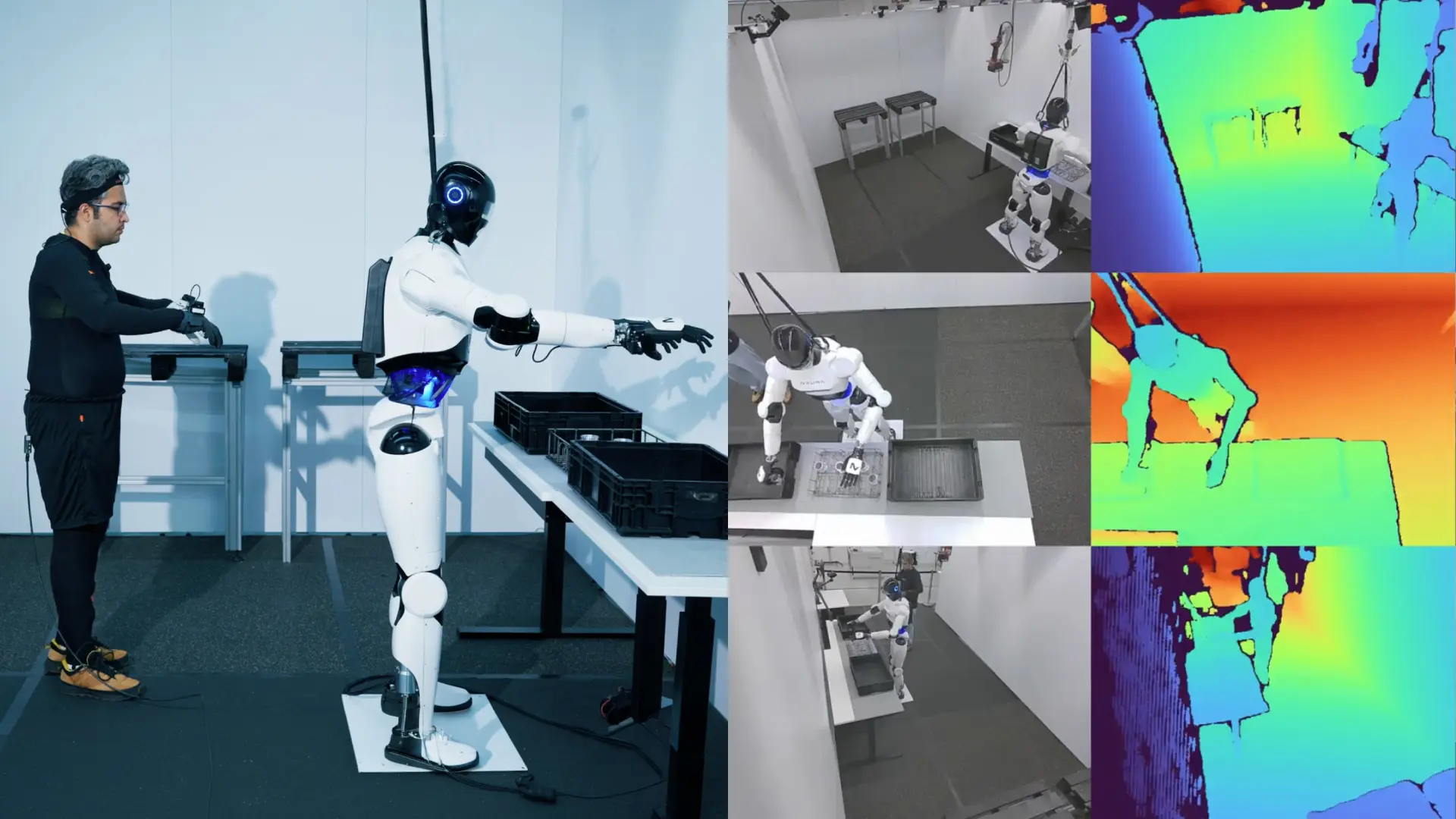
MANUS describes combining its hand-tracking gloves with Xsens full-body motion capture. Human demonstrations are intended to provide data for robot learning and the Neuraverse platform. This describes the proposed training infrastructure; it does not establish that watching one demonstration lets a machine master any task. [4]
It is useful to distinguish a recorded movement, a learned control policy and a working application. Video or sensor data is input to the process. Software still has to use it to make decisions. The complete configuration then needs evaluation when objects are not arranged exactly as they were in the demonstration.
For our cardboard-box example, a meaningful assessment would also include boxes of different stiffness, awkward positioning and unsuccessful folds. Repeating the best-looking attempt answers a different question from the one a shift manager would ask: how much useful work gets done without bringing the process to a halt?
What does the customer pay for?
Forbes describes customers renting dedicated training cells to prepare robots for their own jobs. [1] On the NEURA Gym offer page reviewed for this article, we did not find a complete public tariff from which an arbitrary project could be priced. The commercial route is to contact the manufacturer. [5]
Our business interpretation is that a customer should not simply be buying access to a hall. It should be buying a faster or less expensive way to answer a deployment question. Can the selected machine handle a particular family of components? What supervision does it require? What needs changing at the workstation? The service’s value depends on the quality of those answers.
The cost of an experiment should also be separated from the cost of subsequent operations. A training-cell fee is not automatically the price of a complete deployment covering hardware, integration, support and maintenance. A successful experiment could even produce a sensible decision to use a simpler robot arm or reorganise the workstation instead.
Neuraverse: a skills platform, not a magic button
Neuraverse is presented as a platform connecting robots, developers and industry, supporting the creation and use of robotics applications. In April, NEURA also announced collaboration with AWS on Physical AI infrastructure. These are pieces of a broader platform, not evidence that a finished humanoid has been delivered to every named partner. [7] [8]
We would interpret the “Apple of robotics” ambition mainly as an effort to connect devices, software and services. For a customer, the more important question is what can be reused. If a second installation takes as much effort as the first, the platform has not yet solved the central economic problem.
Nor should a skill demonstrated at one station be assumed to work unchanged on any robot. When comparing deployments, we would examine the gripper, sensors, objects, surroundings and software configuration. Two tasks can both be called “packing” without sharing the same operating conditions.
This direction complements our earlier coverage of NEURA’s ADLATUS acquisition and Neuraverse strategy. Here, however, the focus is a different part of the system: not an existing robot fleet, but the infrastructure used to prepare further applications.
$7 billion, $1.4 billion and €17 million are different numbers
Large headlines can blur the distinction between a company’s valuation and money allocated to a project. Here, keeping those figures separate is particularly important:
| Amount | What it refers to | What it does not mean |
|---|---|---|
| Around $7 billion | NEURA’s valuation reported by Forbes. [1] | Not revenue or the amount spent on training centres. |
| Up to $1.4 billion | The Series C round size announced by NEURA on 10 June 2026. [6] | “Up to” does not establish that the entire sum arrived in a single payment. |
| Approximately €17 million | Initial joint investment in TUM RoboGym. [3] | Not a rental tariff or the total cost of a global gym network. |
These figures remain in their original currencies. They describe valuation, corporate financing and an infrastructure budget, rather than a consumer robot offer that needs a comparable retail price.
Does a physical gym mean simulation has failed?
No. The university’s presentation links real-world work with the development of digital environments. It should not be read as evidence that robots can only learn inside a physical hall, or that synthetic data has no value. [3]
When planning an evaluation, the useful question is which risks can be explored earlier and which require contact with the actual object and workstation. Our box example illustrates the distinction: expected geometry is one thing; a particular box with a damaged corner is another. That is a reason to compare methods, not to choose one as an article of faith.
The real exam comes after leaving the gym
For a manufacturer or warehouse operator evaluating such a project, we would propose four acceptance criteria. This is our assessment checklist, not a set of disclosed NEURA results:
| Question | What to record |
|---|---|
| Is the task completed correctly? | Every attempt and the proportion meeting an agreed quality requirement. |
| How much work remains for people? | Interventions, setup, corrections and the time required to resume operation. |
| Does the result transfer beyond training? | Trials with previously unused objects, different arrangements and the intended customer site. |
| Does the solution outperform an alternative? | The full cost of an accepted operation compared with a realistic competing approach. |
We would apply the same approach to a potential project in Poland or elsewhere in Europe: start with a well-defined process, not the assumption that it needs a humanoid. This article does not report a confirmed Polish NEURA Gym. For the wider industrial context, see our analysis of German robotics, including NEURA, Agile and Franka. Another application-led perspective appears in our coverage of NEURA HealthTech and hospital-bed transport.
RoboMorrow’s view: the teacher is more interesting than another demo
The strongest idea here is not that robots are getting their own gym. It is that teaching physical work can be treated as a service that must be designed, priced and evaluated. That deserves attention without first deciding who will win the humanoid race.
The decisive customer outcome is not “the robot learned something in a hall”. It is “after moving into my process, it performs useful work with predictable costs and a defined level of human assistance”. Only then does a humanoid gym become more than a memorable headline.
Sources and methodology
Redakcja RoboMorrow · editorial research date: 19 October 2026. This is an analysis of public sources, not a hands-on test or a visit to TUM RoboGym. We distinguish project participants’ statements, reporting and our own proposed evaluation criteria. Featured image: an official NEURA Robotics composition showing an operator, robot and sensor views. The hall visualisation is identified separately. The video is referenced through its embedding by MANUS; we do not assign unverified ownership of its YouTube channel.
[1] Forbes, feature by Nina Bambysheva, 18 October 2026 · [2] NEURA, TUM RoboGym announcement, 10 March 2026 · [3] TUM, training-centre announcement, 10 March 2026 · [4] MANUS, technology description and video, 3 April 2026 · [5] NEURA Gym, manufacturer offer · [6] NEURA, Series C, 10 June 2026 · [7] Neuraverse platform · [8] NEURA/AWS collaboration, 21 April 2026 · [9] A3, NEURA strategy interview, 15 July 2026.