PitPro deploys its first production tire-changing robot at Kal Tire
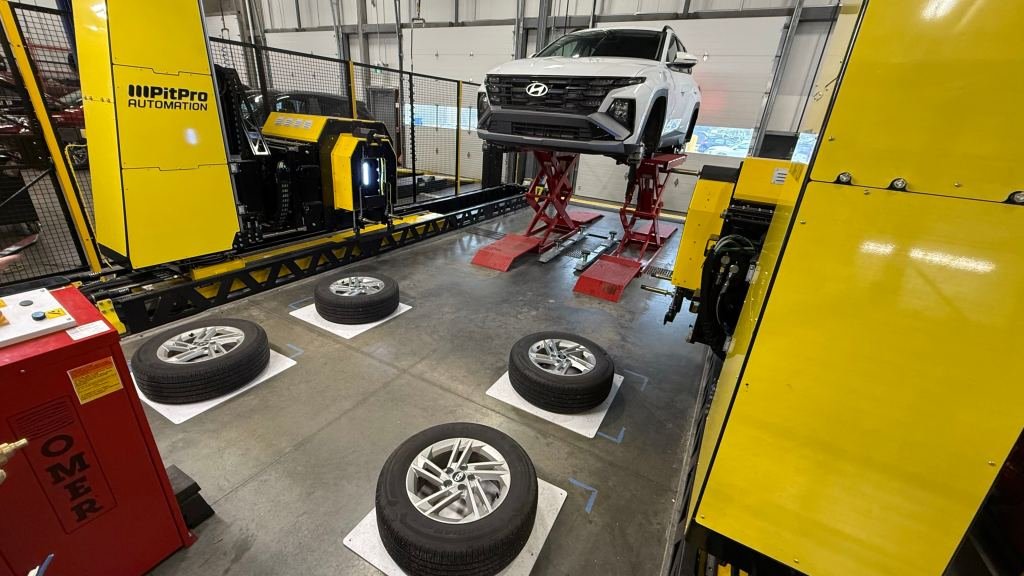
PitPro Automation announced on September 23 that its first production tire-changing system is installed at a Kal Tire store in Calgary. Kal Tire participates in the announcement. PitPro claims a full four-tire swap in under 15 minutes; long-run independent production benchmarks have not yet been published.
Service robotics is moving into workplaces that are messy, variable and difficult to automate. PitPro Automation has installed its first production automated tire-changing system at a Kal Tire location in Calgary. The key word is production: this is no longer only a trade-show demonstration or pilot rig. The machine is sitting in a live customer service bay where seasonal demand, debris and day-to-day operational exceptions matter.
From pilot to a production bay
PitPro publicly revealed the system in 2025, but the September 23 announcement is the first production deployment in the field. It fits inside one service bay and targets Class 3 and smaller vehicles. Two coordinated gantries work across all four wheel positions. The company says the system can complete a full set of tire swaps in under 15 minutes.
TechCrunch independently covered the deployment and interviewed PitPro's founder. Its reporting adds operational detail: the machines use sensors and robotic arms to find and loosen lug nuts, retain the hardware, remove wheels and install the replacements. That is stronger evidence than a vendor demo, although it is still not a statistically meaningful reliability study across thousands of jobs.
Why Kal Tire matters as the customer
Kal Tire says it operates more than 280 retail and commercial stores in Canada and employs roughly 7,000 people. Canadian winter-tire season creates a sharp peak in workload, so this is a demanding environment for a system whose value proposition depends on throughput. If PitPro can maintain uptime during seasonal peaks, that would tell the market much more than performance inside a controlled engineering facility.
The announcement does not say Kal Tire has ordered a chain-wide rollout. The Calgary installation is described as the first unit in PitPro's production rollout, with additional systems planned for other customer sites this fall. The confirmed fact is one production system in a real store. A future network of hundreds of systems remains a possibility, not an announced order.
Does the robot replace the technician?
Kal Tire frames the machine as a force multiplier. The automated system takes over a heavy and repetitive part of the workflow, but tire service still includes inspection, diagnostics, exceptions, customer interaction, quality control and other vehicle work. That mirrors the pattern we see in Richtech's DUST-E retail cleaning deployment: the most credible automation projects remove a repeatable task and leave humans responsible for judgment and edge cases.
For an operator, the important questions are economic rather than cinematic. What does the system cost? How much installation and service does it require? How often does a technician intervene? How does it deal with corrosion, unusual wheels, damaged hardware, snow, mud and sensor contamination? PitPro has not yet published a full production dataset answering those questions.
The real test is the environment
TechCrunch reports that open service-bay doors expose the robots to dust, weather and other contamination, forcing PitPro to harden both the mechanics and sensing. That is a useful reminder that real-world robotics often fails on environmental details that are absent from laboratory demonstrations. Reliability is a systems property, not just a successful manipulation sequence.
The same threshold appears in autonomous logistics. Our coverage of Gatik moving driverless freight beyond pilot status focuses on the operational shift from "the vehicle can do it" to "the system can repeat it inside a customer process." PitPro is now entering that same measurement phase for vehicle service.
What it means for Europe
European tire service has similarly sharp seasonal demand, particularly in Central and Northern Europe. Automating one of the most physical tasks could be attractive to large service chains, fleet operators and high-volume workshops. But the Calgary installation is not a European commercial launch, and RoboMorrow does not treat it as a purchase recommendation for EU shops.
There is no published EU price, distribution model, service network or installation-specific European machinery compliance package. Any European buyer would also need to model total cell cost and safety rather than only machine speed. That is the same framework used in our small-business automation cost and ROI guide.
RoboMorrow take
PitPro matters today because a production unit is operating at a named customer. That moves the story from "a robot can change tires" toward a business-machine question: uptime, throughput, exception rate, maintenance and cost per completed job.
The next meaningful update will be hard operating data or a scaled order. We will watch completed service volume, failure and intervention rates, the economics of one bay and whether the additional fall deployments happen as planned. If Kal Tire expands beyond the first location, this could become a new repeatable automation category rather than an interesting one-off installation.
The next phase will also test repeatability across sites. A fast cycle in one Calgary bay does not prove that the same throughput can be reproduced after a routine installation elsewhere. PitPro says more customer systems are scheduled for this fall, so the useful evidence will be installation time, uptime, intervention rates and whether different shops can reach similar results without extensive custom engineering. Those metrics will determine whether the platform scales as a product rather than as a one-off automation project.