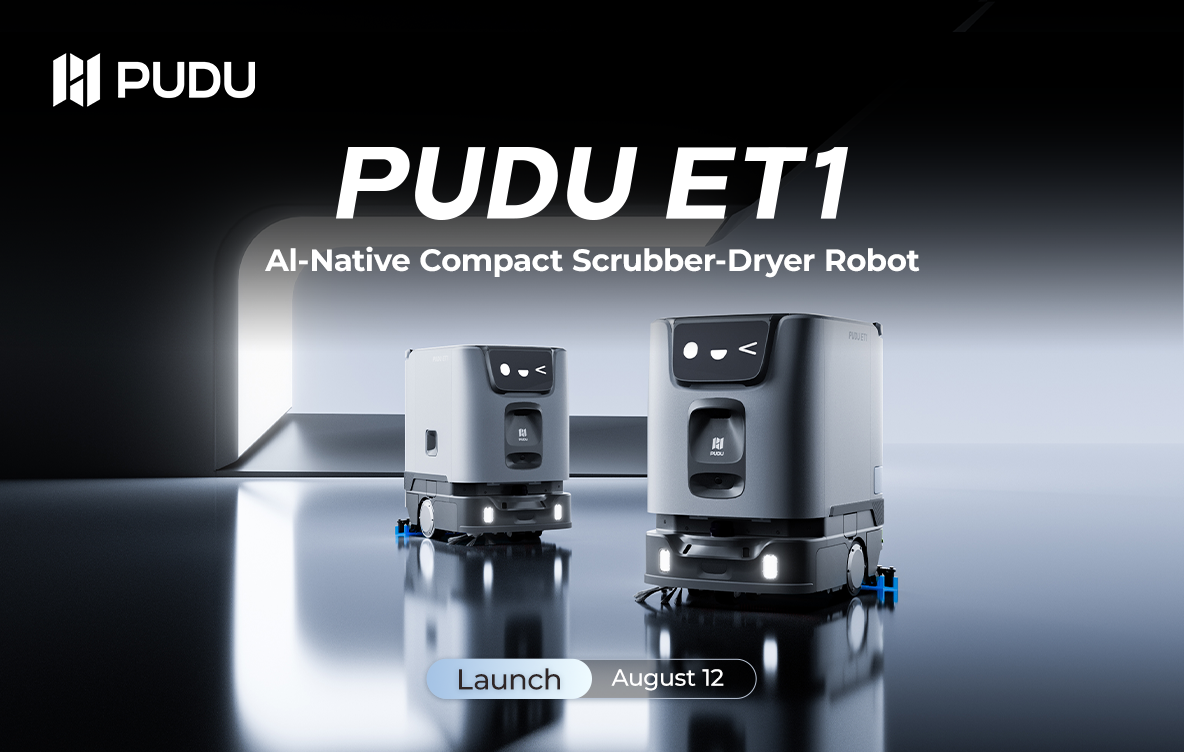
PUDU ET1 targets small shops and restaurants with four cleaning functions in one robot
BUYING IN YOUR MARKET
Availability in your country
Sales, delivery and support can differ by country and exact model. Choose your market to see the evidence we have checked.
PUDU ET1
United States
Local sales channel — request a quote
- Seller / sales channel
- Inland Global
- Price
- Individual quote; no verified public local price
- Delivery
- Confirm stock and the delivery date for your address with the seller
- Warranty and service
- Confirm written warranty terms, parts and service coverage for your address
Inland Global lists this model in its US sales catalogue with a quotation route. Confirm the exact configuration and fulfilment before payment.
Evidence checked: · Not a live stock feed
Inland Global: request a quote ↗Germany
Local sales channel — request a quote
- Seller / sales channel
- JK Robotik
- Price
- EUR 11,950 excluding VAT and shipping; confirm the dock, accessories and installation separately
- Delivery
- Confirm stock and the delivery date for your address with the seller
- Warranty and service
- Confirm written warranty terms, parts and service coverage for your address
JK Robotik lists this exact model for this market. A listing is evidence of a buying route, not a delivery commitment.
Evidence checked: · Not a live stock feed
JK Robotik: request a quote ↗Poland
Local sales channel — request a quote
- Seller / sales channel
- Positive Machines
- Price
- Individual quote; no verified public local price
- Delivery
- Confirm stock and the delivery date for your address with the seller
- Warranty and service
- Confirm written warranty terms, parts and service coverage for your address
Positive Machines lists this exact model for this market. A listing is evidence of a buying route, not a delivery commitment.
Evidence checked: · Not a live stock feed
Positive Machines: request a quote ↗Netherlands
Local sales channel — request a quote
- Seller / sales channel
- Fulin Robots
- Price
- See the linked offer for the current price, configuration and taxes
- Delivery
- Confirm availability and delivery to your address with the seller
- Warranty and service
- Confirm warranty territory, local service and return shipping with the seller
This supplier lists the exact model. Request a written offer with the exact configuration, delivery date and service coverage.
Evidence checked: · Not a live stock feed
Fulin Robots: model offer ↗Spain
Local sales channel — request a quote
- Seller / sales channel
- Intec Robots
- Price
- See the linked offer for the current price, configuration and taxes
- Delivery
- Confirm availability and delivery to your address with the seller
- Warranty and service
- Confirm warranty territory, local service and return shipping with the seller
This supplier lists the exact model. Request a written offer with the exact configuration, delivery date and service coverage.
Evidence checked: · Not a live stock feed
Intec Robots: model offer ↗Portugal
Local sales channel — request a quote
- Seller / sales channel
- Intec Robots
- Price
- See the linked offer for the current price, configuration and taxes
- Delivery
- Confirm availability and delivery to your address with the seller
- Warranty and service
- Confirm warranty territory, local service and return shipping with the seller
This supplier lists the exact model. Request a written offer with the exact configuration, delivery date and service coverage.
Evidence checked: · Not a live stock feed
Intec Robots: model offer ↗France
Local sales channel — request a quote
- Seller / sales channel
- CAP Robotics
- Price
- See the linked offer for the current price, configuration and taxes
- Delivery
- Confirm availability and delivery to your address with the seller
- Warranty and service
- Confirm warranty territory, local service and return shipping with the seller
This supplier lists the exact model. Request a written offer with the exact configuration, delivery date and service coverage.
Evidence checked: · Not a live stock feed
CAP Robotics: model offer ↗United Kingdom
Local sales channel — request a quote
- Seller / sales channel
- Purozo
- Price
- See the linked offer for the current price, configuration and taxes
- Delivery
- Confirm availability and delivery to your address with the seller
- Warranty and service
- Confirm warranty territory, local service and return shipping with the seller
This supplier lists the exact model. Request a written offer with the exact configuration, delivery date and service coverage.
Evidence checked: · Not a live stock feed
Purozo: model offer ↗Canada
Local sales channel — request a quote
- Seller / sales channel
- Nova Dynamic
- Price
- See the linked offer for the current price, configuration and taxes
- Delivery
- Confirm availability and delivery to your address with the seller
- Warranty and service
- Confirm warranty territory, local service and return shipping with the seller
This supplier lists the exact model. Request a written offer with the exact configuration, delivery date and service coverage.
Evidence checked: · Not a live stock feed
Nova Dynamic: model offer ↗Australia
Local sales channel — request a quote
- Seller / sales channel
- WorkPlace Robotics
- Price
- See the linked offer for the current price, configuration and taxes
- Delivery
- Confirm availability and delivery to your address with the seller
- Warranty and service
- Confirm warranty territory, local service and return shipping with the seller
This supplier lists the exact model. Request a written offer with the exact configuration, delivery date and service coverage.
Evidence checked: · Not a live stock feed
WorkPlace Robotics: model offer ↗Japan
Local sales channel — request a quote
- Seller / sales channel
- USEN
- Price
- See the linked offer for the current price, configuration and taxes
- Delivery
- Confirm availability and delivery to your address with the seller
- Warranty and service
- Confirm warranty territory, local service and return shipping with the seller
This supplier lists the exact model. Request a written offer with the exact configuration, delivery date and service coverage.
Evidence checked: · Not a live stock feed
USEN: model offer ↗India
Local sales channel — request a quote
- Seller / sales channel
- Autofina Robotics
- Price
- See the linked offer for the current price, configuration and taxes
- Delivery
- Confirm availability and delivery to your address with the seller
- Warranty and service
- Confirm warranty territory, local service and return shipping with the seller
This supplier lists the exact model. Request a written offer with the exact configuration, delivery date and service coverage.
Evidence checked: · Not a live stock feed
Autofina Robotics: model offer ↗Switzerland
Local sales channel — request a quote
- Seller / sales channel
- GetDone
- Price
- See the linked offer for the current price, configuration and taxes
- Delivery
- Confirm availability and delivery to your address with the seller
- Warranty and service
- Confirm warranty territory, local service and return shipping with the seller
This supplier lists the exact model. Request a written offer with the exact configuration, delivery date and service coverage.
Evidence checked: · Not a live stock feed
GetDone: model offer ↗Romania
Local sales channel — request a quote
- Seller / sales channel
- Autonomo
- Price
- See the linked offer for the current price, configuration and taxes
- Delivery
- Confirm availability and delivery to your address with the seller
- Warranty and service
- Confirm warranty territory, local service and return shipping with the seller
This supplier lists the exact model. Request a written offer with the exact configuration, delivery date and service coverage.
Evidence checked: · Not a live stock feed
Autonomo: model offer ↗Italy
Local preorder offer — request a delivery quotation
- Seller / sales channel
- Bubbles Technology
- Price
- See the linked offer for the current price, configuration and taxes
- Delivery
- Confirm availability and delivery to your address with the seller
- Warranty and service
- Confirm warranty territory, local service and return shipping with the seller
Bubbles labels ET1 as preorder. Its base configuration excludes the optional 8-in-1 dock, and transport is quoted separately. Confirm lead time and the complete configuration before ordering.
Evidence checked: · Not a live stock feed
Bubbles Technology: model offer ↗No verified local offer in this dataset
No country-specific offer for this exact model has been established in our current sources. This is a gap in our research, not a statement that the robot cannot be bought here. Use the manufacturer’s sales contact to request a supplier serving your address; confirm configuration, imports, warranty and service.
- Price
- No verified local price in this dataset
- Delivery
- No confirmed date for your address
- Warranty and service
- Local coverage not verified
“Listed” confirms a product page or sales route, not stock, delivery to every address or local service. “Pre-order” is not immediate availability. Unverified means we lack evidence; it does not mean unavailable. Prices belong to the named market and currency. Confirm the exact version, tax, shipping and support before ordering.
PUDU Robotics is expanding its commercial cleaning range with a machine designed not for airports or huge shopping centres, but for much smaller venues. PUDU ET1 is a compact autonomous scrubber-dryer aimed, according to the manufacturer, at spaces of roughly 100–800 m² such as convenience stores, drugstores, chain restaurants, economy hotels and offices.
The robot was launched on August 12, 2026 and is the first product in the new PUDU E Series. The basic idea is straightforward: bring the automation level of larger professional cleaning robots into locations where a full-size machine may be impractical or difficult to justify economically.
PUDU ET1 price: request a quote you can compare
| Quote line | Require in writing | Why it matters |
|---|---|---|
| Hardware | Robot, 8-in-1 dock, cables and starter consumables | A robot-only figure may exclude the automation being evaluated. |
| Deployment | Delivery, installation, mapping, acceptance test and training | Moves start-up cost into comparable CAPEX. |
| Service | Warranty, SLA, travel, spare parts and replacement-unit policy | Downtime can erase labour savings. |
| Consumables | Rollers, squeegees, brushes, filters and approved chemicals | These belong in three-year TCO. |
| Software | Licences, fleet management, reports, connectivity and data retention | Recurring fees and security requirements change the business case. |
| Options | 21.5-inch display and branding priced separately | Do not blend cleaning ROI with a marketing budget. |
ET1 pilot: six KPIs instead of a demo
- square metres completed without intervention, not the 300–720 m²/h headline;
- intervention count and duration per shift;
- human handling time for setup, dock care and maintenance;
- acceptance quality on your floor, edges and typical greasy spills;
- route availability with customers, chairs, mats and 50 cm passages;
- cost per 1,000 m² including service, consumables and energy.
Two-to-four-week stop/go gate
Scale only when the robot completes the agreed route share without help, cleaning quality meets the site's standard and saved labour exceeds handling time. Never translate a manufacturer throughput figure directly into headcount reduction.
Open the PUDU ET1 profile, compare the broader class in PUDU CC1 vs Gausium Phantas, or continue to RoboMorrow for Business.
PUDU supplies the 100–800 m² positioning, 300–720 m²/h throughput, 2.5–4 h runtime and dock claims. Validate them in your site. Public-price status checked 5 September 2026.
Four cleaning functions in one pass
ET1 combines sweeping, scrubbing, vacuuming and dust-mopping. PUDU uses a front-sweep and rear-scrub layout so that the robot can collect dry debris and tackle wet stains during the same run.
The manufacturer specifies a maximum scrubbing-roller speed of 800 rpm and 5000 Pa of downward pressure. Its docking station can fill the robot with water heated to as much as 85°C, while onboard heating is intended to maintain the temperature during cleaning. The system is particularly aimed at environments where grease or sticky residue is a recurring problem.
ET1 also recovers dirty water immediately, which PUDU says helps leave floors dry after a pass and reduce residual water marks.
AI Magic Cleaning and automatic mapping
PUDU describes ET1 as an “AI-native” robot. In practical terms, the central feature is AI Magic Cleaning, which combines environmental perception, motion control and cleaning parameters. The robot can automatically map a new environment without requiring a technician to prepare a map beforehand.
The system is designed to identify floor surfaces and stain types and adjust cleaning behaviour accordingly. When it encounters a stubborn stain, ET1 can slow its travel speed, increase roller speed and increase water output at the same time. It also detects carpet edges and lifts the scrubbing roller to keep carpets dry. When liquid spills are detected, the sweeping and side brushes can be lifted to avoid spreading the contamination.
The dock is designed to reduce daily maintenance
One of ET1's most practical elements is an eight-function docking station. It handles automatic charging, roller cleaning, squeegee rinsing, roller spin-drying, clean-water refilling, wastewater drainage, detergent dosing and water heating.
The robot also carries a 2.5-litre dust box. PUDU says that under a typical use scenario it may only need to be emptied about once a week. That is a manufacturer claim, and real-world frequency will depend on the venue and the amount of debris collected.
A small robot for narrow aisles
ET1 measures roughly 500 × 380 × 580 mm and weighs about 45 kg. PUDU specifies a minimum clearance of 50 cm in width and 60 cm in height. For restaurants, small retail stores and other constrained environments, this figure may matter more than peak cleaning throughput.
The stated cleaning efficiency is 300–720 m²/h, with 2.5–4 hours of runtime and roughly three hours of charging. The clean-water tank holds 8 litres, while the wastewater tank holds 7.2 litres. Maximum cruise speed is 1 m/s.
What is confirmed
The ET1 launch is confirmed by PUDU's official newsroom and its dedicated product page. Published specifications include four cleaning functions, automatic mapping, adaptive cleaning behaviour, hot-water scrubbing up to 85°C, an eight-function dock and a compact chassis. The launch announcement was also distributed through PR Newswire and republished by outlets including Yahoo Finance and Dealroom.
What is not known yet
The biggest missing piece is price. PUDU has not published a public ET1 price or a separate dock price. There is also no confirmed Polish price list or a published list of local partners selling this exact model yet. Independent tests are still missing, so cleaning quality, runtime and the actual amount of routine human maintenance remain unverified outside manufacturer material.
Teleoperation: the launch material presents ET1 as an autonomous system with automatic mapping. PUDU does not describe teleoperation as a required part of normal daily operation.
Why Poland and the EU should watch
ET1 is interesting because it targets a numerically much larger group of sites than major industrial facilities: small stores, restaurants, pharmacies, hotels and offices. Cleaning is repetitive in these environments, but the floor area can be too small for a large autonomous scrubber.
If pricing and service support are competitive, specialised robots like ET1 may reach small and medium-sized businesses faster than humanoids. Their value proposition is easier to measure: they perform one clearly defined job, operating time and cleaned area can be tracked, and the deployment can be compared directly with the cost of the current cleaning process.
RoboMorrow assessment
ET1 looks like a practical step toward robotics for smaller businesses, although almost all performance information currently comes from the manufacturer. The most interesting element is not the number of features by itself, but the combination of compact dimensions and an automated service dock. If the robot genuinely requires little daily attention, it could address one of the biggest problems in small deployments: there is often no dedicated employee available to babysit a robot.
RoboMorrow will track ET1 pricing, availability in Poland and the EU, and the first independent deployments. Those data points will be necessary before its real payback period and operational value for smaller venues can be assessed.
Next step: compare models and define the deployment
Before discussing price, define the work, acceptable manual support and pilot acceptance criteria.
Want to discuss robot selection or a possible deployment with RoboMorrow?
Prepare the country and town, usable area, floor and dirt types, and schedule. Include the narrowest passages and access to water, drainage and power.
Contact RoboMorrow for business
This is a discussion about your requirements and project scope, not a PUDU sales offer or a claim of authorised reseller status. Confirm price, availability and service terms with your selected supplier.
From specifications to an implementation quote
ET1 does not have one public price that applies to every market and site. Ask the supplier to separate the robot, station, commissioning, service and consumables, then calculate payback only from measured labour savings.