Unity Simulation Pro enters Early Access for robotics
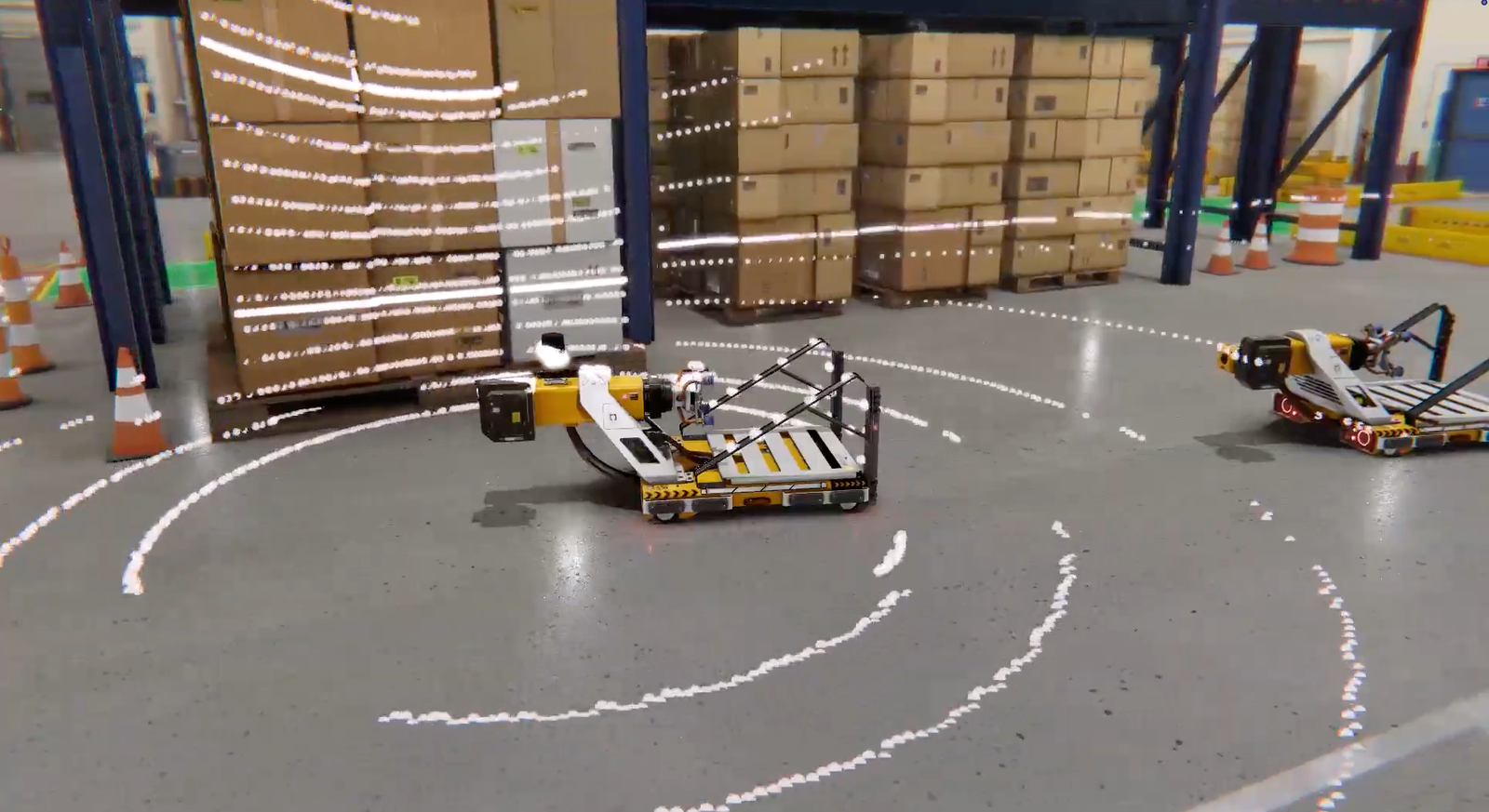
Unity announced Early Access on September 22 for a robotics-focused Simulation Pro package. It requires Unity 6.3 or newer and a Unity Industry license. The package includes a URDF importer, LiDAR/camera/IMU simulation, ROS 2 compatibility and a headless Linux build target.
Unity wants a bigger role in robotics simulation again. The new robotics-focused Simulation Pro package brings several pieces that teams often assemble themselves into one supported workflow: robot descriptions, sensors, ROS connectivity and scalable simulation. It is less visually exciting than a new robot, but potentially more important to engineering teams trying to reduce the distance between a digital model and a machine deployed in the field.
What Simulation Pro contains
The package includes a URDF importer that Unity says preserves the robot's kinematic chain, out-of-the-box LiDAR, image and IMU sensor simulation, ROS 2 compatibility and a headless Linux build target. Headless execution matters when a team wants to run many simulations in parallel without carrying a graphical desktop on every worker.
Unity positions the package for sensor simulation, robot training, virtual commissioning and synthetic data. Those use cases overlap directly with the software-stack shift covered in our Isaac ROS 5.0 and Intrinsic Core analysis. Unity's differentiator is its starting point: a mature real-time 3D engine, asset pipeline and development workflow used far beyond robotics.
A new package, not Unity's first robotics work
The Simulation Pro name has existed inside Unity's industrial simulation ecosystem for years, and robotics teams were already building on Unity Industry. The September announcement is better understood as a new supported robotics package that consolidates modern workflows, not as the moment Unity first entered robotics simulation.
Unity cites work by TIER IV/AWSIM, KITECH and Medtronic as examples of what teams can build on the platform. Those case studies show capability, but they are not a neutral benchmark against Isaac Sim, Gazebo or MuJoCo. We do not yet have a controlled comparison of fidelity, speed, cost and sim-to-real transfer on identical workloads.
URDF and ROS 2: reducing infrastructure glue
The practical promise is straightforward: teams should not have to rebuild every robot description, implement common virtual sensors from scratch and maintain a custom ROS bridge for each project. If the importer and sensor stack are robust, engineering time can shift toward behavior, edge cases and validation rather than infrastructure.
That matters more as robotics foundation models scale. The data challenge described in our coverage of Generalist AI and robot foundation models does not disappear when models get larger. Simulation can expand scenario coverage, but only if the sensor and physics models are sufficiently representative for the target task.
What Unity claims - and what remains unproven
Unity says the package can shorten the path from simulation to deployment, reduce bespoke infrastructure and scale validation. Those benefits are plausible, but RoboMorrow has not seen an independent measurement of engineering time or cost saved by Simulation Pro. There is also no simple standalone retail price in the announcement; access requires Unity Industry.
We also do not yet know how well the package behaves with very large ROS 2 systems, unusual sensors, demanding closed-loop control or thousands of parallel simulations. Production teams will care about determinism, CI automation, asset versioning and experiment reproducibility as much as rendering quality.
Where it sits against Isaac Sim, Gazebo and MuJoCo
Simulation Pro does not need to win one universal benchmark to matter. Teams choose simulators according to rendering, contact physics, integration with target compute, openness, world-building workflow and cloud scale. Unity may be especially attractive to organizations that already have skills and assets in the Unity ecosystem.
NVIDIA has a powerful Physical AI stack, Gazebo is deeply embedded in ROS, and MuJoCo remains strong in research and control learning. Real motion datasets such as HiPHI's hundreds of hours of humanoid motion data are also part of the picture. Future training stacks are likely to combine simulation, human demonstrations and experience gathered on physical robots rather than rely on one data source.
What it means for Europe
European integrators and R&D teams may benefit from faster prototyping without maintaining as much simulation infrastructure themselves. The workflow could fit warehouse robots, industrial systems, medical robotics and autonomous machines. Smaller teams in particular may value ready-made sensors and URDF import if support and documentation prove strong.
The trade-offs are the cost of the broader Unity Industry environment, the need for Unity expertise and potential asset lock-in. Open-source simulators remain an important alternative. For now, Simulation Pro is best treated as a serious additional option in the stack rather than a default replacement for existing tools.
RoboMorrow take
The most interesting part of the launch is not the sensor checklist. It is the productization of a robotics workflow into a supported package. If Unity can reduce integration glue and make large validation runs easier, it could materially accelerate teams already invested in Unity Industry.
The evidence still has to arrive. We want independent benchmarks, clearer cost information and full sim-to-real case studies. Early Access is the beginning of that validation. The checkpoints are ROS 2 reliability, URDF fidelity, headless scaling and whether robotics developers build repeatable production workflows around the package.