Universal Robots UR15 vs ABB GoFa 12: full comparison 2026
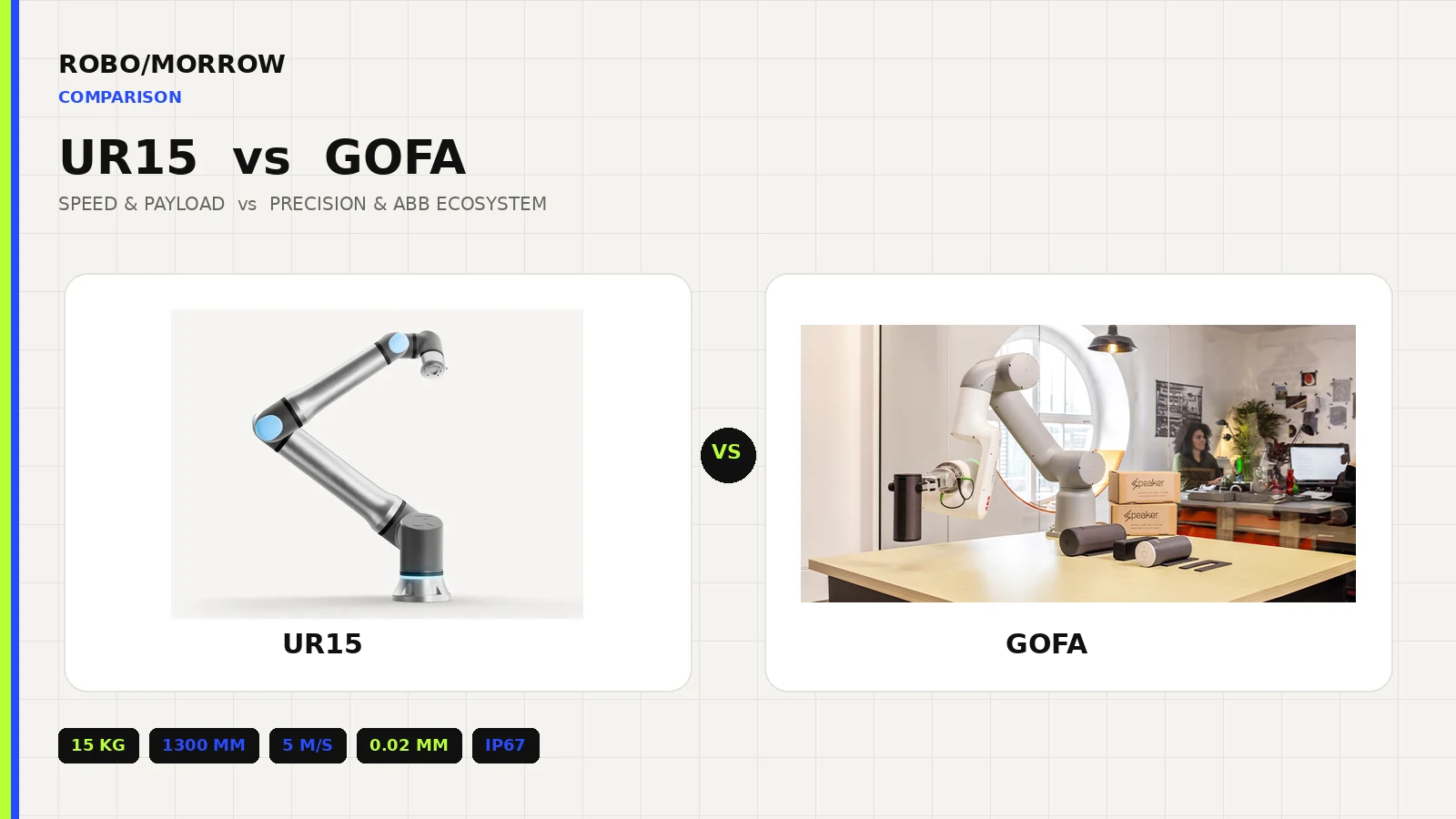
Short answer: UR15 and ABB GoFa 12 are different enough that asking for the “better cobot” without a process is the wrong question. UR15 emphasises high dynamics, 15 kg standard payload and the huge UR+ ecosystem. GoFa 12 emphasises accuracy, RobotStudio, OmniCore, IP67 capability and the Ultra Accuracy option. For fast machine tending or dynamic handling, UR15 looks stronger on paper. For precision paths, ABB environments and demanding process quality, GoFa may be the better foundation.
UR15 vs ABB GoFa 12 — key data
| Universal Robots UR15 | ABB GoFa 12 | |
|---|---|---|
| Payload | 15 kg; up to 17.5 kg under specified conditions | 12 kg class; current ABB page states up to 14 kg in wrist-down configuration |
| Reach | 1300 mm | 1270 mm wrist / about 1370 mm flange |
| Max TCP speed | 5 m/s | up to 2.2 m/s for GoFa family |
| Repeatability | ±0.05 mm | up to ±0.02 mm |
| Protection | IP65 | up to IP67 |
| Software | PolyScope / PolyScope X, UR+ | OmniCore, FlexPendant, RobotStudio |
| Distinctive edge | motion performance and application ecosystem | Ultra Accuracy and strong offline programming |
These are manufacturer specifications, not one common test. ABB’s current GoFa page shows values that depend on variant and configuration; always compare the exact quotation against technical documentation.
1. Payload: UR15 clearly offers more headroom
UR15 has 15 kg standard payload and Universal Robots describes a 17.5 kg extended capacity under specified conditions. That leaves more room for a heavier gripper, dual-grip tooling or workpieces near the 10–12 kg range. GoFa 12 is a 12 kg-class design, although ABB’s current page lists up to 14 kg in a defined wrist-down configuration.
Centre of gravity matters more than the headline. An 8 kg part with a 4 kg gripper still requires load and moment calculations on both platforms. UR15’s margin can help, but should not be purchased automatically.
2. Speed: UR15’s 5 m/s is a tool, not a guaranteed cycle time
Universal Robots positions UR15 as its fastest robot, with up to 5 m/s TCP speed. GoFa lists up to 2.2 m/s. In a pure specification comparison, UR15 has a large speed advantage. But full cycle time includes gripping, machine signals, doors, placement, inspection and safety constraints. If 70% of the cycle is waiting for the CNC machine, faster arm motion may barely move ROI.
Collaborative risk assessment can also reduce speed on both systems. Ask for a simulation or measurement of the complete process—not a catalogue TCP comparison.
3. Accuracy: GoFa has a strong argument for path-dependent processes
UR15 states ±0.05 mm repeatability. GoFa lists up to ±0.02 mm, while ABB says Ultra Accuracy can deliver path accuracy down to 0.03 mm and absolute positioning accuracy of 0.1 mm. That may mean little for a cardboard box but much more in gluing, sealing, laser welding, cutting or additive deposition.
If your process is simply “point A to point B”, do not overpay for accuracy you cannot use. If quality depends on the complete path, GoFa deserves a serious pilot.
4. Reach: effectively close, but cell geometry can reverse the result
UR15 has 1300 mm reach. GoFa 12 has 1270 mm to the wrist and around 1370 mm to the flange on ABB’s current page. These numbers are close enough that joint geometry, tool orientation and actual process points matter more than a few centimetres. Model the cell in 3D for machine tending.
5. Environmental protection: GoFa advantage in tougher sites
UR15 is IP65. ABB lists GoFa up to IP67. In dusty, damp or frequently cleaned environments, the higher rating may simplify the design. Still verify the gripper, cables and peripherals—the arm’s rating does not make the complete cell IP67.
6. Programming: PolyScope vs RobotStudio are different philosophies
Universal Robots built its position around PolyScope simplicity and the large UR+ ecosystem. For integrators and operators this means a very broad pool of ready accessories and partners. ABB brings RobotStudio, a mature simulation/offline-programming environment, plus OmniCore and FlexPendant. A factory already using ABB may benefit from common tools, service and skills.
Do not judge an interface from a 20-minute demo. Ask your operator to change a recipe, adjust a point and recover from an error.
7. Tooling ecosystem: UR+ is a major UR15 advantage
UR+ is one of Universal Robots’ strongest assets. Ready grippers, cameras, welding packages, palletisers and software reduce the amount of engineering built from scratch. ABB also has an extensive ecosystem and application templates. For a smaller manufacturer, ask the local integrator which packages they have actually deployed and support.
8. Welding: both make sense, but other questions dominate
ABB has developed GoFa welding packages and Easy Teach, while UR has a broad partner ecosystem for cobot welding. In high-mix fabrication, reprogramming time, process parameter control, positioner integration and part consistency matter more than the logo on the arm. Test your actual part and measure time from drawing to the first acceptable batch.
9. Machine tending: UR15 can exploit dynamics when the rest of the cell keeps up
With fast doors, prepared part presentation and short machine cycles, UR15’s dynamics can reduce load/unload time. If the machine runs an eight-minute machining cycle, a two-second robot difference will not drive ROI. Service, reliability and easy recovery then matter more.
10. Palletising: UR15 payload advantage, but check height
UR15 has greater standard payload headroom, useful with heavier cartons and grippers. GoFa may be sufficient for lighter packages. Both may need a lift or linear axis for tall pallets. Calculate the highest and lowest pallet corners before choosing the arm.
11. Safety: no winner without an application
Both manufacturers provide advanced collaborative safety functions. That does not make every application open. High-speed UR15 motion, a heavy GoFa payload, sharp gripper or welding torch changes the risk. Design zones, modes and protective devices around the process.
12. Local service and competence
Both brands have recognised European partner networks. The logo is not enough. Ask the actual integrator for SLA, spare-parts strategy, remote support, travel response and references for a similar application. One day of downtime can cost more than the arm-price difference.
13. Which one for a small business?
| Scenario | Starting point | Why |
|---|---|---|
| fast handling / packaging | UR15 | dynamics and payload |
| precision gluing / path work | GoFa | Ultra Accuracy and RobotStudio |
| heavy gripper | UR15 | more payload headroom |
| existing ABB factory | GoFa | common control and skills |
| many plug-and-play accessories | UR15 | UR+ ecosystem |
| wet/dusty environment | GoFa | higher stated protection |
What to measure in a pilot
- full cycle time, not arm speed;
- heaviest workpiece and worst centre-of-gravity case;
- operator-accessible error recovery;
- changeover time;
- path quality on the real process;
- speed after required safety functions are active;
- integrator response to a simulated fault;
- gripper wear and service needs.
RoboMorrow verdict
We would pilot UR15 when fast handling, payload headroom, scaling across applications and a broad component ecosystem are priorities. We would pilot GoFa 12 when the process needs more accurate paths, the factory already uses ABB or IP67 and RobotStudio create clear value. We do not name an overall winner: without an identical side-by-side RoboMorrow Labs test, that would be a false simplification.
UR15 card → · ABB GoFa 12 card → · Best cobots 2026 →
14. Control and software: ecosystem can matter more than the interface
UR15 uses PolyScope/PolyScope X and the broad UR+ ecosystem, which can simplify selection of compatible grippers, cameras and application packages. ABB combines GoFa with OmniCore, FlexPendant and RobotStudio. RobotStudio becomes particularly relevant when a manufacturer wants trajectory simulation, offline preparation or already uses ABB standards.
For an SME, the key question is not which screen looks better, but who can maintain the application six months later. During the pilot, ask your own operator to correct a point, change a recipe and recover from a fault. That exposes the practical usability difference better than a sales demo.
15. PLC, vision and machine integration
In machine tending, both cobots need well-defined communication with the machine tool. Door, chuck, cycle-complete and alarm signals plus restart logic often matter more than robot motion. For vision, compare more than camera compatibility: measure calibration time, handling of multiple variants and diagnostics after lighting or product changes.
If the plant already has ABB robots, controls and RobotStudio competence, GoFa may reduce organisational integration cost. If the integrator has reusable UR+ packages and standard CNC or palletising libraries, UR15 may have the advantage. This engineering-cost difference is invisible in the arm specification table.
16. Working environment: IP, cleanroom and installation
UR15 is specified as IP65 and Cleanroom Class 4. ABB’s current GoFa materials state IP67 protection. That can matter around dust, splashes or frequent cleaning, but an arm IP rating does not automatically apply to the full cell. Gripper, camera, connectors, cables and controller must be assessed separately.
For cleanroom use, verify the exact configuration, tooling and cabling requirements. In both cases, base geometry, cable routing and service access should be part of the 3D layout before purchase.
17. Four scenarios that reveal the difference
Short-cycle CNC tending
UR15 deserves a pilot when fast handling matters, workpiece plus gripper approaches the 12 kg range and machine doors do not dominate the cycle. GoFa can still be the better system when the plant is standardised on ABB and robot time is a small share of the machining cycle.
Gluing or dispensing along a path
GoFa belongs high on the shortlist because ABB emphasises path performance and offers Ultra Accuracy. The test still has to use the actual material, nozzle, speed and process temperature—point repeatability alone is not an application result.
Carton palletising
UR15 provides more standard payload headroom, but a tall pallet may require a vertical lift regardless of arm brand. Compare the complete package: gripper, lift, safety, pallet-pattern software and changeover time.
Vision inspection
If the process is more vision-intensive than force-intensive, the integrator and camera stack may decide the winner. Test calibration, trigger timing, result storage, NOK handling and image auditability rather than merely asking whether a camera can be connected.
18. Training and changeovers
In high-mix production, measure everyday operation rather than only first-program learning. Can an operator select a recipe without administrator rights? Is a gripper change poka-yoke? Will the system detect a shifted tray? How many points require correction after a format change?
UR+ can reduce custom code in common applications. ABB may have the advantage where the team already knows RobotStudio and OmniCore standards. With either platform, require training on the real cell rather than a generic demonstration rig.
19. How to compare two proposals without biasing the result
| Pilot criterion | How to measure | Example weight |
|---|---|---|
| full cycle time | 100+ consecutive cycles with real parts | 20% |
| quality / path performance | process metric, not robot claim | 15% |
| operator interventions | number and duration per shift | 15% |
| changeover | A→B to first good part | 15% |
| fault recovery | time for a normal operator | 10% |
| safety | achievable cycle after final safeguards are active | 10% |
| service / SLA | contract terms and local resources | 10% |
| TCO | complete cell plus assumed three-year costs | 5% |
The weights are illustrative, not a universal standard. What matters is that both systems are tested on the same application using criteria agreed before the demo.
20. What must be included in the final quotation
Ask both suppliers for the same scope: exact arm and controller variant, gripper, base, safety, vision, PLC, cabling, commissioning, FAT/SAT, training, documentation, warranty, SLA and optional costs. If one proposal is a complete cell and the other is an arm plus accessories, the price comparison is meaningless.
Include the cost of future changes. Ask for programming rates, the cost of adding another recipe, backup policy and software licences. For an SME, the ability to add the next product without rebuilding the project is part of the investment value.