Vision AI or RTK for a robot mower? Choosing a navigation system
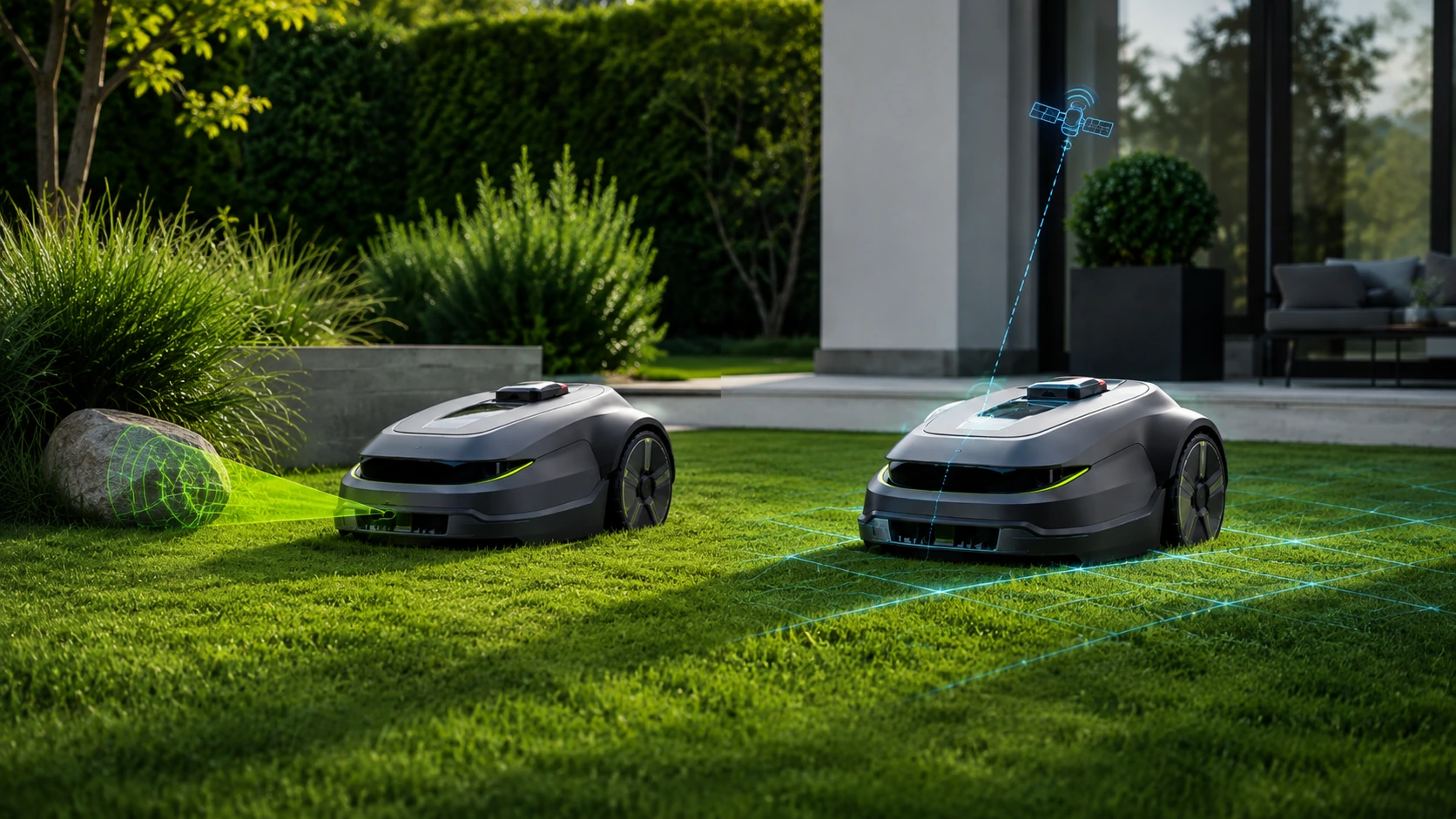
Vision AI and RTK are often presented as competing ways to remove the boundary wire. They actually solve other parts of the problem.
RTK primarily answers the question: where exactly is the robot located?
Vision AI answers: what does the robot see in front of it and where is the boundary likely?
That's why more and more devices combine both approaches. The camera helps under trees, recognizes obstacles and interprets the edge of the lawn, and RTK stabilizes the position in open spaces and allows you to run even lanes.
Key differences
| Criterion | Vision AI | RTK |
|---|---|---|
| Main Task | understanding image, boundaries and obstacles | precise position on map |
| Satellite dependency | small or intermediate | large |
| Light dependence | may be important | small |
| Working under trees | often better | may get worse |
| Unambiguous boundaries | very important | the boundary is written digital |
| Narrow passages | depends on the image and room for maneuver | depends on GNSS reception and sensor fusion |
| Mow in even stripes | possible with good location | natural advantage of accurate map |
| Obstacle recognition | yes, depending on algorithm | no |
| Privacy | need to check image processing | less visual data |
| Typical Weakness | shadow, dirty camera, unreadable edge | trees, walls and signal reflections |
How does Vision AI work?
The camera provides a series of images that the algorithm analyzes in real time. The system may search for:
- difference between grass and cube;
- edge discounts;
- wall, fence or border;
- toys, people and animals;
- landmarks used for location;
- changes direction and movement relative to the surroundings.
The word "AI" alone does not tell you how well the device works. Camera quality, field of view, processing power, training data set and behavior in case of uncertain recognition are important.
A mature robot should not guess aggressively. If the boundary is unclear, it is safer to leave a narrow lane rather than enter the pond.
How does RTK work?
RTK improves satellite positioning with data from a point with known coordinates. The boundary is saved as a map in the application, and the robot compares its current position with it.
RTK does not need to see a physical difference between grass and a flowerbed. If the map is correct and the position is stable, the device can drive along the virtual line even if both surfaces look similar.
The problem occurs when dense trees, a roof or a high wall limit satellite reception. Then support from other sensors is needed.
When does Vision AI have an advantage?
Under the spreading trees
The camera can recognize edges and solid objects when the GNSS signal is weakened. This does not mean that every vision robot will perform equally well. Clear boundaries, constant lighting and good localization algorithms help.
In a garden with many obstacles
Vision AI can distinguish the ball from the grass, avoid a chair or slow down next to a person. However, it is important to remember that the declaration of recognizing hundreds of objects does not replace a safe schedule.
When you don't want the RTK antenna
Some LiDAR and camera-based robots require neither a cable nor a local satellite station. An example is the Dreame A2, which uses 3D LiDAR and a camera, and the ECOVACS GOAT O500 Panorama combines LiDAR with a dual vision system.
With boundaries that can be easily read
A lawn separated by even cubes, a wall or a clear flower bed is easier for the camera than a turf that smoothly flows into a meadow.
When does RTK have an advantage?
On an open plot
With a good view of the sky, RTK ensures a stable position and facilitates systematic mowing with parallel lines.
When the border is not visible
The virtual line can run across a uniform surface, for example separating a section of lawn used as a playing field. The camera will not see this division, but the RTK robot can respect it from the map.
When changing zones frequently
A no-go zone around a seasonal pool, play area or freshly planted grass can be added in the application without building a physical barrier.
When you want a repeating pattern
Precise position makes it easier to guide strips, continue the task after loading and mow different zones in separate directions.
And what about the garden under the trees?
This is the most important test for a system without a cable. It is not enough to check whether the manufacturer has a camera or RTK. Need to determine:
- how long the robot can drive without full satellite position;
- is the camera only for obstacles or also for location;
- whether the device uses LiDAR, IMU and odometry;
- what happens when the lens gets dirty;
- whether the difficult part is at the border or in the middle of the zone;
- whether the charging station has a good view of the sky.
A hybrid system has an advantage when the sensors actually complement each other, not just appear in one list of functions.
Vision AI at night and in low light
Do not assume that the camera automatically allows you to mow safely at night. Some systems require daylight. GARDENA clearly indicates that smart SILENO sense needs light to work.
Night mowing is also not recommended due to hedgehogs and other small animals active after dark. Even an effective camera does not eliminate the risk.
Best practice is to work during the day when the garden is empty and the painting is in good conditions.
Is the camera an invasion of privacy?
It depends on the system design. Before purchasing, please check:
- is the image processed locally;
- whether recordings are sent to the cloud;
- is live view available;
- who can access the account;
- does the camera cover the neighbor's property;
- how long data is stored;
- is it possible to disable monitoring functions?
GARDENA declares that images from smart SILENO sense remain on the device and are not accessible externally or via the cloud. Other models may offer remote viewing, which is convenient but increases the importance of securing your account.
Why does LiDAR change the comparison?
LiDAR measures the distance to elements of the environment and builds a geometric image of space. It doesn't depend on grass color or contrast as much as a regular camera. Can support shadow location and obstacle detection.
However, it is not a magic solution. Thick, tall grass, rain, dirt and small objects can still pose a challenge. The position of the sensor, the number of beams, algorithms and the method of combining with the image are important.
Hybrid systems: the most sensible direction
The examples of available approaches show several different paths:
- Mammotion LUBA mini 2 AWD connects NetRTK to three cameras;
- Kress EyePilot RTKn supports satellites with V-SLAM, IMU and odometry;
- ECOVACS GOAT O500 Panorama uses LiDAR and cameras without a local RTK station;
- Dreame A2 bases mapping on 3D LiDAR and AI camera;
- GARDENA smart SILENO sense combines camera, Vision AI, satellite navigation and mobile connectivity.
There is no single architecture that wins everywhere. What matters is that it fits into the garden.
Selection by scenario
Open Rectangular Lawn
Most often RTK or hybrid system. It will allow for even stripes and easy map editing.
Small garden with clear borders
Vision AI can simplify installation. Check minimum passage width and edge performance.
Old garden with tall trees
LiDAR/vision or boundary wire may be a safer choice than a simple RTK system.
Large plot with slopes
You need not only RTK, but also the right drive, traction and safe work at the border.
Lawn with no visible border
RTK with a manually created map will be more predictable than automatic edge recognition.
Garden often rebuilt
Virtual RTK zones or hybrid mapping will make changes much easier.
List of pre-purchase questions
- Is the camera used for location or only for avoiding obstacles?
- Does the device work without a full RTK signal?
- Does it require daylight?
- Where is the image processed?
- Does the system have LiDAR, IMU and odometry?
- What does the behavior look like after losing a position?
- Is it possible to manually correct a part of the map?
- Do you need an antenna or Network RTK coverage?
- What is the minimum passage width?
- Does the manufacturer provide a separate slope limit at the boundary?
RoboMorrow Request
Don't choose between Vision AI and RTK based on which name sounds more modern.
- RTK is strong in precise positioning and virtual zones.
- Vision AI is strong in interpreting environments and obstacles.
- LiDAR adds color and contrast independent geometry.
- Hybrid System has the greatest potential in a complex garden, but only if the manufacturer has designed the switching between sensors well.
The best robot is the one whose weaknesses do not coincide with the most difficult place in your lawn.
FAQ
Can Vision AI work without RTK?
Yes. Some robots use cameras and LiDAR for mapping and localization without an RTK station.
Does RTK work without a camera?
Yes, but then the robot needs a separate way to detect obstacles and may perform worse when the satellite signal is lost.
What's better under the trees?
Typically a LiDAR/vision system or a hybrid solution. Simple RTK may lose stability when the sky is covered.
Can the camera robot work at night?
Varies by model, but should not be assumed. Some equipment requires daylight, and night mowing increases the risk to small animals.
Is the camera recording the garden?
Policies vary between manufacturers. Need to check local processing, cloud, remote viewing and data retention time.
Is a hybrid system always better?
Has greater resilience to a single problem, but is more complex. The quality of algorithms and support matters more than the sheer number of sensors.
Will Vision AI recognize the boundary between a lawn and a meadow?
Might have difficulty with this if there is no clear contrast. In such a place, a virtual border or a physical perimeter is better.
Does LiDAR replace a camera?
Not fully. LiDAR measures geometry well, and the camera is better at recognizing the type of object. Many systems combine both sensors.
Related materials
- How does RTK work in a robot mower?
- Robot mower without cord
- RTK or boundary wire?
- Robot mowing under trees
Sources and verification date
Product parameters and examples checked on August 2, 2026 in official manufacturer materials:
- https://www.gardena.com/uk/products/lawn-care/robotic-lawnmowers/smart-sileno-sense-600-m/970817810.html
- https://www.ecovacs.com/uk/shop/goat-robotic-lawn-mower/bundle-goat-o500-panorama-garage
- https://global.dreametech.com/products/a2
- https://eu.mammotion.com/products/luba-mini-2-awd-1000-robot-lawn-mower
- https://www.kress.com/en-gb/kress-eyepilot-rtk%E2%81%BF-1000-m%C2%B2-robotic-lawn-mower-with-zerotrim-integrated-4g-kr261es/
Related tabs in Robot Database
Check verified model cards associated with this advisory. Product price, availability and status are updated separately in the Robot Database.
- MAMMOTION YUKA mini 2 800
- SEGWAY NAVIMOW i210 LiDAR Pro
- ECOVACS GOAT O800 RTK
- EUFY Robot Lawn Mower E15
- WORX Landroid Vision AI M600 WR206E
- DREAME A2 2000
See the entire Robot Database →
Where to buy models from this article
We show only exact verified Amazon product pages. Before purchase, confirm the variant, seller, warranty and box contents.
Exact Amazon links. Where a verified RoboMorrow marketplace tracking ID is active, the link is an affiliate link and we may earn from qualifying purchases. Price and availability can change after you click.