5,000 Amazon robots in Dobromierz: how the warehouse works — and what it costs
ANALYSIS | verified 25 September 2026
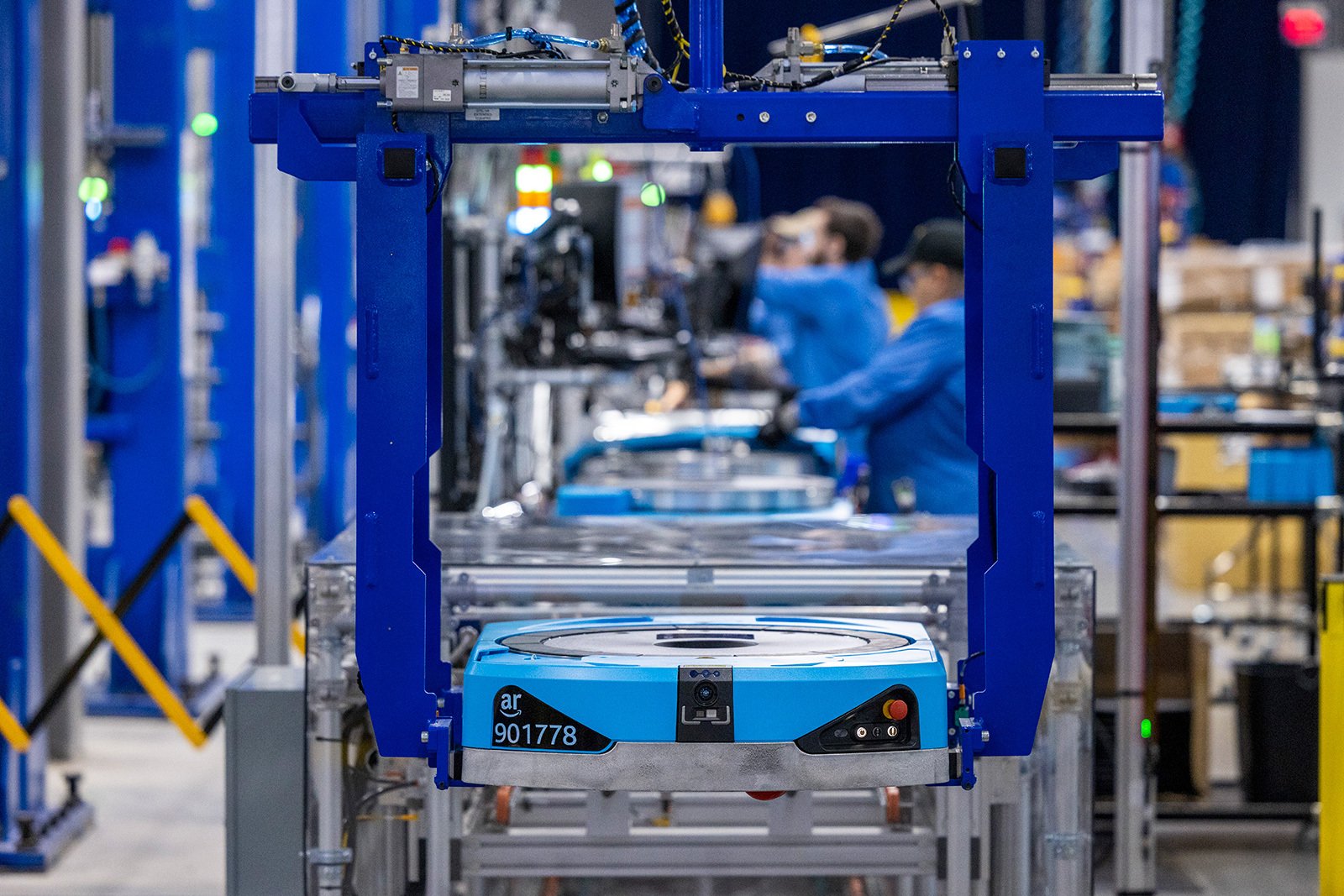
The headline is irresistible: more than 5,000 robots and more than 1,000 people under one roof. But the most interesting thing about Amazon’s new Dobromierz fulfillment center is not the number “5,000”. It is the way thousands of specialized machines, tens of thousands of mobile storage pods, vision systems, automated packaging and fleet software combine into one operating system. At this scale, the warehouse itself starts to look like the robot.
- more than 200,000 m² across four floors, according to Amazon Poland;
- more than 5,000 Amazon Robotics units, with shelf transport and product sortation confirmed by Amazon;
- more than 1,000 jobs expected in 2026 — not a denominator that can be used to calculate a meaningful “robots per employee” replacement ratio;
- more than 65,000 mobile storage pods across three Amazon Robotics storage floors, according to the site director during an on-site presentation reported by Spider’s Web;
- two automated packaging lines according to the on-site report; Amazon officially confirms that made-to-fit automated packaging is a first for its Polish fulfillment network;
- no public Hercules list price and no disclosed robotics CAPEX for Dobromierz. Any precise total-cost claim would be guesswork.
What is actually automated in Dobromierz?
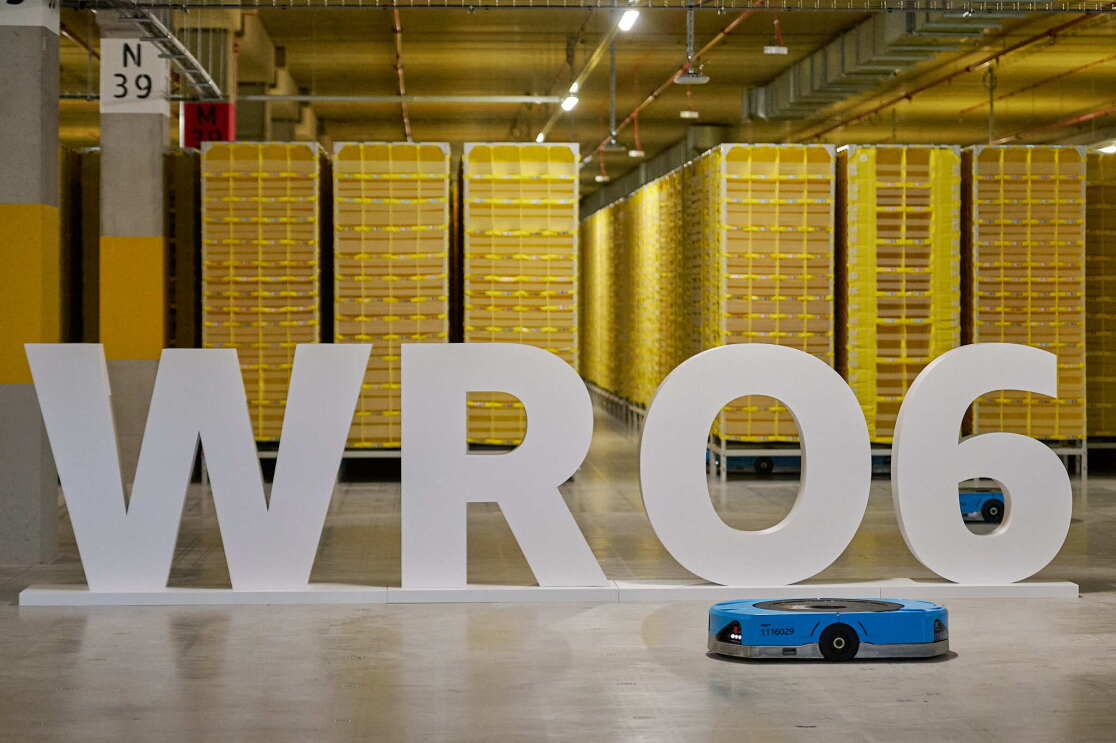
Amazon opened WRO6 in Dobromierz on 21 September 2026, describing it as its most advanced robotics fulfillment center in Poland and the fourth Amazon Robotics site in the country. The confirmed robot functions sound less cinematic than a humanoid walking through the building, but they matter far more to warehouse economics: moving storage shelves and sorting products.
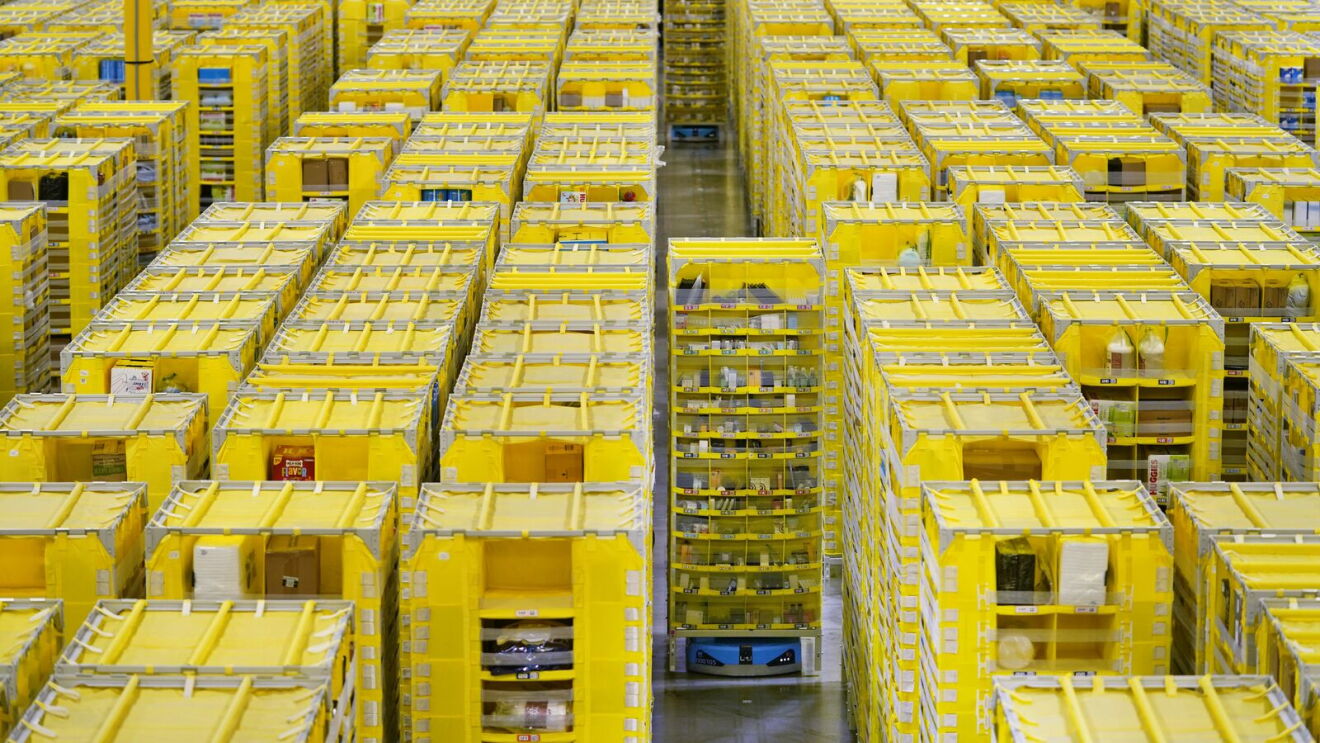
Reporting from the site launch adds useful detail. Three floors are dedicated to Amazon Robotics storage with more than 65,000 mobile pods. Products are identified during receiving and entered into the inventory system. When a product is needed, the employee does not walk hundreds of metres to a fixed shelf. The relevant shelf comes to the employee. At the picking station, vision systems, scanners and a projector help identify the correct location.
This is a goods-to-person architecture. In a conventional warehouse, people move through fixed aisles. Here, storage itself becomes part of the transport system. That changes the geometry of the building: less worker travel, denser storage and a much larger share of movement assigned to machines.
Are all 5,000 robots Hercules?
There is no public evidence for that claim. Amazon has not published a model-by-model inventory for Dobromierz or said how many units of each type make up the “5,000+” figure. Official WRO6 photos clearly show low-profile drive units working with mobile pods, an architecture associated with Amazon Robotics. That is not enough to label the entire fleet “5,000 Hercules robots”.
Hercules is still the best reference point for understanding the design. Amazon describes it as a widely deployed drive unit that slides under a four-sided storage pod, lifts it and carries it to an employee workstation. The current company specification lists a payload of up to 1,250 lb, roughly 567 kg.
Hercules is also not simply a consumer robot deciding where to wander. Amazon describes two layers of control. The unit uses a forward-facing 3D camera to identify obstacles and reads encoded markers on the floor. At the same time, overall fleet movement is coordinated by centralized planning software. With thousands of robots, that coordination is essential: a route that is locally optimal for one machine can create a global traffic jam for hundreds of others.
| System / class | What it does | Dobromierz status |
|---|---|---|
| Mobile drive units / Hercules architecture | Moves under a mobile storage pod, lifts it and delivers it to a workstation. | Function confirmed; exact model mix and Hercules count are not public. |
| Sortation | Routes products or packages into downstream process paths. | Function confirmed; full WRO6 device inventory not disclosed. |
| Packaging Automation | Measures the order and creates a correctly sized paper bag or box. | Confirmed in Dobromierz; first deployment of this kind for Amazon in Poland. |
| DeepFleet | AI foundation model intended to improve fleet travel efficiency. | Amazon is scaling it across the network; no site-specific WRO6 confirmation found. |
| Titan | Heavier drive unit that can lift twice as much as Hercules. | Not confirmed for Dobromierz. |
| Proteus | Autonomous mobile robot designed to move through open spaces shared with people. | Not confirmed for Dobromierz. |
| Vulcan / Sparrow | Manipulates individual items using touch/force, vision and suction. | Not confirmed for Dobromierz. |
| Robin / Cardinal / Sequoia / STARK | Package handling, robotic arms, containerized storage and tote handling. | Not confirmed for Dobromierz. |
Follow one order through the system
The easiest way to understand the architecture is to follow a single product. After receiving, the item is identified and recorded in the warehouse system. During stow, it is assigned to a location in a mobile pod. The system therefore knows not only what is in the pod but where that pod is and which future orders may need access to it.
When an order is placed, the software can dispatch a drive unit to the relevant pod. The robot slides underneath, lifts it and travels across the controlled robotics floor. At the workstation, visual guidance identifies the correct compartment. An employee retrieves the item, and the pod can immediately leave while another takes its place.
Automation then continues through sortation, order consolidation, packaging and outbound flow. Dobromierz adds an important Polish first: made-to-fit automated packaging. Amazon says the machines measure the product or order in real time and create a correctly sized paper bag or box. Reporting from the launch says the site has two such lines.
This is why “warehouse robot” is too broad a label. One machine moves shelves. Another sorts. Another measures and packages. A software layer plans movement. The economic value emerges from synchronizing all of them, not from one spectacular robot demo.
The most important robot may have no wheels: fleet orchestration
Amazon says it has now deployed more than one million robots across more than 300 facilities. At that scale, building a good drive unit is no longer the only problem. The system must decide which robot performs which task, which route it takes, when it charges, where a pod should be parked and how to avoid congestion.
Amazon introduced DeepFleet as a foundation model designed specifically for robot-fleet movement. The company says it can improve robot travel time by roughly 10%. That is an Amazon-reported network-level result, not an audited WRO6 metric. We found no public confirmation that DeepFleet is specifically running Dobromierz today, so it should not be listed as a confirmed WRO6 system.
The direction nevertheless matters. As fleets grow, more value shifts from the individual robot to the orchestration layer. RoboMorrow explored the same problem in our Samsung SDS Robot Orchestration Platform analysis: once facilities operate heterogeneous fleets, software, task allocation and system integration can become more strategic than a single hardware unit.
How much does one Amazon robot cost?
The honest answer is that Amazon does not publish a Hercules list price. Hercules is not a retail product sold as a standard AMR. Amazon designs and manufactures its own hardware at a scale unavailable to an ordinary warehouse buyer.
Amazon also has not disclosed the robotics CAPEX for Dobromierz. Public figures cover the building, robot count, employment and some operational systems, but not a line-item breakdown for drive units, pods, charging, sortation, packaging lines, servers, networking, software and integration.
We can, however, establish cost boundaries and historical context without pretending to know the answer.
| Reference | Public figure | How to interpret it |
|---|---|---|
| Amazon Hercules | No public list price | Amazon’s in-house platform; there is no credible public unit price. |
| Dobromierz WRO6 | No disclosed robotics CAPEX | A “5,000 × robot price” calculation would not describe the complete system. |
| Kiva Systems, 2011 | about $1–2m for a starter system; about $15–20m for a large system with around 1,000 robots | Fifteen-year-old historical benchmark including system/software; not a current Hercules price. |
| KNAPP Open Shuttle | starts at about €45,000 per AMR plus integration | Current public benchmark for a different AMR architecture; not directly comparable with Amazon drive units. |
| Amazon acquisition of Kiva, 2012 | about $775m | Price of an entire company and technology platform, not robots in one fulfillment center. |
The old Kiva data are useful because they show that even the original architecture was sold as a system, not a box with wheels. CNNMoney described months of planning, simulation, testing and training for a large installation. A modern Amazon facility is far more complex, while Amazon also produces its own robots at massive scale. Those effects push economics in opposite directions and make a simple extrapolation unreliable.
The KNAPP benchmark only establishes that a modern commercial AMR can start in the tens of thousands of euros before integration. Multiplying that price by 5,000 would be misleading: Open Shuttle is a different machine, the procurement model is different, Amazon’s production volume is different, and the surrounding infrastructure is different.
What actually costs money in a robotics fulfillment center
The drive unit is only one line in the budget. A system also needs mobile pods, a prepared robotics floor and localization grid, charging, wireless networking, controllers, picking stations, machine vision, scanners and projection, sortation, conveyors, packaging lines, integration with WMS/WES/WCS, spare parts, diagnostic tools, software, redundancy and a maintenance organization.
Commissioning is another cost layer. In industrial robotics, hardware is the most visible part of a project but rarely the whole risk. Integration, safety, exception recovery and process changes can decide ROI. The same lesson appears in our Universal Robots Gen 7 analysis: the price of the arm is not the price of a functioning cell.
For that reason, RoboMorrow is not publishing a made-up “Dobromierz robotics cost” in euros. Public evidence does not support a defensible figure. The correct conclusion is that this is a very large industrial automation system — not that 5,000 robots “must have cost X”.
Does it pay back? ROI is not just about removing jobs
Amazon has not published an ROI figure for Dobromierz. The value case nevertheless has several obvious components: less employee travel, higher storage density, greater throughput and predictability, and less packaging material plus better transport cube utilization from made-to-fit packaging.
At its different, more advanced Shreveport facility, Amazon reports up to 25% shorter fulfillment processing time and a target 25% improvement in cost to serve during peak periods. Those are company-reported figures for another site with another technology stack. We use them only to illustrate the type of operating benefit Amazon is pursuing — not as Dobromierz performance data.
Public AMR vendors likewise emphasize project-specific integration and process design. The better question is not “what does one robot cost?” but “what is the cost per fulfilled order before and after the system, at the required service level and peak throughput?”.
5,000 robots does not mean 5,000 eliminated jobs
The comparison “5,000 robots versus 1,000 employees” makes a strong headline and a weak labor metric. A robot is not a full-time-equivalent employee. A drive unit performs a narrow transport task and may spend time charging, waiting or repositioning. A person can resolve exceptions, inspect quality, run a workstation, supervise flow and respond to situations outside the automation model.
Dobromierz still needs receiving, picking and shipping operators, technicians, robotics and IT engineers, operations managers, safety specialists and administrative teams. Robotics changes the task mix. It does not by itself prove the disappearance of an entire occupation.
Amazon says its next-generation sites with advanced robotics require roughly 30% more employees in reliability, maintenance and engineering roles than less advanced facilities. Again, that is a company claim about another class of site, not a Dobromierz statistic. It highlights a cost that disappears from simplistic automation math: a large robot fleet creates its own demand for maintenance, diagnostics, software and spare parts.
Safety is more complicated than “robots remove injuries”
Amazon argues that robots reduce long walking, heavy pushing and lifting, and work outside the ergonomic power zone. Mechanically, the logic is clear: a half-ton pod is moved by a drive unit rather than a person. That does not mean automation removes every ergonomic risk.
A 2025 ILR Review study, “Lucy and the Chocolate Factory,” found warehouse robotics were associated with a 40% decrease in severe injuries but a 77% increase in non-severe injuries in the studied population. The authors present evidence that part of the increase in less severe injuries is linked to faster work pace at robotics facilities.
This is not a Dobromierz study and should not be treated as a causal estimate for WRO6. It is valuable because it shows why safety must be measured after deployment. Automation can remove heavy transport while also increasing the number of repetitive motions at a fixed workstation.
Why Vulcan may matter more than another faster drive unit
Moving shelves is now a mature technology. Manipulating individual products is harder. People can push aside a soft package, change grip, recognize an irregular object and feel unexpected resistance. For a robot, those tasks are much more difficult than driving across a controlled floor.
That is why Vulcan and Sparrow matter — without claiming they are in Dobromierz. Vulcan combines vision with force/touch sensing; Amazon says it can pick and stow roughly three quarters of the item types in its fulfillment centers. Sparrow uses computer vision and AI to move individual products. This layer automates not only the walk to the shelf, but part of what the human hand does after the shelf arrives.
Amazon Robotics therefore evolves in layers: Kiva/Hercules automate shelf movement; Proteus expands autonomous movement into shared spaces; Vulcan and Sparrow push into manipulation; DeepFleet and related software optimize the system above them.
What comes next in Europe
Amazon has announced more than €10 billion of investment to expand and modernize its European fulfillment network. The program includes broader deployment of Vulcan, the STARK tote-handling system and next-generation Proteus. Amazon plans the first European deployments of next-gen Proteus in the first half of 2027.
That does not mean those systems are coming to Dobromierz. It does establish the technology roadmap of the network WRO6 belongs to. A new building has one advantage over a legacy site: power, networking, workstations and material flow can be designed around robotics from day one. The next question is therefore not simply “how many more robots will Amazon add?” but which manual handling steps will disappear next, and how many exceptions will still require a person?
RoboMorrow: the real robot is the warehouse
The most useful lesson from Dobromierz runs against the popular image of robotics. You do not need 5,000 humanoids to build an extremely robotic facility. You need many specialized machines, infrastructure and software that together perform a huge number of narrow, predictable operations.
A single drive unit is relatively simple compared with a humanoid. Five thousand machines coordinated around more than 65,000 mobile pods, vision systems, packaging and centralized planning are something else entirely. The value is not contained in one robot. It emerges from the warehouse’s ability to decide what should move, where, when and how.
That is why Dobromierz is more interesting than the headline number. It shows robotics after industrial scaling: less spectacular on video, but deeply embedded in process design and business economics.
Read next on RoboMorrow
FAQ: Amazon robots in Dobromierz
Are all 5,000+ robots in Dobromierz Hercules units?
Unknown. Amazon confirms the fleet size and functions but has not published a complete model breakdown. Photos show mobile drive units working with storage pods, but that is not enough to identify the entire fleet as Hercules.
How much does one Hercules cost?
Amazon does not publish a list price. Historical Kiva costs and current commercial AMR prices provide context, not a reliable Hercules valuation.
How much did Dobromierz automation cost?
Amazon has not disclosed it. Public sources do not provide the CAPEX for robots, pods, sortation, packaging, IT infrastructure and integration, so a precise figure would be speculation.
Are the robots fully autonomous?
It depends on the class. Drive units such as Hercules operate on controlled robotics floors under fleet planning. Proteus is an example of an AMR designed to operate more freely in shared space. Proteus has not been publicly confirmed for Dobromierz.
Does DeepFleet run in Dobromierz?
Amazon is scaling DeepFleet across its network and reports about a 10% improvement in robot travel time, but we found no public site-specific confirmation for WRO6.
Can the facility run without people?
No. More than 1,000 people are expected to work at the site. Human roles remain across receiving, picking, exceptions, quality, shipping, robotics maintenance, IT and operations management.
Sources
- Amazon Poland — Dobromierz opening, 21 Sep 2026
- Business Insider Poland — 5,000 robots in Dobromierz, 25 Sep 2026
- Spider’s Web — on-site Dobromierz report (marked as sponsored placement)
- Amazon — Hercules
- Amazon — fulfillment robotics portfolio
- Amazon — one million robots and DeepFleet
- Amazon — Vulcan
- Amazon — next-generation Proteus and European investment
- Amazon — Kiva Systems acquisition, 2012
- CNNMoney — historical Kiva deployment costs, 2011
- KNAPP — current Open Shuttle AMR pricing benchmark
- ILR Review — warehouse robotics and worker safety, 2025