ECOVACS GOAT O500 Panorama vs Segway Navimow i205 AWD: which is better for 500 m²?
BUYING IN YOUR MARKET
Availability in your country
Sales, delivery and support can differ by country and exact model. Choose your market to see the evidence we have checked.
ECOVACS GOAT O500 Panorama
No verified local offer in this dataset
A current local sales offer, exact regional variant, delivery date and service coverage have not been verified for this country in the regional dataset. This does not mean that the robot is unavailable.
- Price
- No verified local price in this dataset
- Delivery
- No confirmed date for your address
- Warranty and service
- Local coverage not verified
Segway Navimow i205 AWD
Germany
Local store offer — check checkout availability
- Seller / sales channel
- Navimow Germany
- Price
- See the local offer for the current price and exact bundle
- Delivery
- Confirm stock and the delivery date for your address with the seller
- Warranty and service
- Confirm written warranty terms, parts and service coverage for your address
Navimow Germany lists this exact model for this market. A listing is evidence of a buying route, not a delivery commitment.
Evidence checked: · Not a live stock feed
Navimow Germany: check local offer ↗No verified local offer in this dataset
No country-specific offer for this exact model has been established in our current sources. This is a gap in our research, not a statement that the robot cannot be bought here. Use the manufacturer’s sales contact to request a supplier serving your address; confirm configuration, imports, warranty and service.
- Price
- No verified local price in this dataset
- Delivery
- No confirmed date for your address
- Warranty and service
- Local coverage not verified
“Listed” confirms a product page or sales route, not stock, delivery to every address or local service. “Pre-order” is not immediate availability. Unverified means we lack evidence; it does not mean unavailable. Prices belong to the named market and currency. Confirm the exact version, tax, shipping and support before ordering.
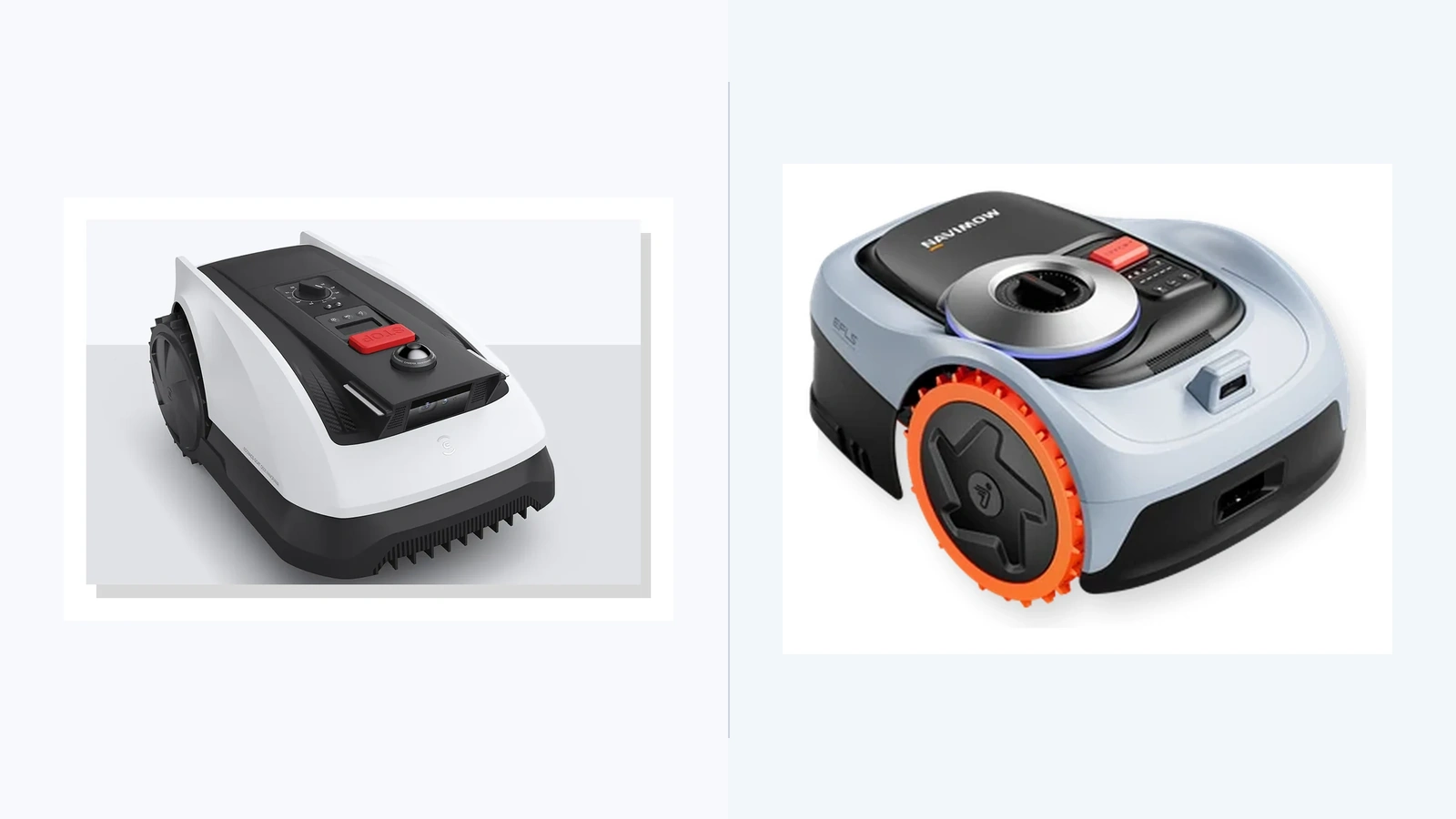
ECOVACS GOAT O500 Panorama and Segway Navimow i205 AWD target the same segment: wire-free mowing of roughly 500 m², but they use two clearly different architectures. GOAT relies on LiDAR plus dual vision and does not require a local RTK reference station. Navimow combines Network RTK with vision and adds AWD. The decision is therefore less about a single specification-table winner and more about the garden: sky visibility, narrow connectors, banks, soft ground and connectivity.
Key differences at a glance
| Feature | ECOVACS GOAT O500 Panorama | Segway Navimow i205 AWD |
|---|---|---|
| Target lawn | 500 m² | 500 m² |
| Positioning | LELS Panorama: LiDAR + dual vision | EFLS NRTK + VisionFence |
| Local RTK base | No | Not required for Network RTK |
| Drive | Conventional drive layout | Xero-Turn AWD |
| Maximum slope | 45% (24°) — consistent with the Polish page and detailed UK copy | 45% (24°) |
| Narrow passages | 0.7 m — ECOVACS laboratory claim | No equivalent minimum stated; chassis 545 × 385 × 285 mm |
| Obstacle avoidance | AIVI 3D: 200+ types — manufacturer claim | VisionFence: 150+ types — manufacturer claim |
| Protection | IPX6 | IP66 |
| Noise | UK official page is internally inconsistent at 57 vs 58 dB(A) | 59 dB(A) |
| Official price | Polish product page active; no clear price visible in the retrieved source | €899 for i205 AWD in the EU store when checked |
1. Navigation: LiDAR + vision versus Network RTK + vision
GOAT O500 Panorama uses LELS Panorama, a fusion of LiDAR and dual vision. ECOVACS describes it as centimetre-level positioning with automatic boundary recognition, no perimeter wire and no local RTK reference station. This architecture is particularly logical in gardens where the mower can use local geometry: walls, paving, kerbs, beds and other visually or geometrically clear boundaries.
Navimow i205 AWD uses EFLS NRTK, combining network-delivered RTK corrections with VisionFence. Segway describes the setup as antenna-free and says NRTK access is included for the lifetime of the mower. For the owner this removes the need to mount a dedicated RTK base in the garden, although Network RTK coverage should still be checked for the specific address.
2. Trees and limited sky view
This is where the architectural difference becomes most interesting. GOAT has a strong local-sensing stack, so its core positioning concept does not rely on a local RTK base. In a garden with tall trees, walls and partly blocked sky, LiDAR plus vision is an intuitively attractive approach.
That does not mean Navimow automatically loses under trees. i205 fuses NRTK with vision, so it is not a simple “GPS-only” mower. If sky-view problems are limited to a few spots and most of the lawn is open, NRTK plus VisionFence can be a very sensible hybrid. A specification sheet cannot honestly settle this scenario without both mowers being tested on the same site.
3. Slopes, uneven ground and traction
Both manufacturers state a maximum slope of 45% (24°). The important difference is that the i205 AWD has all-wheel drive and Xero-Turn. Segway specifically positions the drivetrain for slopes, uneven paths and short rough or gravel sections. If a lawn is only 500 m² but includes a few awkward banks, ruts or slippery patches, AWD is a concrete hardware advantage.
ECOVACS says the GOAT O500 can cross obstacles up to 3 cm, but it does not use AWD. On a flat or moderately shaped garden the practical difference may be small; at the traction limit, however, Navimow has more drivetrain headroom. Maximum-slope figures should still be treated as test-condition claims rather than a guarantee on wet grass or close to an exposed boundary.
4. Narrow passages and compact gardens
GOAT has a very specific claim here: passage through corridors as narrow as 0.7 m. ECOVACS explicitly labels that figure as a laboratory result and says real performance varies with grass, terrain and garden layout. Even with that caveat, it is useful information for urban lawns where two zones are connected by a narrow strip between a bed and a wall.
Navimow does not publish an equivalent minimum on the current i2 AWD page. We do know that the mower measures 545 × 385 × 285 mm and that Xero-Turn is designed for tight pivots without dragging across the turf. That can help in compact areas, but we will not reverse-engineer an unsupported minimum corridor width from chassis dimensions alone.
5. Obstacles and edges
ECOVACS claims detection of 200+ obstacle types through AIVI 3D using AI Vision and 3D-ToF LiDAR. Segway claims 150+ types through VisionFence. Those counts are useful indicators of product ambition, but they are not a comparable independent benchmark. In a real garden it matters more whether the mower sees a thin cable, small toy, ball, animal or low object under a particular lighting condition and grass height.
Edges are similar. GOAT markets TruEdge and boundary recognition, while Navimow relies on precise mapping plus Xero-Turn manoeuvrability. Flat paving beside the lawn is a completely different edge from a vertical wall. RoboMorrow therefore does not award an “edge-cutting winner” without a repeatable physical test.
6. Noise, weather protection and daily operation
Navimow specifies 59 dB(A) and IP66. ECOVACS specifies IPX6, while its UK O500 page contains a small internal noise inconsistency: the feature summary says 57 dB and the detailed specification table says 58 dBA. We therefore do not use a one- or two-decibel catalogue gap as a purchase argument. Both are presented as quiet garden robots, but a same-distance measurement under identical conditions would be needed for a meaningful comparison.
GOAT has a 22 cm cutting width, 3–8 cm height adjustment and a 4 Ah battery. For the i205, Segway states 2.55 Ah, around 60 minutes of mowing, 60 minutes of charging and up to 125 m² per charge. Battery capacities should not be compared 1:1 without voltage, control strategy and real energy-use data.
7. Connectivity and ongoing cost
GOAT uses Bluetooth and 2.4 GHz Wi‑Fi. Navimow has a built-in 4G module. Segway separates two services that are easy to conflate: Network RTK is described as lifetime-free, including the cellular data needed for positioning, while remote 4G functions — app control, out-of-boundary alerts and GPS tracking — include one year of data and then renew at €29.99 per year.
If the lawn has weak Wi‑Fi and the owner wants continuous remote access, built-in 4G is a practical Navimow advantage. If remote access is not important, the later 4G fee should not automatically be treated as a mandatory cost of NRTK positioning itself.
8. Price and practical value
When checked on 23 August 2026, Segway Navimow's European store listed the i205 AWD at €899. The Polish ECOVACS GOAT O500 Panorama page was active, but the retrieved source did not expose a clear price, so we do not insert a marketplace price or invent a local figure. At this point Navimow therefore has the more transparent official price reference.
That does not automatically mean better value. In a small, geometrically complex garden, local LiDAR + vision perception and less reliance on Network RTK may be more valuable than AWD. On uneven terrain, however, a similar purchase price for AWD, NRTK and built-in 4G can be the more rational allocation of hardware.
Which one fits which garden?
- Small urban lawn with walls, beds and narrow connectors: the GOAT O500 Panorama architecture looks especially logical.
- Short bank, uneven ground or slippery section: i205 AWD has more relevant hardware because of AWD.
- Many trees and difficult GNSS: GOAT has an architectural advantage in local perception, but the result needs site-specific testing.
- Open lawn with good Network RTK coverage: Navimow offers straightforward setup, NRTK + vision and a clear €899 reference price.
- Very narrow connector around 0.7 m: GOAT has an official laboratory claim for that width; Navimow does not state an equivalent minimum.
- Remote access outside Wi‑Fi is important: i205 has built-in 4G, with a separate data fee after year one.
Important ECOVACS data correction
The official UK GOAT O500 page is internally inconsistent: its feature summary shows “50% (24°)” while the detailed slope section says “45% (24°)”. The Polish page also states 45% (24°). Because 24° corresponds to roughly 44.5% grade, this comparison uses the conservative and internally consistent 45% (24°). We also avoid treating the UK page's 57 vs 58 dB noise discrepancy as meaningful. These are documentation inconsistencies, not evidence of a product fault.
RoboMorrow verdict
There is no honest specification-sheet winner here. GOAT O500 Panorama is the more interesting fit for a compact, geometrically complex lawn when LiDAR + vision, automatic boundaries and narrow passages matter most. Navimow i205 AWD is the stronger candidate when traction, AWD, Network RTK, built-in 4G and a transparent official price matter more.
This is a recommendation based on architecture and verified manufacturer specifications, not a simulated hands-on review. Final judgement on edge quality, behaviour under trees, response to small obstacles, app stability and real noise belongs in a physical RoboMorrow Labs comparison.
Related
- ECOVACS GOAT O500 Panorama — robot card
- Segway Navimow i205 AWD — robot card
- Best robot mowers of 2026
- Vision AI or RTK for a robot mower?
Sources
- ECOVACS Poland — GOAT O500 Panorama
- ECOVACS UK — GOAT O500 Panorama
- Segway Navimow Europe — i2 AWD / i205 AWD
Specifications, prices and service terms verified on 23 August 2026. Availability and pricing can change. RoboMorrow has not yet physically tested these two models side by side under the same conditions.
Where to buy models from this article
We show only exact verified Amazon product pages. Before purchase, confirm the variant, seller, warranty and box contents.
Exact Amazon links. Where a verified RoboMorrow marketplace tracking ID is active, the link is an affiliate link and we may earn from qualifying purchases. Price and availability can change after you click.