Best Robot Lawn Mowers 2026: Picks by Garden Type
Decision update · 12 October 2026
Home-garden and commercial mowing are different purchases. For a garden, begin with reachable grass and connected zones; for a campus or sports field, also agree work windows and the accepted turf finish. Do not move a commercial GT-series area claim into a home-mower ranking score.
| Constraint | Verify on site |
|---|---|
| Positioning | Sky, trees, buildings and the exact correction service |
| Traction | Boundary slope separately from slope inside the lawn |
| Transfers | Narrow points, non-grass crossings and manual carrying |
Treat a future-season announcement as a watchlist entry until local sales, the final variant and support are confirmed. For current models, compare season cost including edge work, wear parts and downtime. Record slope in the units and conditions the manufacturer uses; degrees and percent are not the same value.
Choose a mower using reachable grass, boundaries, transfers and schedule before catalogue area. Separate a home garden from a commercial project. A model announced for a future season is not a confirmed solution for delivery today.
Redakcja RoboMorrow · advice updated: 8 October 2026. Source dates remain stated alongside the data.
This is not a RoboMorrow Labs head-to-head test. The ranking uses verified manufacturer specifications, current commercial maturity and fit to a defined garden problem. Claimed slope, coverage and positioning limits remain manufacturer claims unless supported by comparable independent testing.
Quick picks by garden type
| Garden scenario | Model / family to shortlist | Why |
|---|---|---|
| Small, simple lawn up to roughly 500 m² | GARDENA SILENO minimo 500 / ECOVACS GOAT O500 Panorama | Avoid paying for heavy AWD when the garden does not need it. |
| Small perimeter-free lawn with vision focus | ECOVACS GOAT O500 Panorama | Compact visual-navigation proposition; manufacturer states up to 45% / 24°. |
| Around 500 m² with more difficult terrain | Segway Navimow i205 AWD | AWD in a smaller-garden class; manufacturer states 500 m² and up to 45%. |
| About 600 m² with privacy emphasis | GARDENA smart SILENO sense 600 | GARDENA describes local/on-device image processing and 600 m² coverage. |
| Steep sections / AWD priority | Mammotion LUBA mini 2 AWD 1000 | AWD and manufacturer maximum up to 80% / 38.6°; not a RoboMorrow test result. |
| Large, obstacle-rich garden | Dreame A2 | Navigation and perception aimed at more complex larger properties. |
| RTK with sensor fusion / 4G | Kress EyePilot RTKⁿ KR261E(S) | RTKⁿ + V-SLAM + IMU + odometry and integrated 4G. |
| Very difficult slopes and mature ecosystem | Husqvarna Automower 435X AWD NERA | Manufacturer states up to 70% inside the work area and 50% at the boundary. |
| New-generation large lawns — watchlist | Mammotion LUBA 4 AWD 3000F/6000F/12000F | Quad-Vision + 360° LiDAR + NetRTK, active steering and bidirectional AWD. |
How to read this ranking
A mower is unusually environment-dependent. An open lawn with a clear sky, a garden under mature trees and a narrow multi-zone property beside a house are three different positioning problems. Add slope, edges, non-grass crossings, play equipment, pets and network coverage and the correct choice can change completely.
That is why we do not create a single numerical score. We filter by five questions: does navigation fit the property, is there enough traction margin, can the mower pass the narrow connectors, what infrastructure or subscription does it require, and is the service channel mature enough for that model.
1. Small, simple lawn: do not buy technology you will not use
On a flat lawn around 500 m², a large AWD platform can be unnecessary cost and weight. GARDENA SILENO minimo 500 represents the conventional small-lawn route. If a boundary wire is acceptable, the system can be refreshingly predictable because navigation does not depend on satellite visibility or a network positioning service.
ECOVACS GOAT O500 Panorama is more interesting if you want perimeter-wire-free setup and visual navigation. RoboMorrow uses the corrected manufacturer limit of up to 45% (24°), not an older 50% shorthand. On a small property, however, passage width and reliable perception often matter more than the maximum slope number.
2. Segway Navimow i205 AWD: small lawn, harder geometry
i205 AWD is unusual because it combines a roughly 500 m² class with all-wheel drive. Segway states a 45% / 24° maximum slope. A townhouse garden with one short steep bank may therefore benefit more from this compact AWD concept than from a much larger all-terrain mower.
Keep positioning and connectivity terms separate. NRTK and remote 4G are not the same service. Check the exact market terms because included periods, subscriptions and coverage can vary.
3. GARDENA smart SILENO sense 600: privacy and simplicity
GARDENA states up to 600 m² and up to 25% slope. The more distinctive point is its communicated local image-processing approach. For buyers who want camera-assisted navigation but do not want to treat cloud image processing as an automatic default, it is worth shortlisting.
This is not the machine for extreme slopes. If the lawn includes very steep short sections, AWD and traction reserve become more important. SILENO sense fits gardens where easy setup, moderate terrain and a clear privacy model matter most.
4. Mammotion LUBA mini 2 AWD 1000: traction first
LUBA mini 2 AWD 1000 is a natural candidate for smaller but difficult lawns. Mammotion states a maximum slope of up to 80% (38.6°). We always label that as a manufacturer maximum, not an independently reproduced RoboMorrow result.
AWD is not magic. Wet grass, soil, ruts, travel direction and turning on the slope all change traction. But where a 2WD mower regularly loses grip, genuine all-wheel drive provides a meaningful engineering advantage.
5. Dreame A2: larger lawn and perception
Dreame A2 targets larger properties and combines positioning with environmental perception. Its documentation contains different area numbers for mapping/navigation and for mowing efficiency over a day. Those are not interchangeable metrics, so do not buy against the largest figure without understanding what it describes.
A2 makes sense when the garden has many zones, obstacles and changing geometry and the owner wants to avoid a boundary wire. Local service, app limitations and parts availability remain important because downtime on a large-property machine is expensive.
6. Kress EyePilot RTKⁿ KR261E(S): sensor fusion and connectivity
Kress combines RTKⁿ with V-SLAM, IMU and wheel odometry and integrates 4G. This is a sensible architecture for properties where one positioning method can occasionally struggle. More sensors do not automatically mean better results; the quality of fusion and recovery behaviour matters more than the list itself.
Kress can be especially attractive when a dealer-led setup and local support are valuable. For some gardens, professional commissioning is worth more than saving on a mower purchased purely online.
7. Husqvarna Automower 435X AWD NERA: mature all-terrain option
Husqvarna states up to 70% slope inside the work area and 50% at the boundary. That distinction matters because a mower may cross the middle of a steep bank yet struggle when it has to turn at the edge. Husqvarna also states different maximum areas depending on mowing pattern: roughly 3,500 m² irregular and up to 5,000 m² systematic.
The premium only makes sense when you exploit AWD, the ecosystem and service maturity. On a flat 700 m² lawn it can be excessive engineering.
New after IFA 2026: Mammotion LUBA 4 AWD enters the watchlist
Mammotion unveiled LUBA 4 AWD at IFA Berlin on 4 September 2026. The family includes 3000F, 6000F and 12000F variants for stated maximum lawn areas of 3,000, 6,000 and 12,000 m². The headline change is a positioning stack combining four cameras, 360° LiDAR and NetRTK with independent front-wheel steering and bidirectional AWD.
Mammotion states up to 80% / 38.6° slope, obstacle crossing up to 60 mm and mowing speed up to 1.0 m/s. The 12000F uses three cutting discs and a 530 mm cutting width; 3000F and 6000F use two discs and 440 mm. The optional edge-trimming module is listed for the 3000F and 6000F, not the 12000F.
Why is LUBA 4 AWD not immediately the winner? Because launch specifications do not tell us enough about repeatable navigation, turf marking, behaviour under trees, wet-slope traction, software maturity and service. It is one of the most important new mower platforms to watch, and a candidate for the next major ranking refresh once evidence matures.
Boundary wire, RTK, LiDAR or vision?
Boundary wire
Not glamorous, but predictable. A good fit for a stable garden where installation is acceptable and you do not want navigation to depend on sky view. The trade-off is installation and repair of the wire.
RTK / NetRTK
Potentially very precise in suitable conditions, especially on open lawns. Tree cover and buildings increase the value of backup positioning and good recovery logic.
LiDAR
Builds a geometric view of the environment and can reduce dependence on satellites. Buyers still need to know how the software handles dynamic obstacles, tall grass and thin objects.
Vision
Cameras can support both localisation and object understanding. Performance depends on light, lens cleanliness and software. Privacy architecture can also be a buying factor.
Choosing by slope
Slope percentage and degrees are not the same. 45% is about 24°, while 80% is about 38.6°. A manufacturer maximum does not describe a full wet-season performance envelope. Measure the worst section and buy with margin rather than planning to operate continuously at the claimed limit.
Also measure the boundary. Turning at the top or bottom of a slope can be harder than traversing its middle. A bank that ends at a wall, pond or public road needs a much larger safety margin.
Narrow passages and zones
Large properties are often constrained by connectors rather than total area. Check minimum passage width and whether the mower can cross paving or non-grass sections safely. Maximum zone count becomes important on gardens divided by buildings, beds and fences.
Service and total ownership cost
Mowers live outdoors in dust, moisture and heat, so service is part of the product. Check blades, wheels, battery, charger and local repair availability. For premium AWD models, ask about drive-module cost and in-season repair lead time.
Add possible 4G or positioning subscriptions, garage, cleaning accessories and blade replacement. A cheaper machine can become more expensive over three years if parts are difficult to obtain.
RoboMorrow ranking rules
- No numerical score without a shared test methodology.
- Manufacturer claims stay separate from independent evidence.
- Maximum slope is never presented as a guarantee for every surface.
- A new model does not win solely because it carries more sensors.
- We update this permanent URL instead of creating duplicate 2026 rankings for the same search intent.
Related resources
See our robot database cards for ECOVACS GOAT O500 Panorama, Segway Navimow i205 AWD, GARDENA smart SILENO sense 600, Mammotion LUBA mini 2 AWD 1000, Kress EyePilot RTKⁿ and Husqvarna 435X AWD NERA.
Sources
Manufacturer sources: GARDENA SILENO minimo; ECOVACS GOAT O500; Segway Navimow AWD; GARDENA smart SILENO sense; Mammotion LUBA mini 2; Dreame A2; Kress KR261ES; Husqvarna 435X AWD NERA; Mammotion LUBA 4 AWD. Last verified: 15 September 2026.
Eight garden archetypes: start here before choosing a brand
Square metres are only the first filter. Two 800 m² lawns can require completely different machines: one may be an open rectangle with clear sky, while the other has a steep bank, three zones, a narrow corridor and mature tree cover. Classify the property by the hardest recurring constraint before comparing products.
A 30-minute pre-purchase garden audit
1. Working lawn area, not property area
Subtract the house, driveway, patio, beds, pool and other non-mown surfaces. Then add margin. If the current lawn is 920 m², a mower marketed for a 1,000 m² maximum leaves little headroom for complex zones, slower seasonal operation and battery ageing.
2. Maximum slope and boundary slope
Measure the middle of the bank and where the mower must turn. 45% and 80% describe gradient, not climb height. Near the manufacturer limit, wet grass, soft soil and travel direction matter more. RoboMorrow prefers usable margin over designing routine operation exactly at a headline maximum.
3. Narrowest corridor
Measure the gap between walls, beds, hedges and the routes linking zones, then include turning space. A robot can physically fit through a corridor yet still fail to localise or turn reliably at its end.
4. Sky visibility and canopy
Mark zones under dense trees, beside tall walls, under pergolas or close to the house. These are especially important for GNSS/RTK-dependent systems. If a critical area is persistently shaded from the sky, prioritise a platform that can bridge the gap using vision, LiDAR, odometry or another redundant signal.
5. High-consequence edges
A soft flower bed is not the same boundary as stairs, a pond or a public road. Where a localisation error has high consequence, conservative boundary margin, a physical barrier or a robust no-go zone matters more than cutting to the last centimetre.
RTK in the real world: where failures come from
RTK can deliver excellent precision, but it is not a universal cure. Tall walls, dense canopy and narrow spaces can degrade satellite reception or create reflections. Correction may come from a local reference station, a network service or a hybrid architecture. The buyer should focus on what the mower does when high-quality positioning temporarily disappears.
- Does it stop safely or continue with uncertain position?
- Can it bridge a short outage using odometry or vision and reacquire position?
- Does recovery require a human intervention?
- Is network correction subscription-based and what happens when the subscription ends?
- Is the positioning service fully supported in your country rather than merely hardware-compatible?
LiDAR and vision: when the premium is justified
LiDAR provides a geometric map and can reduce satellite dependence. Cameras can add semantic context by helping distinguish a generic obstacle from a toy, animal or garden object. The most interesting 2026 systems increasingly combine sources instead of asking one sensor to solve every condition.
Pay for extra sensing when it addresses a known property constraint. An open, simple lawn may gain little from an expensive LiDAR/camera stack. A garden with canopy, walls, toys and multiple transitions can benefit materially if redundancy reduces interventions.
Daily throughput: why the maximum m² number is incomplete
Maximum supported area does not tell you how quickly the lawn can be maintained. Daily output depends on cutting width, driving speed, path efficiency, charging, zone count and transit distance. On a large property, ask how much can be cut in a typical day under your configuration rather than relying only on a maximum map size.
Capacity headroom has another benefit: the mower can operate fewer hours, avoid the wettest periods and retain useful performance after several seasons of battery ageing.
Edge cutting: marketing language versus geometry
Terms such as zero-edge or edge cutting do not describe identical outcomes. For safety, the cutting disc is usually inset from the shell. Manufacturers compensate with offset discs, lateral movement, special edge passes or an auxiliary trimmer.
Match the claim to your edge. Flat paving is easier than a vertical wall. If eliminating manual trimming is a priority, look for evidence on the same edge geometry you have at home rather than extrapolating from a paving-stone demonstration.
Rain, mud and turf marking
Weather resistance does not mean the mower should always run in heavy rain. Wet grass reduces traction, heavy machines can compress soft soil and repeated paths can create visible ruts. Useful software should allow rain delays, direction changes and temporary exclusion of vulnerable zones.
AWD improves climbing ability but can also deliver more torque to the turf. On a wet slope the question is not only whether the mower can climb, but whether repeated turning damages the grass.
Children, pets and small objects
Obstacle detection should be an additional safety layer, not the only one. Remove thin cords, nets and very small objects before mowing. In homes with children or pets, schedule mowing to minimise overlap between active play and robot operation.
AI object categories can improve perception, but catalogue size is not a guarantee of behaviour in every scene. RoboMorrow values clear safety behaviour and predictable recovery more than the raw number of object classes.
Five service questions before the season starts
- Who repairs the mower locally and is there an authorised workshop?
- What is typical in-season repair lead time and is a loaner available?
- Are battery, wheels, blades, charger and sensors sold as service parts?
- Can one failed camera/LiDAR module be replaced separately?
- How long does the vendor plan to support the app and cloud backend for this model?
Five-year ownership cost
Purchase price is only the first line. Add blades, optional garage, cellular or positioning subscriptions, electricity, battery replacement, post-warranty service and your own time. Boundary-wire systems add installation and possible cable repair; wire-free systems can add network services or reference infrastructure.
Check current price and availability for the exact variant, country and bundle; an older promotion is not a current offer.
12-point buying checklist
- Real lawn area plus at least 20–30% headroom.
- Maximum slope and boundary slope measured separately.
- Narrowest passage with turning space.
- Tree canopy, walls and other weak-sky zones.
- Number of zones and the physical routes between them.
- Edge type: paving, wall, bed, pond or stairs.
- Recurring obstacles: trampoline, trees, toys and furniture.
- Wi‑Fi/4G availability and subscription rules.
- Local service and spare parts.
- Blade replacement and cleaning burden.
- Dock location: power, level surface, positioning signal and manoeuvring space.
- Return/test policy if the positioning system does not suit the property.
What LUBA 4 AWD could change if the specification translates into reality
LUBA 4 AWD matters because it combines three positioning layers — cameras, 360° LiDAR and NetRTK — with mechanics designed for difficult terrain. That may represent the next premium pattern: instead of choosing RTK or LiDAR, the machine builds redundancy and uses whichever signal is strongest.
The next ranking refresh should answer specific questions: track stability under tree cover, recovery when one positioning layer degrades, whether active steering reduces or increases turf marking, real 12000F throughput, wet-slope behaviour and first-season service quality. Only then should the launch specification turn into a stronger recommendation.
September 2026 ranking verdict
There is no universal winner. Small simple lawns still favour simple systems; short steep banks need traction margin; tree cover increases the value of sensor fusion; very large properties are won by daily throughput and service. LUBA 4 AWD is the most important new platform on the post-IFA watchlist, but it does not automatically replace mature recommendations for defined use cases.
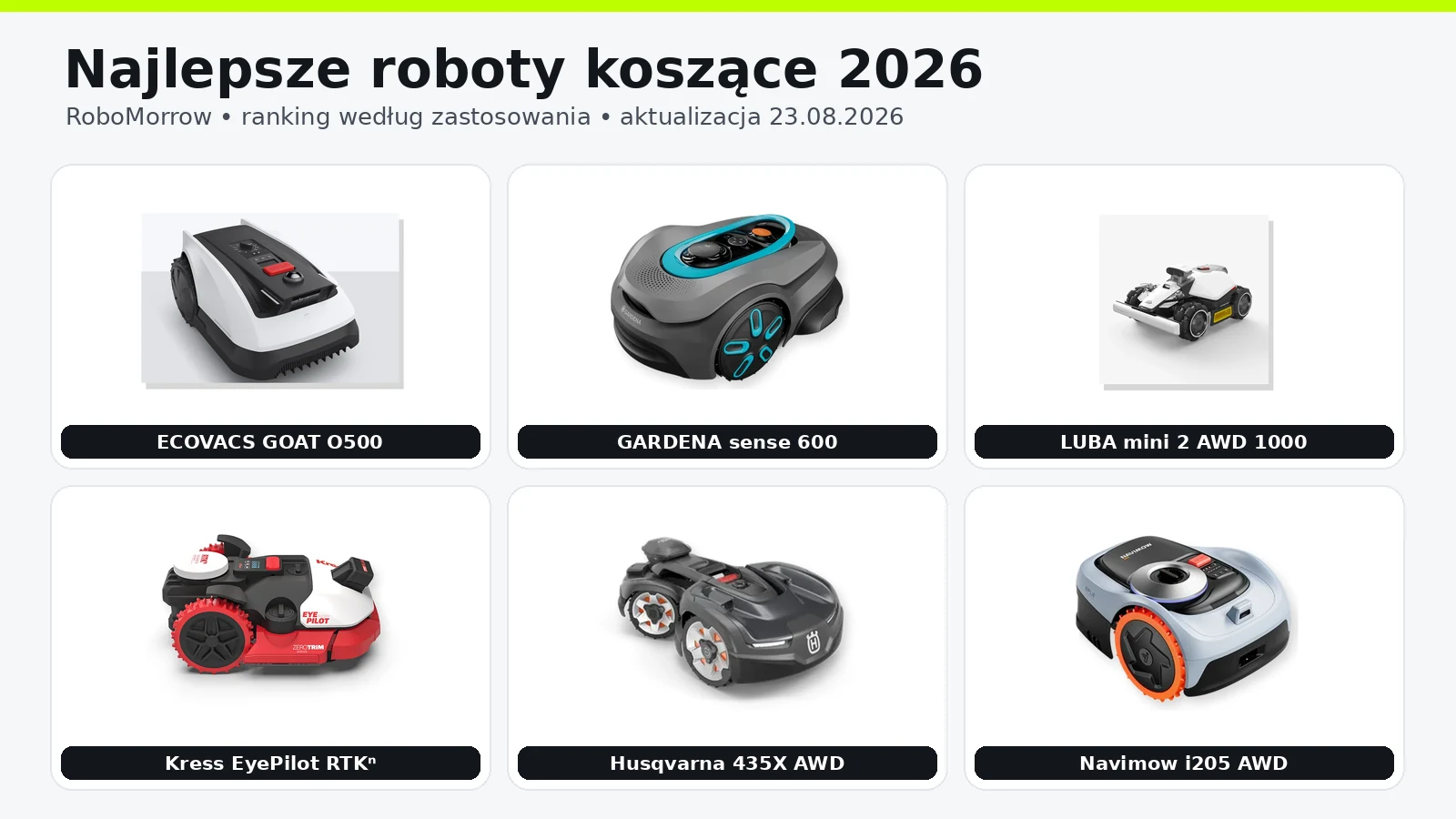
Author: Redakcja RoboMorrow. Advice and use-case selection are editorial analysis. Manufacturer claims are not RoboMorrow test results. The image illustrates a model or comparison; it does not document an editorial test.
Continue with the exact decision
Source scope: the decision block was checked on 12 October 2026. Earlier dated source statements retain their dates. Seller listings establish an enquiry route, not live stock or a delivery promise. No new affiliate offer has been verified or added.
Image: manufacturer material already published by RoboMorrow; illustrative, not evidence of an editorial hands-on test.
Where to buy models from this article
We show only exact verified Amazon product pages. Before purchase, confirm the variant, seller, warranty and box contents.
Exact Amazon links. Where a verified RoboMorrow marketplace tracking ID is active, the link is an affiliate link and we may earn from qualifying purchases. Price and availability can change after you click.