PUDU GT5 vs Husqvarna CEORA: start with the clipping workflow
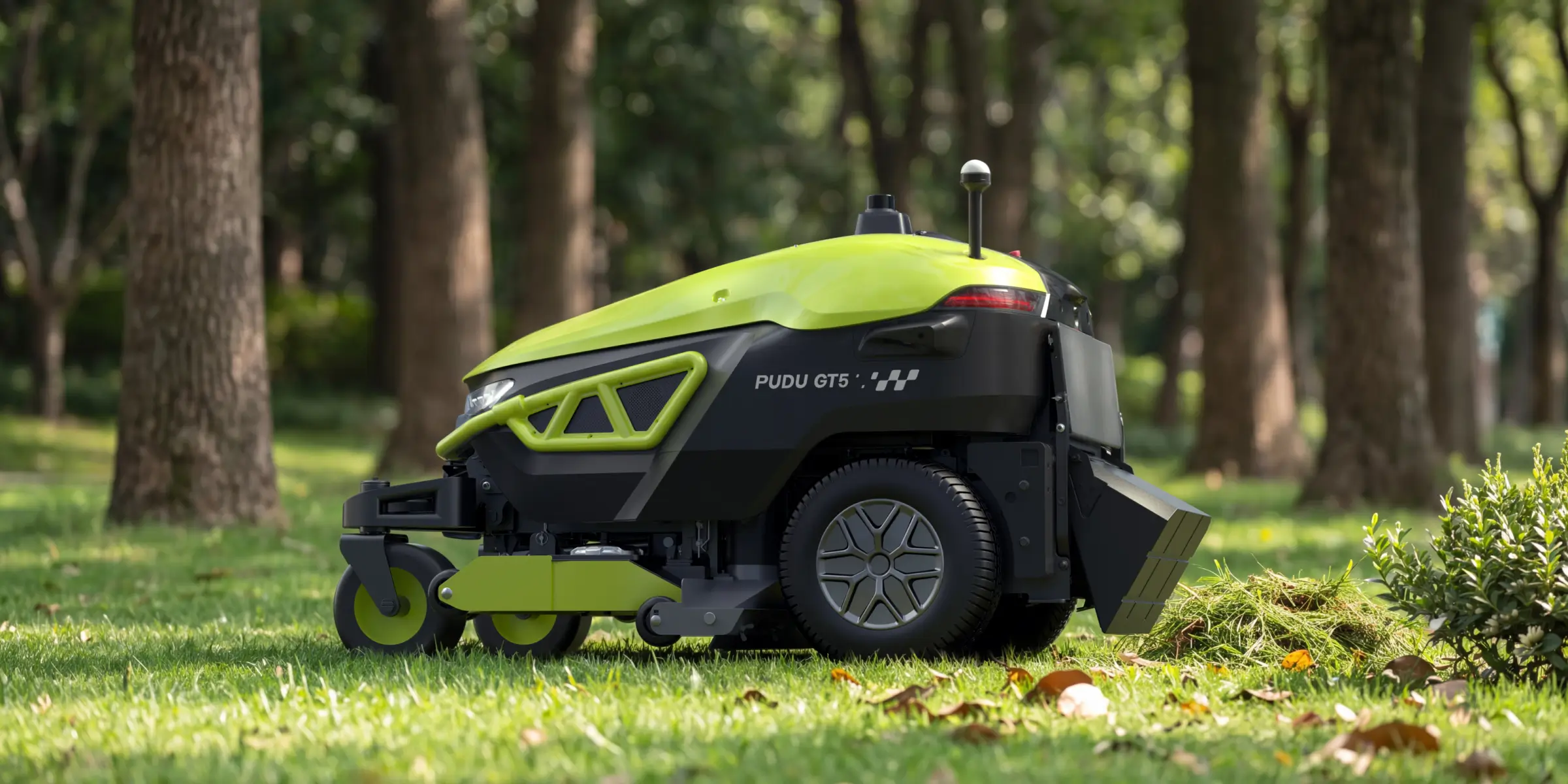
The featured image shows GT5 during an emptying demonstration. PUDU material, not a joint GT5 and CEORA test. Image source.
GT5 and CEORA should not compete for a winner's badge based on the largest area number. First decide whether clippings must be collected, when work can happen and what result the site manager will accept.
This compares manufacturer claims and purchasing scenarios, not our field-test results. For Husqvarna, the reference is the specific CEORA 546 EPOS / RZ 43L / CS4 configuration. The family name alone is not precise enough. Documentation was read on 14 September 2026.
Different systems, different denominators
PUDU describes GT5 as cutting and collecting clippings with automatic dumping. The CEORA reference is a configuration for systematic turf maintenance with defined mowing-frequency capacity categories. Do not assume those processes are interchangeable at every facility. GT5, specified CEORA configuration.
| Stated figure or function | What it describes | What it does not establish |
|---|---|---|
| GT5: up to 65,000 m² per charge | Area under the manufacturer's conditions | Accepted-quality output at every site |
| CEORA: Standard 48 — 48,000 m²; Sport 24 — 24,000 m² | Two maintenance-capacity categories | Area on one battery charge |
| GT5: mowing and collection | The proposed process | Elimination of every manual task |
These are not results from a common test. Dividing one area figure by another would not establish a productivity advantage.
First decision: must the clippings leave the site?
Describe the accepted outcome in the enquiry: grass height and appearance, clipping requirements, availability for users and acceptable finishing work. Where collection is mandatory, assess proposals that include that process. Where frequent maintenance without collection is acceptable, compare the complete schedule rather than prioritising the biggest hopper.
For GT5, request the full operating cycle: work, a full hopper, travel to the emptying point, discharge and resumption. The location and management of that point belong in the comparison. A demonstration showing mowing alone cannot establish the cost of the entire workflow.
For CEORA, ask which working pattern and equipment configuration will deliver the required finish. Do not buy only a product-family name. The quotation should identify the drive unit, deck, charging arrangement and installation components.
Second decision: when can the robot actually work?
A sports venue, hotel and park may offer very different operating windows. Record the intervals available for maintenance and the closures imposed by site use. Do not automatically count every hour of the day as mowing time.
Add charging, transfers and interventions. If activities regularly interrupt the programme, the demonstration should include stopping and resuming. A sensor list is not sufficient evidence for safe operation around people. The supplier and those responsible for the site need to define operating conditions.
Think about the week rather than the machine's most impressive run. A system with a lower instantaneous output may fit a longer maintenance window, while another may need to complete a defined job quickly. That is a scheduling question to evaluate, not an assumed advantage for either brand.
A fair comparison on the actual site
Agree the required result first. Assess representative zones, including turning, transfers, charging and manual finishing. Record accepted area, complete elapsed process time and human hours. If the systems need different schedules, compare a week of maintenance instead of forcing an artificial identical single-pass test.
An illustrative calculation: accepting 12,000 m² after three hours of the complete process gives 4,000 m²/h. That is not either machine's output. It shows a common denominator that can be used after actual measurements.
Do not calculate labour savings only from the time someone previously sat on a mower. Work may move into preparation, transport, checks and servicing. Count a cash saving only when the corresponding cost genuinely disappears.
The quotation needs commissioning and support
Separate the exact machine configuration, installation, accessories, training, cutting parts, recurring charges and service. The cited Slovak CEORA page explicitly excludes the reference station from the listed configuration; those commercial terms should not automatically be applied to another country. Configuration inclusions.
For both proposals, agree service response, replacement-equipment arrangements and a maintenance fallback during downtime. A manufacturer product page is not confirmation of local stock or a commissioning date.
Also define responsibility for future updates and any change to the mapped site. A new access restriction or event layout can change the operating problem even though the grass area is unchanged. The proposal should explain how such changes are handled and priced.
Our conditional verdict
GT5 is a demonstration candidate when clipping collection is an important part of the job. CEORA is a candidate for a designed recurring-maintenance schedule in a specified configuration. The final choice belongs to site results, support and total cost—not incompatible area claims.
We do not publish a GT5 purchase price without a quotation or promise that either system pays back faster. Settle the central question first: which process achieves the required turf condition within the available windows and with an acceptable amount of human work?
For the product-family context, read RoboMorrow's PUDU GT3, GT5 and GT7 overview. Its dated launch figures should be read alongside the current manufacturer specification.