PUDU GT5: price, specifications and collection costs
RoboMorrow · Decision Lab
Before you buy
PUDU GT5
Check the product, target market and delivery scope separately. A manufacturer page does not automatically establish availability in Poland.
Not confirmed in this passport
Not confirmed in this passport
Distributor quotation catalogue; not stock confirmation
Price and date
No verified delivered EUR price for the target market. Request price, tax, shipping and the exact bundle.
What is included
GT5: agree on collection, emptying and route requirements.
Your part of the job
Automating a planned task requires mapping, operating rules, consumable handling and an intervention procedure.
Service and warranty
Confirm who supports the local variant, parts, transport for repair and warranty exclusions. No SLA verified.
Sources and verification dates
Passport compiled on 16 Oct 2026. Market verification dates appear above. Missing confirmation does not mean the product is unavailable. The earlier profile below may include launch prices for other countries.
BUYING IN YOUR MARKET
Availability in your country
Sales, delivery and support can differ by country and exact model. Choose your market to see the evidence we have checked.
PUDU GT5
Netherlands
Local sales channel — request a quote
- Seller / sales channel
- Fulin Robots
- Price
- Individual quote; verify currency, taxes, configuration and installation
- Delivery
- Request the current lead time for the exact model and delivery address
- Warranty and service
- Confirm warranty territory, parts and the named local service provider in writing
Dutch supplier lists this exact mower. Request a quotation, demonstration and address-specific support.
Evidence checked: · Not a live stock feed
Fulin Robots: exact-model sales route ↗Spain
Local sales channel — request a quote
- Seller / sales channel
- Intec Robots
- Price
- Individual quote; verify currency, taxes, configuration and installation
- Delivery
- Request the current lead time for the exact model and delivery address
- Warranty and service
- Confirm warranty territory, parts and the named local service provider in writing
Exact-model listing plus the supplier’s stated Spain/Portugal service area. A site assessment and written quote remain necessary.
Evidence checked: · Not a live stock feed
Intec Robots: exact-model sales route ↗Intec Robots: Spain and Portugal coverage ↗Portugal
Local sales channel — request a quote
- Seller / sales channel
- Intec Robots
- Price
- Individual quote; verify currency, taxes, configuration and installation
- Delivery
- Request the current lead time for the exact model and delivery address
- Warranty and service
- Confirm warranty territory, parts and the named local service provider in writing
Exact-model listing plus the supplier’s stated Spain/Portugal service area. A site assessment and written quote remain necessary.
Evidence checked: · Not a live stock feed
Intec Robots: exact-model sales route ↗Intec Robots: Spain and Portugal coverage ↗France
Local sales channel — request a quote
- Seller / sales channel
- Easy to Clean
- Price
- Individual quote; verify currency, taxes, configuration and installation
- Delivery
- Request the current lead time for the exact model and delivery address
- Warranty and service
- Confirm warranty territory, parts and the named local service provider in writing
France-based supplier offers purchase or rental enquiries for this exact model; delivery timing is confirmed case by case.
Evidence checked: · Not a live stock feed
Easy to Clean: exact-model sales route ↗Easy to Clean: French registered office ↗Australia
Local sales channel — request a quote
- Seller / sales channel
- Perth Robots
- Price
- Individual quote; verify currency, taxes, configuration and installation
- Delivery
- Request the current lead time for the exact model and delivery address
- Warranty and service
- Confirm warranty territory, parts and the named local service provider in writing
Order enquiries are open for Perth and Western Australia. This record does not establish delivery or on-site support throughout Australia.
Evidence checked: · Not a live stock feed
Perth Robots: exact-model sales route ↗Türkiye
Local sales channel — request a quote
- Seller / sales channel
- Pudu Turkey / Robotlar
- Price
- Individual quote; verify currency, taxes, configuration and installation
- Delivery
- Request the current lead time for the exact model and delivery address
- Warranty and service
- Confirm warranty territory, parts and the named local service provider in writing
The Turkish distributor’s mower catalogue lists GT3, GT5 and GT7. Request exact configuration, price and deployment terms for your site.
Evidence checked: · Not a live stock feed
Pudu Turkey / Robotlar: exact-model sales route ↗No verified local offer in this dataset
A current local sales offer, exact regional variant, delivery date and service coverage have not been verified for this country in the regional dataset. This does not mean that the robot is unavailable.
- Price
- No verified local price in this dataset
- Delivery
- No confirmed date for your address
- Warranty and service
- Local coverage not verified
“Listed” confirms a product page or sales route, not stock, delivery to every address or local service. “Pre-order” is not immediate availability. Unverified means we lack evidence; it does not mean unavailable. Prices belong to the named market and currency. Confirm the exact version, tax, shipping and support before ordering.
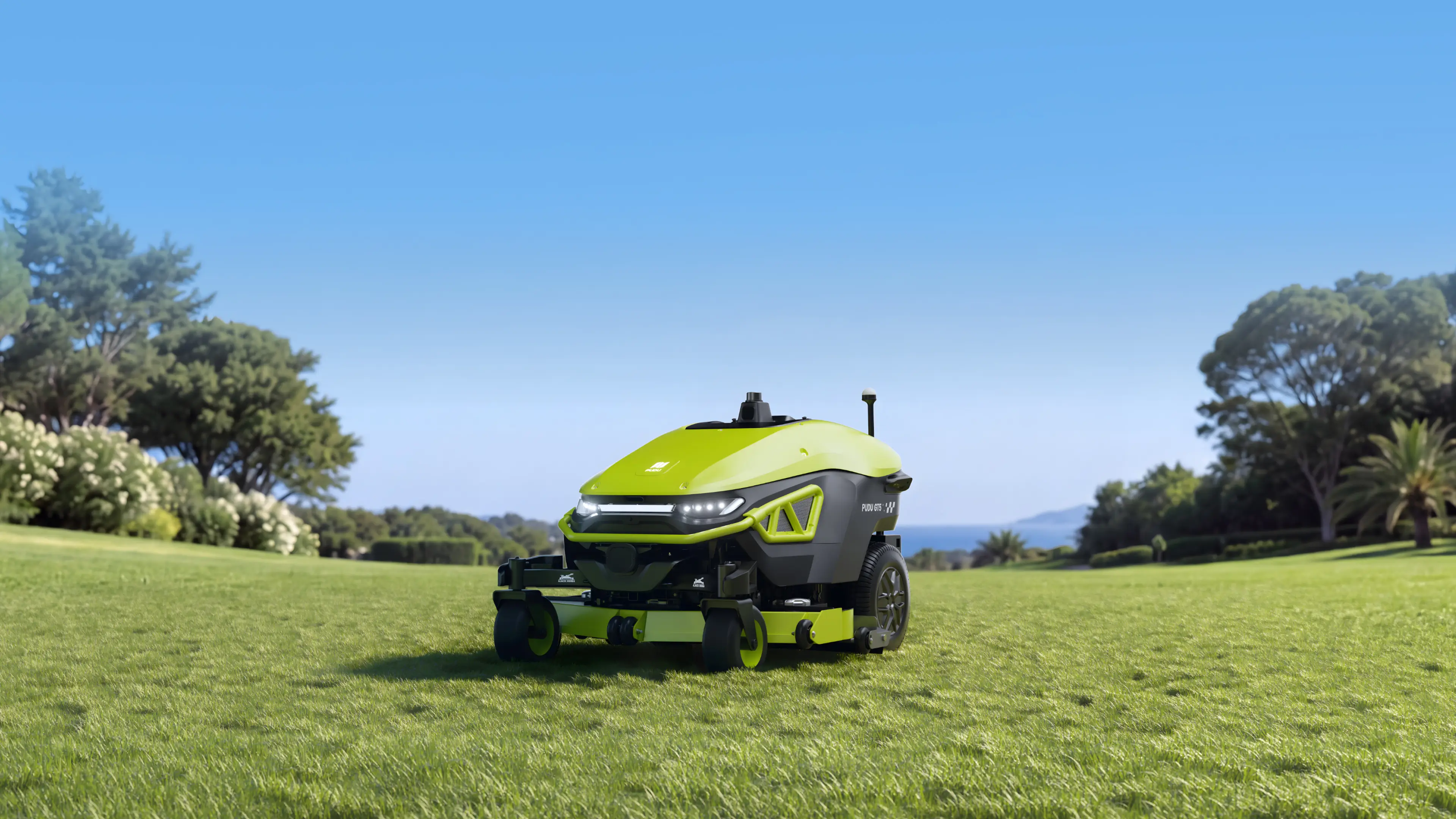
PUDU GT5 is a wide-area rotary mower for lawns that require clipping collection. Its wide deck is only one part of the process. Travel between zones, hopper emptying and the human work left after mowing also determine what a shift actually delivers.
GT5: price and quotation scope
The reviewed sources do not provide a comparable public price for a complete GT5 package. Intec Robots lists the GT5 with a quotation route and states coverage in Spain and Portugal. That is a specific way to enquire, not confirmation of local inventory or delivery to other countries.
Do not substitute the GT3 price in a cost model. Request a separate proposal covering the machine, cutting equipment, charging, transport, commissioning and training. For leasing or rental, obtain the entire payment schedule and end-of-term conditions. A missing public price does not justify inventing an editorial estimate.
Manufacturer specifications
| Specification | GT5 |
|---|---|
| Dimensions (L × W × H) | 1910 × 1586 × 1293 mm |
| Weight including battery | 850 kg |
| Cutting width | 1.52 m |
| Cutting height | 26–152 mm |
| Battery | 26 kWh |
| Runtime | 8–10 h |
| Area per charge | up to 65,000 m² / 6.5 ha |
| Standard charging | 8 h / 3 kW |
| Optional fast charging | 4 h / 6 kW |
Source: PUDU — GT5. These are not our test results or a guarantee of site performance.
Mowing and collection: count the complete clipping cycle
PUDU describes cutting, suction and collection, autonomous travel for emptying, and task resumption. During the demonstration, check the distance to the dumping point, travel when the hopper fills, and subsequent material handling. Emptying the hopper does not remove the collected grass from the property. Record who performs that final task and how often.
Why 8,000 m²/h does not size the fleet
The manufacturer publishes a mowing rate of 8,000 m²/h and up to 6.5 ha per charge. They are different measures, not a promise to deliver 8,000 accepted square metres during every hour of a complete shift. We do not multiply a peak rate by maximum runtime to promise coverage above the manufacturer’s own claim. Base the quotation on completing the job within actual site-access hours.
Transit and charging may become the constraint
The published body width is 1586 mm; the 1.52 m figure describes the cut. Check gates, turns, access to the dumping area and parking. PUDU lists eight hours for standard 3 kW charging or four hours with the optional 6 kW arrangement. Include the difference in the schedule rather than assuming all hours when the site is closed are available for mowing.
The trial: representative grass and a real dumping point
Choose typical regrowth and the actual emptying route. Record accepted area, complete elapsed time, interventions and finishing work. Approve the lawn after the task is finished, not merely a video of the deck running. Agree obstacle-handling procedures and the approved operating area with the supplier; perception systems do not replace the organization of a safe demonstration.
Service and acceptance conditions
Before ordering, obtain written delivery terms for your country, the service provider’s name, parts availability and a commissioning date. Agree how the grounds will be maintained during downtime and who arranges and pays for repair transport. A telephone response target does not establish when mowing will restart.
At acceptance, record the approved area, complete cycle time, interventions and human minutes required. Define the result to be maintained through a normal week of operation. Use that basis to compare purchase cost, financing and the work that remains.
Compare the alternatives
Our GT3, GT5 and GT7 comparison includes the differences, six comparable quotation lines and a site-trial log. Compare GT3 for mixed lawns and paths, or GT7 where reel cutting is required.
For a different maintenance process, see GT5 vs Husqvarna CEORA. Align the accepted turf condition and clipping-handling requirement first.
Prepare an enquiry for your site
Include the country, area the robot can actually reach, working hours, target cutting height and required clipping-handling process. Describe the narrowest passages, charging location and main constraints. Describe your project in the RoboMorrow enquiry form. Your enquiry goes to our editorial team; it is not an order or a binding supplier quotation.
Sources and method
PUDU — GT5 · Intec Robots — GT5 · Intec Robots — Spain / Portugal
Editorial verification: 15 October 2026. Specifications come from manufacturer documentation; prices describe the named regional offer, not a global price list. Selection guidance, demonstration criteria and cost analysis are editorial work, not RoboMorrow field-test results. Original PUDU visual assets are retained from the existing publications; these include manufacturer product illustrations, not photographs from our own test. No affiliate offer has been added.
Where to buy
We do not yet have a verified exact Amazon product page for this model. Check the official source above.
News about this robot and brand
No related news is available yet.
Guides
Restaurant robots in 2026: waiter, delivery or cleaning — where is the ROI?
Robot waiter, dish transport or autonomous cleaning? We examine where restaurant robots make operational sense and how to measure ROI.Read more →
Hotel robots in 2026: cleaning, room service and reception — what actually makes sense?
Which robots actually make sense in hotels? Cleaning, room service, dish transport, reception, elevator integration and ROI measurement.Read more →Comparisons and rankings
No related comparisons are available yet.