Commercial robotic mowers: four configurations by use case
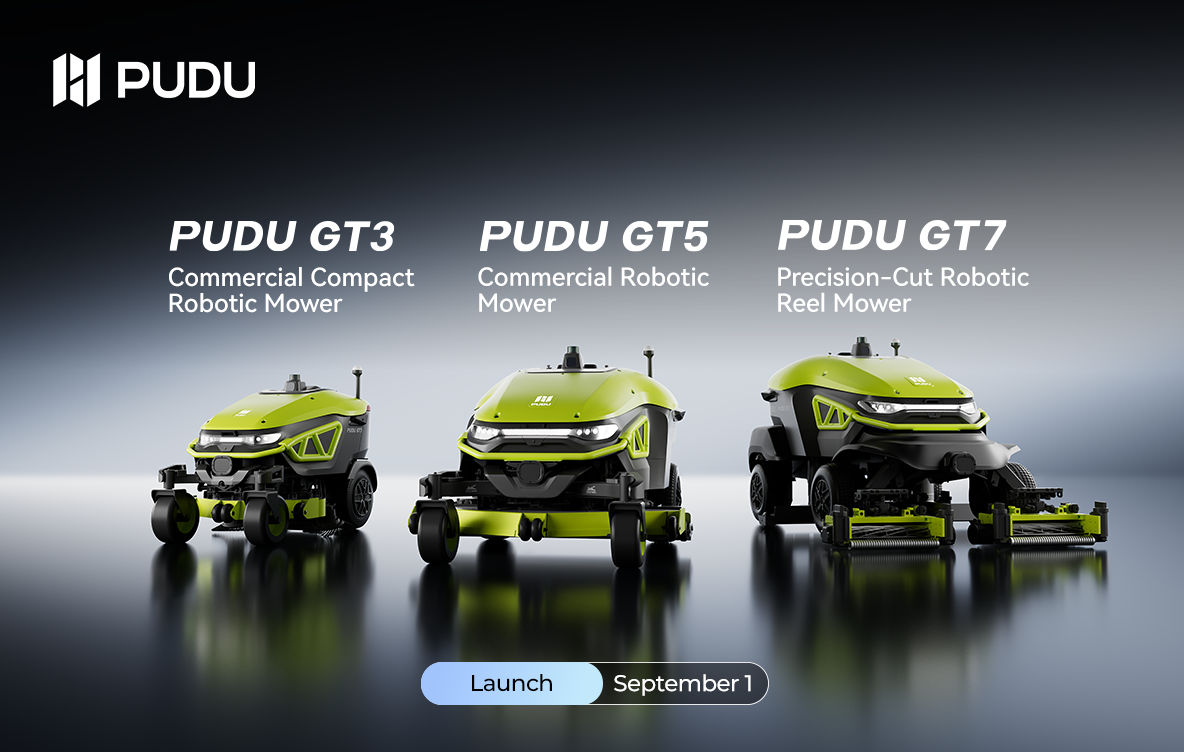
Featured image: PUDU material from the GT-family article. CEORA is a separate comparison candidate and is not the model shown in this illustration. Image source.
A robot maintaining hotel grounds and a machine intended for demanding sports turf do not belong on a single performance podium. Our shortlist therefore starts with the job. It identifies four configurations for assessment, not the four best-tested commercial robots in the world.
We selected the PUDU GT family covered in our existing reporting and a specific Husqvarna CEORA configuration as a comparison point. This is an explicitly limited selection, not a complete market survey. We have not carried out a common field test. Documentation was read on 14 September 2026; local pricing and delivery require quotations.
Start with the task
| Main requirement | Candidate to assess | Condition before recommending |
|---|---|---|
| Recurring maintenance of extensive turf | CEORA 546 EPOS / RZ 43L / CS4 | A site-specific schedule and confirmed configuration |
| Mowing combined with light walkway cleaning | PUDU GT3 | Demonstration of both jobs and the waste cycle |
| Large-zone mowing with collection | PUDU GT5 | Accepted finish and full-process time verified |
| Specialist cutting-quality requirements | PUDU GT7 | Assessment by the person responsible for the turf |
The order is not a performance score. A candidate is rejected when it fails the requirements of the particular site.
CEORA: assess a complete maintenance schedule
The referenced CEORA setup combines the 546 EPOS drive unit, RZ 43L deck and CS4 charging station. The manufacturer separates included components from optional equipment. Configuration source.
I would ask for a weekly plan across all zones, including charging and closures. A recommendation would depend on delivering the required turf condition during normal site use. A result on a simple empty lawn should not automatically be extended to grounds interrupted by routes, events or changing access.
The essential quotation question is what a person's job looks like after deployment. An answer limited to installing the app is not yet a complete operating plan.
GT3: demonstrate the two jobs separately
PUDU presents GT3 as a compact mowing-and-collection machine that can sweep when its blades are disabled. GT3 manufacturer description.
That makes it a candidate where an appropriate site maintains both grass and paved routes. It does not establish that two functions replace two complete human jobs. Define the accepted mowing result, cleaning result and emptying process separately.
Check transfers between zones, access to the waste point and any preparation needed when changing work. Include tasks the proposed system will not take over. A multifunction machine can be useful without eliminating the entire grounds-maintenance workload.
GT5: collection belongs in the workflow
PUDU positions GT5 as the larger mowing-and-collection platform with automatic dumping. GT5 manufacturer description.
Bring the person who will own the result and daily operation to the demonstration. They should see the full cycle, not merely a run across an open section of turf. Record manual finishing, waste handling and time spent outside active mowing.
If the complete process still needs a person continuously present, it may have value, but describe that value accurately. The benefit may be a change in workload rather than the removal of a staffing cost. A purchasing comparison should make that distinction visible.
GT7: specialist cutting needs turf assessment
GT7 uses a triplex reel-cutting arrangement. The current manufacturer page lists a 5–50 mm cutting-height range. GT7 source.
That is a reason to involve the person accountable for the turf standard, not to put the machine automatically at the top of a ranking. The relevant criteria are the accepted finish, maintenance requirements and whether the planned programme sustains them.
Request the exact variant and the conditions behind its stated performance. Do not mix launch-release figures with a later product specification. Where sources differ, identify the discrepancy and ask the manufacturer to confirm the applicable version.
Four reasons to reject any candidate
A missing approved operating and safety plan. A critical route or working window that the proposal cannot satisfy. An unacceptable finish on a representative part of the site. No credible continuity arrangement during downtime. Any one matters more than a place in a shortlist.
We do not award points for a feature whose usefulness has not been established. Instead of a score such as 9.7/10, use three states: met the criterion in the demonstration, requires verification, and did not meet the criterion. Keep the conditions alongside the result. That supports a decision without pretending to laboratory precision.
Turn the shortlist into comparable proposals
Select no more than two operating approaches that fit the facility and issue comparable enquiries. Keep the scope consistent: exact configuration, commissioning, training, recurring charges, cutting parts, service and fallback arrangements. Ask for a site demonstration and a local delivery commitment.
One additional useful check is how a supplier handles a failed acceptance criterion. A proposal that defines the boundary of the system and offers a practical alternative is more useful than a promise that every setting can be solved after purchase.
The best candidate is the one whose process and support meet your site's requirements. Without those data, we will not declare a winner. A manufacturer page is the beginning of the assessment, not the end of the buying decision.
For the launch background and model relationships, see the PUDU GT-series overview. The next useful comparison is the complete operating proposal, rather than another table of incomparable area claims.
Related guides and robot profiles
- PUDU Enters Commercial Robotic Mowing With GT3, GT5 and GT7
- PUDU GT3: 36-inch mower, 20,000 m² and sweeping
- PUDU GT5: 60-inch mower, 8,000 m²/h and 65,000 m² per charge
- PUDU GT7: reel mower, ±2.5 cm RTK and up to 70,000 m²
PUDU GT5 vs Husqvarna CEORA: start with the clipping workflow