EGO AURA-R2 combines RTK, VSLAM and VIO. Is hybrid navigation the next step?
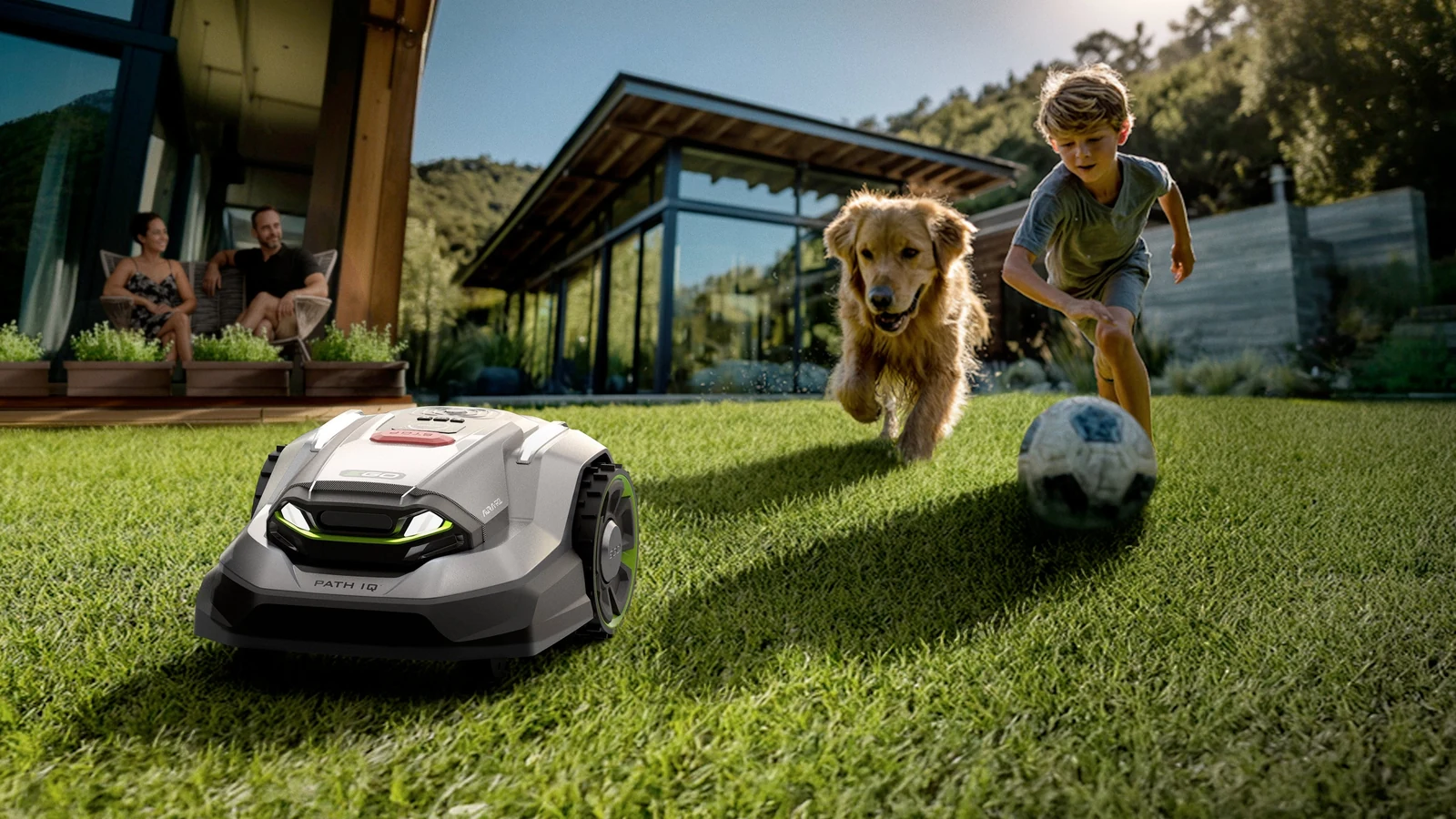
The EGO AURA-R2 does not try to settle the “RTK or camera” argument. PATH IQ combines local RTK, VSLAM and VIO because each technology answers a different question. RTK tells the mower where it is on the saved map. VSLAM helps it recognise the surroundings and stable landmarks. VIO tracks short-term movement from images and inertial sensors.
That architecture is logical in a garden where open sky turns into tree cover, a wall-side strip or a narrow corridor. It does not automatically guarantee perfect navigation. The outcome depends on sensor-fusion algorithms, behaviour when position confidence falls, map quality and clean cameras. AURA-R2 matters not because it has three acronyms in its specification but because it illustrates where the category is going.
The short answer
PATH IQ makes most sense as a navigation-continuity system:
- RTK stabilises absolute position and supports straight passes relative to a virtual boundary;
- VSLAM builds a visual map and can recognise environmental features as satellite conditions deteriorate;
- VIO estimates movement and orientation between reliable position fixes.
The key caveat is that EGO describes those components and their roles but does not publish the full fusion logic, confidence thresholds or maximum safe duration without stable RTK. Those details should not be invented.
Three technologies, three kinds of information
RTK: position relative to the map
The mower receives GNSS signals while the PATH IQ antenna acts as a local reference source for corrections. Under favourable conditions this supports a position accurate enough for virtual boundaries and systematic mowing. RTK still needs sky visibility. Corrections reduce positional error; they cannot create satellite signals where the sky is blocked or reflections from walls dominate.
VSLAM: a map made from camera landmarks
Visual Simultaneous Localisation and Mapping means building a map while locating the device within it. AURA-R2 uses binocular RGB stereo vision. Two cameras can provide geometric cues and recognise stable features such as a trunk, wall edge or fence section. Performance depends on lighting, clean lenses, seasonal change and whether the scene contains distinctive features.
VIO: movement between reliable fixes
Visual-inertial odometry combines image changes with motion-sensor data. It can estimate how far and in which direction the mower moved from the last strong position. This is valuable during a short interruption, but VIO is not an unlimited replacement for RTK: small errors accumulate with time and wheel slip.
How the layers may work across a garden
| Situation | Most important layer | What can still go wrong |
|---|---|---|
| open rectangular lawn | RTK and the map | poor mapping, wheel slip, a moved antenna |
| route beneath a tree | VSLAM + VIO supporting RTK | low light, uniform scenery, wet lens |
| narrow wall-side corridor | vision, movement and last reliable position | GNSS reflections and little room to correct |
| avoiding a toy | visual perception | small, flat or low-contrast object |
| returning to the dock | position, map and local sensors | poor reception at the station or a changed scene |
This is the value of sensor fusion: one weak source does not have to cause immediate loss of orientation. It is not complete fault tolerance. If several sensors lose confidence at once, a mature mower should slow down, stop or return to a safe point instead of guessing aggressively.
What EGO gets right at concept level
First, localisation is separated from perception. RTK cannot recognise a ball, while a camera does not know an invisible digital boundary by itself. Combining them reflects the real needs of a robot mower.
Second, VIO is part of the stack. This less marketable layer matters because continuity during a brief satellite interruption can be more useful than an abrupt switch to a completely separate map.
Third, the range shares one navigation concept. The models differ in area, battery and zone count, while the technical architecture remains coherent. That can help software and support if EGO maintains the platform over several seasons.
The AURA-R2 range in numbers
| Model | Area | Battery | Runtime / charge area | Zones | Polish price 21 Aug 2026 |
|---|---|---|---|---|---|
| RMR1500E | 1,500 m² | 5 Ah | 2 h / 330 m² | 20 | about €2,300 |
| RMR3000E | 3,000 m² | 5 Ah | 2 h / 330 m² | 20 | about €2,800 |
| RMR6000E | 6,000 m² | 10 Ah | 4 h / 660 m² | 40 | about €4,250 |
All three list a 24 cm cutting width, 20–90 mm height range, three pivoting blades, IP66, Bluetooth, Wi‑Fi and 4G, plus a claimed 50% gradient. The RMR6000E doubles battery capacity and cycle length. The RMR1500E and RMR3000E publish the same per-charge figures, so prospective 3000 buyers should ask how the practical area rating is established.
Early tests: good mowing, with software still consequential
T3 tested an AURA-R2 on a simple lawn in May 2026. The reviewer praised neat stripes and boundary keeping, while reporting inconsistent obstacle detection, sensitive controls during manual mapping and an app less polished than category leaders. That distinction matters: strong localisation is not the same as reliable perception of every object.
GadgetGear described a more positive experience after the map was refined and problem patches excluded. The mower handled slopes and produced an orderly cut, but holes and uneven ground could unsettle the front castors and the app still felt under development.
Both reviews come from early in the product’s life. Updates may improve the app and behaviour, but improvement should not be assumed without newer evidence. Firmware version and review date belong in every assessment.
Hybrid navigation does not remove installation work
PATH IQ uses a local RTK antenna. It still needs a suitable position, stable mounting and the correct relocation procedure if moved. EGO’s store presents antenna and mounting components among the accessories, so the dealer quotation should clearly state what is included.
The charging station should not be hidden casually below a deep roof either. Vision and VIO can support the mower, but docking and reacquiring a strong fix are easier when the system does not begin every task in the garden’s most difficult position.
Questions the specification does not answer
- How long can the mower operate without a full RTK solution?
- What exact condition triggers a safe stop?
- Does the app expose current position confidence or active source?
- Where are camera images processed and are they stored?
- How does the system react when one lens is dirty?
- Can a boundary section be corrected without remapping everything?
- Which functions remain after the three-year data package?
A missing public answer is not proof of a defect. It identifies what to check in the manual, with the dealer or during a supervised trial.
Why EGO’s move matters
EGO belongs to Chervon Group, which also owns SKIL and FLEX. Chervon presents EGO as an outdoor-power brand developed since 2014. AURA-R2 reflects a broader shift: robot mowers are becoming a category for established outdoor-power-equipment manufacturers rather than a separate robotics niche.
That background may bring a stronger dealer network, service structure and mechanical experience. It does not guarantee mature apps or navigation algorithms. Robotics requires motors, batteries and housings to meet software, data and long-term updates.
The garden where PATH IQ looks strongest
- most grass has open sky, with local trees or walls;
- virtual boundaries and multiple zones matter more than the lowest price;
- the user values stripes and map editing;
- there is a suitable place for the antenna and dock;
- small objects can be removed before mowing.
A less convincing scenario is an old garden almost entirely beneath dense canopy, with narrow passages, deep ruts and hazardous waterside boundaries. There, PATH IQ should be compared with LiDAR, a mature vision-only platform or a boundary wire.
RoboMorrow verdict
PATH IQ is one of the more interesting examples of robot-mower sensor fusion in 2026. Its technical logic is strong: absolute RTK position, a VSLAM visual map and short-term VIO continuity. AURA-R2’s main virtue is not a single centimetre-accuracy claim but its attempt to manage the transition between good and difficult localisation conditions.
Early tests also show that an elegant architecture on paper does not guarantee an equally mature app or obstacle system. AURA-R2 deserves a positive but honest reading: it is a substantial debut from an established outdoor brand, and its updates and long-term tests are worth following.
FAQ
Does PATH IQ work without a boundary wire?
Yes. Boundaries are digital and the system uses RTK, cameras and motion sensors.
Does VSLAM replace the RTK antenna?
Not in EGO’s description. VSLAM supports localisation, while PATH IQ includes a local RTK antenna.
Can VIO continue indefinitely after satellite loss?
That should not be assumed. Inertial odometry accumulates drift and needs periodic correction from a reliable position source.
Does the camera guarantee safety around pets and toys?
No. Early tests found inconsistent recognition of some objects. Daytime mowing on a clear lawn remains safer.
Which model supports 40 zones?
The model table lists 40 zones for RMR6000E and 20 for RMR1500E and RMR3000E.
Can RMR6000E mow 6,000 m² in one day?
The specification does not support that conclusion. EGO lists a 3,300 m² daily area, so the full property requires a multi-day schedule.
Sources and verification date
Specifications and availability checked 21 Aug 2026 using EGO Robot Mowers, the EGO 2026 catalogue, the AURA-R2 manual and Chervon’s EGO profile. Practical context: T3 and GadgetGear. RoboMorrow has not tested the mower.
EGO cards in the Robot Database
EGO AURA-R2 RMR1500E · EGO AURA-R2 RMR3000E · EGO AURA-R2 RMR6000E
Related RoboMorrow material
Vision AI or RTK? · How RTK works · Robot mower without a local RTK station