Robot mower for a small garden: layout matters more than area
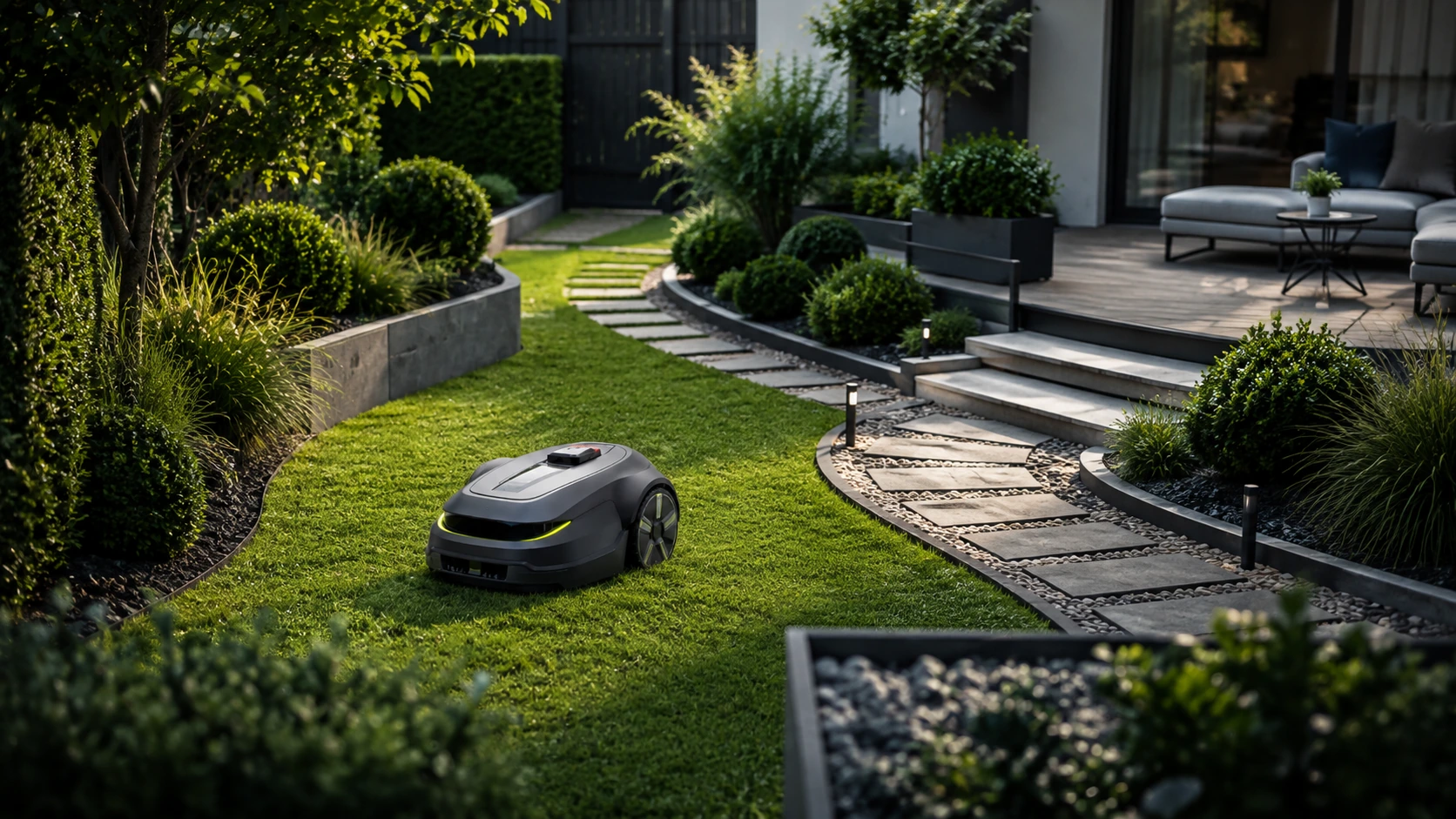
A small garden is not always an easy environment for a robot. There may be more corners, flower beds, furniture, toys and narrow passages on 250 m² than on an open lawn of 1,500 m².
Therefore, when choosing a device for a small garden, it is not worth considering the largest battery and the maximum area. What matters are precise maneuvers, easy mapping, passage width, edges and whether the station will fit in the right place at all.
This material complements the guide Robot mowing up to 500 m². There we focus on selecting the surface class. Here we analyze geometry and everyday use of a small gardento prevent both articles from answering the same question.
Does the robot make sense for 100-300 m²?
Might have, especially if the owner wants to keep the turf even without having to pull out the mower every week. However, the economic return will be smaller than on a large plot, because manual mowing takes little time.
Small lawn robot is bought more often for:
- regular appearance of the turf;
- convenience;
- quiet, frequent operation;
- no storage for large mower;
- easier mowing around garden features;
- automation during trips.
If the lawn is one rectangle with an area of 80 m² and a manual mower is at hand, the robot may be more of a gadget than a savings. With 250 m² divided into several zones, the value of automation increases.
Count the lawn first, not the plot
In a terraced house, the plot may be 350 m², but the lawn, after deducting the house, terrace, driveway and flower bed, takes up only 120 m². The "up to 500 m²" model then has a huge headroom that will not be of benefit if the device does not cope well with a 75 cm wide passage.
Measure separately:
- the area of each piece of grass;
- narrowest passage;
- edge length at the wall;
- distance between discounts;
- flat station space;
- slope at boundary;
- width of the gate or passage between the front and back of the house.
Narrow passages are more important than maximum space
The manufacturer may specify the minimum corridor width, but it is worth checking how it is measured:
- between wires;
- between physical walls;
- as the width of the crossing itself;
- with additional margin for the signal;
- only for transport or also for mowing.
ECOVACS declares a 0.7 m corridor passage for GOAT O500 Panorama. GARDENA describes CorridorCut in wired models as a solution for narrow sections. Each technology does this differently.
The most difficult part is the corridor between the two high walls. The RTK robot may have a weak signal, the camera has a limited view, and the device needs room for track corrections. In a location like this, a guide wire can still be very effective.
Edges: The Biggest Source of Manual Fixes
On a small lawn, the share of edges in relation to the surface is large. If the robot leaves 8-12 cm on each wall, the owner can still use the trimmer frequently.
Check:
- is the drive centered or offset;
- can the robot move the wheel over a flat cube;
- does it have a separate edge disk;
- how to turn around at the wall;
- what margin does it leave at the virtual border;
- whether the "edge" function works on any type of edge.
The best edge for the robot is grass that runs flat into cubes. The worst thing is a high wall without a band.
Sometimes it is cheaper to rebuild 10 cm of the edge than to pay extra for a much more expensive device.
Cable or robot without cord in a small garden?
The cable makes sense when:
- chip is fixed;
- the garden is very shaded;
- there is a narrow passage near the walls;
- you want to reduce the cost;
- one-time installation is not a problem;
- you don't need many zone changes.
GARDENA SILENO minimo 250 and 500 are examples of devices deliberately designed for small spaces. The boundary is physical, so trees do not affect its course.
A system without a cable makes sense when:
- you move the trampoline or pool frequently;
- you change discounts;
- you want to create temporary forbidden zones;
- you don't want to lay the cable;
- the garden has conditions suitable for a camera, LiDAR or GNSS;
- you accept a greater role for applications and software.
In small spaces, systems without a local antenna, such as GOAT O500 Panorama, GARDENA smart SILENO sense 600 or LiDAR robots, are attractive. However, you need to check the light requirements, range and readability of the borders.
Where to set the station?
In a small garden, the station can take up a surprising amount of space. It shouldn't be pushed into any corner just because that's where it's least visible.
Needs:
- flat, stable ground;
- entry and exit locations;
- power;
- signal conditions consistent with the instructions;
- protection against puddles and running water;
- access for cleaning and service.
A roof can protect the device, but in the GNSS model, hiding the station too deep under a terrace or metal structure may impair positioning.
Noise and operating hours
On a small plot, the robot works close to the windows of the house and neighbors. A difference of a few decibels can make a difference, but the nature of the sound is also important: the hum of the engine, the sound of the blades hitting hard stems and the squeaking of the drive when turning.
Useful are:
- daily schedule;
- prohibition of work during rest hours;
- silent mode;
- shorter, regular sessions;
- keep knives sharp;
- removing cones and twigs.
Do not plan to mow at night. In a small garden, small animals have fewer escape routes and there is little benefit from working in the dark.
Obstacles and everyday mess
A small garden often sees heavy use. The following appears on the lawn:
- balls;
- toys;
- garden hose;
- dog bed;
- chairs;
- solar lamps;
- children's pool;
- fruits falling from trees.
Camera and LiDAR help, but should not be considered an exemption from lawn inspection. Thin wires, strings and toys hidden in the grass are particularly dangerous.
A good solution is to have a regular mowing time preceded by a quick check of the garden.
Small slopes and faults
Small size does not mean flat terrain. A garden next to a terraced house may have a short, sharp slope next to the terrace. Check separately:
- maximum slope inside zone;
- limit at border;
- risk of falling down stairs;
- behavior on wet grass;
- possibility to create a flat seat belt.
GARDENA smart SILENO sense declares 25% and ECOVACS O500 50%. A higher number does not determine the choice if there is no such slope in the garden.
Four types of small garden
1. Simple lawn next to a terraced house
Most often, a simple wired model or an inexpensive robot without a cable will work. Priorities: quiet operation, edges and small station.
2. Garden with a narrow passage to the front
Minimum corridor width and ability to return to the station are key. Do not purchase without confirming the dimensions in the manual.
3. Little garden under the trees
Cable or LiDAR/vision may be more reliable than RTK dependent on full sky.
4. Garden often changed by children
Virtual zones and efficient obstacle detection are more valuable than maximum performance. The schedule should only run when the garden is empty.
Models and solutions worth checking
This is not a separate ranking, but examples of different philosophies:
GARDENA SILENO minimo 250/500
For permanent garden where cord is acceptable. The 250 m² model meets the real needs of very small lawns.
ECOVACS GOAT O500 Panorama
For the user who wants automatic mapping without RTK and has corridors from approximately 0.7 m according to the manufacturer claim.
GARDENA smart SILENO sense 600
For a clear garden with good light and range. Interesting for local image processing.
Segway Navimow i105E
500 m² class model with virtual border and satellite positioning. Requires assessment of sky visibility and antenna space or conditions of a specific system version.
Mammotion LUBA mini 2 AWD 1000
It is oversized for a typical 200 m² lawn, but may make sense if your small garden is particularly steep and uneven. It's not worth paying for AWD without a real need.
How much spare space?
For a small, simple lawn, there is no need to buy a robot with three times the efficiency. A 20-30% margin is reasonable when:
- there are many obstacles;
- the robot can only work a few hours a day;
- the garden has several zones;
- grass grows fast;
- crossings are narrow;
- part of the route leads along a slope.
For a real 180 m², the 250 m² model may be enough in a simple garden. For 450 m² with many obstacles, it is worth considering the 600-800 m² class.
When is a robot for a small garden not profitable?
- the lawn is several dozen meters long and can be mowed in five minutes;
- most of the area is blocked;
- robot requires constant movement between zones;
- no space for safe station;
- a trimmer is needed for each edge anyway;
- the garden is used by children most of the day;
- the structure requires expensive reconstruction of the area.
Then a compact cordless lawn mower can be simpler and cheaper.
Checklist before purchasing
RoboMorrow Request
In a small garden, the best robot does not have to be the most powerful. Should be precise, quiet, easy to install and cope well with space geometry.
Measure transitions and edges first. Only then compare the battery, size and number of AI functions.
FAQ
What robot for a 200 m² garden?
Usually, a 250-500 m² class model is sufficient. Narrow passages, edges and space for a station are more important than battery supply.
Does the robot make sense for 100 m²?
It may be convenient, but financially it often does not save much time. It is worth counting manual mowing and trimmer adjustments.
Cable or no cable for a small garden?
Cable is good with a fixed, shaded arrangement. Cable-free system makes frequent changes and time zones easier.
How wide is the passage needed?
Depends on model and measurement method. Please refer to the instructions and not just the case width.
Will the robot cut the grass right next to the wall?
There will usually be a strip left to repair. The width depends on the position of the drive, housing and edges.
Where to place the station in a small garden?
On a flat surface with docking space, power and signal conditions as specified in the instructions.
Will the 1000 m² model be better for 200 m²?
Not automatically. It may be larger, more expensive and less maneuverable, and the additional capacity will remain unused.
Can you work at night?
It is better to plan work during the day when the garden is empty. Night mowing increases the risk to hedgehogs and other animals.
Related materials
- Robot mowing up to 500 m²
- Best robot mowers 2026
- Robot mower without cord
- How to prepare the garden for a robot mower?
Sources and verification date
Product parameters and examples checked on August 2, 2026 in official manufacturer materials:
- https://www.gardena.com/uk/products/lawn-care/robotic-lawnmowers/robotic-mower-sileno-minimo-250-m/970462810.html
- https://www.ecovacs.com/uk/shop/goat-robotic-lawn-mower/bundle-goat-o500-panorama-garage
- https://www.gardena.com/uk/products/lawn-care/robotic-lawnmowers/smart-sileno-sense-600-m/970817810.html
- https://navimow.segway.com/pages/navimow-i
- https://eu.mammotion.com/products/luba-mini-2-awd-1000-robot-lawn-mower
Related Tabs in Robot Database
Check verified model cards associated with this advisory. Product price, availability and status are updated separately in the Robot Database.
- MAMMOTION YUKA mini 2 800
- SEGWAY NAVIMOW i210 LiDAR Pro
- GARDENA smart SILENO free 800
- ECOVACS GOAT O800 RTK
- EUFY Robot Lawn Mower E15
- WORX Landroid Vision AI M600 WR206E
See the entire Robot Database →
Where to buy models from this article
We show only exact verified Amazon product pages. Before purchase, confirm the variant, seller, warranty and box contents.
Exact Amazon links. Where a verified RoboMorrow marketplace tracking ID is active, the link is an affiliate link and we may earn from qualifying purchases. Price and availability can change after you click.