Robot mower for up to 500 m²: choosing a model for a small garden
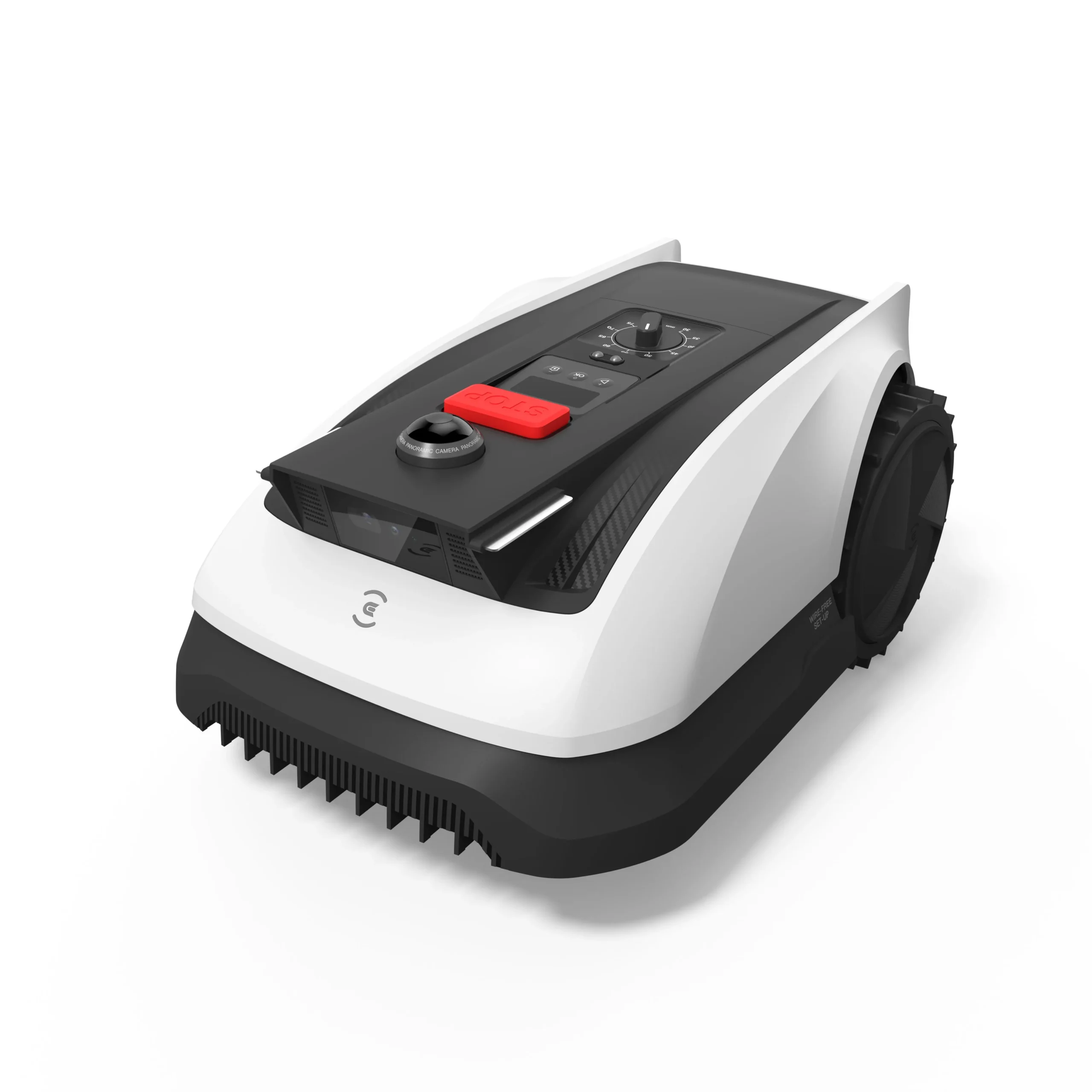
Which robot mower should you choose for up to 500 m² in 2026? Start with the garden, not the logo. A simple open lawn, a tree-filled garden, a slope, narrow passages and several disconnected zones are very different navigation problems. On small lawns, the difference between Network RTK, LiDAR, vision and a physical boundary wire often matters more than an extra 100–200 m² of advertised capacity.
You also do not automatically need a mower rated for exactly 500 m². Actual grass area is usually smaller than the property once you subtract the house, driveway, patio and beds. At the same time, headroom is useful when growth is fast, rain interrupts the schedule or the mower performs many turns. These recommendations are not a single RoboMorrow Labs group test; they combine current manufacturer data with use-case analysis.
A 500 m² lawn does not automatically need a “500 m² mower”
Updated 16 September 2026. Area rating is a limit, not a recommendation to operate at exactly 100% utilisation. On a simple open lawn, a 500 m² mower can be reasonable for 450–480 m². Multiple zones, slopes, tree cover and long transfers make capacity headroom more valuable because it shortens daily operating time and improves recovery after rainy days.
| Actual lawn | Reasonable starting class | When to add headroom |
|---|---|---|
| 250–350 m² | 400–500 m² class | many narrow passages, weak sky visibility or frequent rain delays |
| 400–500 m² | 500–800 m² | multiple zones, slope, many turns or rapid grass growth |
| 500–700 m² | 800–1000 m² | you want a shorter mowing window or plan to expand the lawn |
Do not buy 1000 m² capacity blindly if the larger machine is heavier, less agile or adds technology the property does not need. The new 500 vs 1000 m² capacity-margin guide separates useful headroom from overbuying.
For weak satellite conditions use the LiDAR vs RTK under trees guide; for slopes, size by traction as well as area.
Quick shortlist: five sensible routes for a small garden
| Model / type | Best scenario | Navigation / boundary | Key advantage | Main limitation |
|---|---|---|---|---|
| ECOVACS GOAT O500 Panorama | complex small garden, trees, narrow passages | LiDAR + dual vision, wire-free | LELS Panorama, manufacturer claims paths from 0.7 m | 45% slope; verify corridor geometry |
| Segway Navimow i205 AWD | simple to medium-complex garden, strong value | Network RTK + vision, wire-free | 500 m², AWD, 45% / 24°, around €899 EU | little capacity headroom at a true 500 m² |
| GARDENA smart SILENO free 600 | 400–500 m², wire-free preference | GNSS + smart Gateway | 600 m² headroom without boundary cable | check stock and GNSS conditions |
| GARDENA smart SILENO sense 600 | small obstacle-rich garden, vision wanted | AI camera + GNSS | object recognition, manufacturer says imagery stays on mower | requires daylight; 25% slope limit |
| GARDENA SILENO minimo 500 / wire | simple garden, predictability first | physical boundary wire | mature, deterministic boundary | cable installation and repair |
1. Measure actual grass, not plot size
A 650 m² property may contain only 350 m² of lawn after the house, driveway, patio and planting beds. A compact 520 m² plot can have 450–480 m² of grass. Measure each lawn polygon separately using satellite maps or the manufacturer app, then add connector zones.
At 480–500 m², a mower rated for 500 m² operates near its nominal ceiling. That can work on an easy lawn, but spring growth, several rainy days or complex routing increase workload. A 600–800 m² model can provide a more resilient schedule if the price and features make sense.
2. Wire, Network RTK, LiDAR or camera?
Physical boundary wire
The least fashionable option can still be the most deterministic. The robot follows a physical signal and does not depend on open sky or a visual map. The downside is installation, cable breaks and less flexibility when the garden changes. For one simple lawn, a wired mower can still be more rational than a more expensive wireless stack.
Network RTK / GNSS
Cloud/network correction removes the need for a local RTK base, simplifying installation. The mower still needs sufficient satellite and communications conditions, so high walls and dense tree cover matter. Hybrid systems use cameras, LiDAR or odometry to bridge difficult areas.
LiDAR + vision
GOAT O500 Panorama is a good example of a local-perception-heavy approach. ECOVACS combines LiDAR and dual vision in LELS Panorama, without a physical boundary wire or local RTK base. The manufacturer claims operation through paths from 0.7 m. That architecture is attractive in small gardens with trees, buildings and limited sky view, but turns, edges and obstacle geometry still require validation.
Camera + GNSS
GARDENA smart SILENO sense 600 combines satellite navigation with an AI camera. GARDENA says image recordings remain on the mower and that operation requires daylight. It is a useful privacy-conscious vision option for small gardens, but it is not designed for steep slopes: the manufacturer lists up to 25%.
3. Best starting point for a difficult small garden: GOAT O500 Panorama
GOAT O500 Panorama is designed around the 500 m² class. ECOVACS combines LiDAR with dual vision, states up to 45% (24°) slopes, paths from 0.7 m and cutting-height adjustment from 3 to 8 cm in 0.5 cm steps. Official GOAT O500 Panorama page. It is my first shortlist candidate when 300–500 m² is divided by trees, beds and passages rather than one open rectangle.
4. Best value / AWD route: Segway Navimow i205 AWD
Navimow i205 AWD is rated for 500 m² and was listed at about €899 in Segway’s EU store at verification. Segway states up to 45% (24°) slope capability and Network RTK without a local antenna. Official Navimow offer. AWD is useful for traction, but it does not turn a compact mower into an off-road machine—wet mud, severe ruts and risky slope edges still need attention.
For a real 300–420 m² lawn, i205 has useful headroom. At a full 500 m² it sits at the rating limit, so a more complex garden may justify stepping up in capacity. Its strength is the combination of modern wire-free setup, AWD and a competitive EU price.
5. GARDENA smart SILENO free 600: simple wire-free with headroom
With a 600 m² rating, smart SILENO free 600 leaves practical margin on a 450–500 m² lawn. The Polish official page showed about €1,000 at verification, although stock can vary. Official GARDENA page. It fits buyers who want the GARDENA smart ecosystem and wire-free boundary mapping without paying specifically for a more elaborate vision stack.
6. GARDENA smart SILENO sense 600: vision and privacy trade-offs
The sense version adds an AI camera to satellite navigation. GARDENA says imagery stays on the mower instead of being uploaded to the cloud, and that the vision system requires daylight. Maximum stated slope is 25%. The Approximate price was around about €1,200 in the previous verification window and can change. Official smart SILENO sense 600 page.
7. When a boundary wire is still the smart choice
If you have one simple lawn, rarely change bed boundaries and value deterministic behaviour over a wireless map, a wired SILENO-class mower remains logical. Installation takes effort, but once the loop is correct the boundary is explicit. A cable break is annoying but also a concrete physical fault, rather than a positioning issue that can depend on several systems.
8. Narrow passages: measure the turn, not only width
A manufacturer claim such as 0.7 m does not guarantee every 0.7 m corridor. A straight passage is easier than a 90-degree turn between hard walls. Measure the narrowest point, the approach, turning space and the margin to plants or walls rather than designing right at the specification limit.
9. Slopes: percentage is only the first number
45% is about 24°, while 25% is about 14°. These are geometric limits, not traction guarantees. The hardest manoeuvre may be turning or traversing across wet grass rather than climbing straight up. If the slope ends at a pond, retaining wall or road, use significantly more safety margin.
10. Trees, shade and buildings
A small urban garden can be harder for satellites than an open 2,000 m² field. Walls cause multipath reflections, tree canopies reduce sky visibility and narrow grass strips run between buildings. In those layouts, hybrid perception—LiDAR, vision and odometry—can matter more than best-case GNSS precision.
11. Do you need AWD on 500 m²?
Not because of area. AWD is valuable when traction is the problem: slopes, damp grass, uneven transitions and loose soil near edges. On a flat, smooth lawn it can be an unnecessary feature. i205 AWD is attractive because its price remains competitive, not because every 500 m² garden needs four-wheel drive.
12. How much area headroom should you buy?
For 250–350 m² of actual grass, a 500 m² class is usually comfortable. Around 400–450 m² it can still work well if the layout is not extreme. At 480–500 m², I would lean toward 600–800 m²—especially with multiple zones, frequent charging or restricted mowing hours. Capacity headroom does not improve blade quality, but it makes the schedule more resilient.
13. Total ownership cost beyond the mower
- replacement blades and change frequency
- garage/cover if desired
- cellular or connectivity fees after any included period
- local service and shipping to repair
- battery replacement after several seasons
- installation labour or boundary-wire work
- ground preparation around roots, thresholds and risky edges
14. Pre-purchase checklist
- measure actual lawn area, not property area
- measure the narrowest passage including any required turn
- measure the steepest section
- mark heavy tree cover and tall walls near boundaries
- count separate zones and connectors
- check Wi-Fi/cellular requirements where relevant
- verify local service, parts and current package price
15. My shortlist by garden type
| Garden | First candidate | Why |
|---|---|---|
| 250–400 m², complex / trees | ECOVACS GOAT O500 Panorama | LiDAR + dual vision, no local RTK base |
| 300–450 m², light slope, value | Navimow i205 AWD | Network RTK + AWD + competitive EU price |
| 400–500 m², simple wire-free | GARDENA smart SILENO free 600 | capacity headroom and simple ecosystem |
| 400–500 m², obstacles / vision | GARDENA smart SILENO sense 600 | camera + GNSS, on-device imagery claim |
| simple lawn, maximum determinism | SILENO minimo / boundary wire | physical boundary and mature technology |
FAQ
Will a 500 m² mower handle exactly 500 m²?
It can, but it will operate near its nominal capacity. If the layout is complex or weather frequently interrupts mowing, a 600–800 m² model provides more scheduling headroom.
Is LiDAR better than RTK?
Not universally. LiDAR is useful in complex local geometry and can reduce dependence on clean sky view. RTK/Network RTK is excellent on open sites. The strongest systems combine multiple positioning sources.
Do I need AWD?
Not on a flat lawn. AWD matters most on slopes, damp grass and difficult traction.
Does a camera mower upload garden video to the cloud?
It depends on the product. GARDENA states that smart SILENO sense image recordings remain on the mower. Always verify the latest privacy policy and software settings for the specific model.
Related RoboMorrow resources
Best robot mowers of 2026 · Robot mowers and rain · Robot mower electricity use
Sources
- ECOVACS GOAT O500 Panorama — official page
- Segway Navimow — official EU offer
- GARDENA smart SILENO free 600
- GARDENA smart SILENO sense 600
How to calculate the real 500 m² lawn
Do not use the total plot area from property records. Subtract the house, driveway, terrace, beds, vegetable garden, pond and every non-mowed surface. Then leave roughly 15–30% productivity margin for fast growth, rain and days when the mower cannot work. A 700 m² property may contain only 380 m² of lawn, while a 500 m² property with a small footprint can sit very close to a mower’s full rating.
Headroom matters because robotic mowing is based on frequent maintenance rather than one weekly cut. After several wet days or a temporary shutdown, the machine has to catch up. A mower selected exactly at its nominal ceiling has less capacity to recover the schedule.
Trees and tall buildings: when LiDAR can help
RTK works best with favourable satellite or network-positioning conditions. Dense tree cover, high walls and narrow courtyards can make GNSS-heavy solutions harder to deploy. LiDAR creates a local geometric map and can be valuable in those environments. That does not mean every LiDAR mower performs equally: minimum passage width, map quality and obstacle behaviour still have to match the actual garden.
Small garden with a slope: when AWD is worth paying for
On a flat 400 m² lawn, AWD may add cost with little benefit. On a wet slope, rutted ground or a route that crosses grass on an incline, traction can matter more than an advanced camera. Navimow i205 AWD is one example of a 500 m²-class mower built around stronger traction. Even then, do not design the installation exactly at the manufacturer’s maximum slope claim.
Narrow passages and multiple lawns
The most common small-garden problem is often not area but connectivity between zones. Measure the narrowest usable corridor, including kerbs, plants and turning geometry. If front and rear lawns are linked by a very tight path, one mower may not be able to travel autonomously between them even if total area is well within capacity.
Also verify multi-zone mapping, no-go zones and transport corridors. Virtual-boundary systems can be much easier to edit than buried wire, but map stability and localisation quality become central to everyday reliability.
Edges: do not believe “zero trim” without checking the border
Manual trimming depends heavily on where the cutting disc sits relative to the chassis and on the physical edge. A lawn ending at a vertical wall or raised border will usually leave a strip. A flush paved edge allows the wheels to overrun and can produce a much cleaner result. A photo of the actual border is therefore more useful than an edge-cutting feature name.
Children and pets
A mower should not operate around small children unsupervised simply because it has cameras or obstacle sensors. Detection systems reduce risk but do not eliminate it. Schedule mowing for low-traffic periods, remove toys and cables, and use PIN/lock functions where available.
Service and spare parts: a pre-purchase filter
- local availability and cost of replacement blades
- whether the battery is serviceable and replacement cost
- location of authorised service in Poland/EU
- firmware and app support policy
- what happens if a cloud service is temporarily unavailable
- whether garages, accessories and installation parts are available locally
Four example gardens and a sensible starting technology
| Garden | Main problem | Starting technology | Why |
|---|---|---|---|
| 350 m², open and flat | simplicity and price | RTK/Network RTK or wire | no difficult geometry; avoid overbuying |
| 450 m², trees and walls | challenging sky view / obstacles | LiDAR or sensor fusion | local geometry may matter more than clean GNSS |
| 420 m², slope and wet grass | traction | AWD | drive capability can outweigh extra mapping features |
| 300 m², two lawns + corridor | zone connectivity | strong multi-zone mapping | measure the corridor and turning radius first |
RoboMorrow verdict for the up-to-500 m² segment
There is no single best 500 m² mower for every garden. On an open flat lawn, prioritise simplicity and value. Around trees and walls, robust localisation becomes the priority. On slopes, traction matters. In a complex small garden, passages and map editing can decide the outcome. The right decision order is geometry → positioning → traction → service → price, and only then the long feature list in the app.
How much area headroom do you need?
At 320 m², a 500–600 m² mower has ample capacity and navigation should dominate the decision. At 460 m², a nominal 500 m² model is close to its ceiling, so zones and mowing time matter more. At a true 500 m² of grass, we generally prefer 600–800 m² nominal capacity unless the lawn is exceptionally simple and the mower has strong real productivity.
Five products, five different philosophies
ECOVACS GOAT O500 Panorama — geometry and trees
GOAT O500 Panorama is attractive when a small lawn is harder than its area suggests. LiDAR plus dual vision creates a wire-free map without a local RTK base. ECOVACS states operation in passages from roughly 0.7 m and slopes up to 45%. Measure the narrowest point together with the space needed to turn.
Navimow i205 AWD — value and traction
i205 AWD combines Network RTK with AWD and a 500 m² nominal limit. It is a strong wire-free value route for light slopes without a local antenna, but a true 500 m² lawn leaves little area headroom. Multiple zones or aggressive spring growth may justify a larger model.
GARDENA smart SILENO free 600 — simple wire-free garden
The free 600 uses satellite navigation and virtual boundaries, is rated to 600 m², uses two cutting discs and supports slopes up to 35%. The Polish official page showed about €1,000 and was out of stock when checked. It makes sense for a clear layout where the buyer wants the GARDENA ecosystem and some headroom above 500 m².
GARDENA smart SILENO sense 600 — vision and local image processing
The sense 600 adds an AI camera, object recognition and satellite navigation. GARDENA says camera recordings remain on the mower rather than in the cloud. The system requires daylight, GNSS and connectivity; maximum stated slope is 25%. The official Polish page showed about €1,200 when checked. It is a different profile from free 600: less slope capability, more active vision.
Boundary wire — still rational
A physical wire is not obsolete. On a simple lawn it provides a deterministic boundary, does not depend on a satellite map and has a long service history. Installation and accidental cable damage are the trade-offs. For a garden whose borders rarely change, it remains a credible option.
Trees, walls and signal
Small gardens often place the mower below tree crowns, next to a house, pergola or tall fence more frequently than an open large lawn. A satellite system should not be judged by the RTK label alone; what matters is how the product fuses positioning with vision, LiDAR, odometry and mapping. If two passages are genuinely tight, a local demo or easy-return sales channel is valuable.
Slopes and wet grass
A 45% or 35% claim does not mean identical behaviour on wet clay, cross-slopes and turning near an edge. Measure the hardest point rather than average garden slope and keep margin below the catalogue maximum. AWD improves traction but does not remove safety or physics constraints.
Pets, wildlife and night mowing
Even obstacle-recognition systems should use a risk-aware schedule. Hedgehogs and other small wildlife are active after dark, so daytime mowing, a quick lawn check and avoiding unattended night schedules are sensible. AI vision is not a guarantee that every animal will be detected.
Rain, mud and ruts
Water resistance is not the same as good mowing on saturated soil. Wet grass reduces traction, clumps under the deck and can create ruts, especially on repeated paths to the dock. Do not make the mower “catch up” on soaked ground simply because its electronics tolerate rain.
Installation-day checklist
- measure real grass area
- mark mowing and no-go zones
- measure the narrowest passage
- measure the steepest slope
- choose a dock with easy approach
- confirm GNSS/connectivity if required
- remove cables/toys/low netting for first mapping
- set a wildlife-conscious daytime schedule
- supervise the first complete cycle
- review the map and cutting height after one week
Seasonal ownership cost
Add blades, a future battery, optional garage, connectivity accessories, service and ground preparation to the purchase price. Wire-free can save boundary-cable installation, but an app/network-dependent system has a different risk profile. A cable system can need repair after aeration or digging. Compare four to five years, not one promotional checkout price.
FAQ: mower for up to 500 m²
Will a 500 m² model handle exactly 500 m² of grass?
It can, but it will operate close to nominal capacity. Complex geometry and weather interruptions make headroom more valuable.
Is LiDAR always better than RTK?
No. They are different sensing/positioning architectures. The complete localisation stack and the specific garden matter more than the label.
Does a camera mower upload garden footage?
It depends on the product. GARDENA says sense-series recordings remain on the mower; check the privacy policy for every other system separately.
Should I buy more capacity than I need?
Often yes when the premium is modest and it gives useful productivity headroom. Do not overpay for huge area capacity when the real challenge is navigation rather than square metres.
Also see 500 vs 1000 m²: how much capacity headroom?
Where to buy models from this article
We show only exact verified Amazon product pages. Before purchase, confirm the variant, seller, warranty and box contents.
Exact Amazon links. Where a verified RoboMorrow marketplace tracking ID is active, the link is an affiliate link and we may earn from qualifying purchases. Price and availability can change after you click.