Robot vacuum for high thresholds 2026: what 4, 6 and 8.8 cm really mean
BEFORE YOU BUY
Check three places before buying a robot vacuum.
Low furniture, thresholds and the dock. Check the dimensions of 12 models against your home.
Check my home- Under furniture
- Across thresholds
- Room for the dock
Choose for a threshold using its profile, not one height number. Distinguish a single step from two steps, recording their spacing and approach. A manufacturer double-step maximum does not mean the same height can be crossed as one vertical step.
Redakcja RoboMorrow · advice updated: 8 October 2026. Source dates remain stated alongside the data.
A passage record instead of guessing
Photograph the side and top with a ruler. Record height, width, step spacing and the surface before the obstacle. Mark travel direction because the return may have different conditions. Compare footnotes for the same obstacle type. If passage is not stable during a normal cycle, include interventions in the result. Any threshold or ramp change must fit the manual and home conditions.
Choose your next step
| Your next question | Continue to |
|---|---|
| Understand manufacturer claim conditions | Pa, temperature and thresholds: how to read robot specifications |
| Compare an alternative for your task | Dreame X60 vs X50 Ultra Complete: Is the Upgrade Worth It? |
| Assess the installed result | Robot vacuum home test: a seven-day protocol with five checks |
High-threshold capability has become a major 2026 battleground. Roborock uses AdaptiLift 3.0, Dreame uses ProLeap and MOVA combines StepMaster 2.0 with full-body lift. This is a real change from older robots that commonly stopped around much smaller sills, but it still does not mean every threshold shown on a marketing graphic is passable.
Single step and two-stage threshold are not the same thing
| Model | Manufacturer claim | What it describes | Main caveat |
|---|---|---|---|
| Roborock Saros 20 | about 4.5 cm + 4.3 cm in a two-layer arrangement, roughly 8.8 cm total | two consecutive steps with suitable geometry | 8.8 cm is not one vertical wall |
| Dreame X50 Ultra Complete | 4.2 cm single / up to 6 cm two-step | ProLeap uses chassis movement to climb in stages | a sharp narrow rail may be harder than a broad step |
| MOVA Z60 Ultra Roller Complete | up to 4.5 cm single / up to 8 cm two-step | StepMaster 2.0 plus LiftPro | the 8 cm figure depends on the defined geometry |
All values above are manufacturer claims. RoboMorrow has not yet run one identical threshold course for all three.
How to measure your threshold before buying
Do not record only the highest point. Take three photos and four measurements: the vertical edge from the approach side, the width of the top surface, the drop on the far side and the free floor area before the threshold. Note a sharp metal lip separately. A robot may climb a rounded wooden step yet fail on a lower but slippery narrow rail.
If the obstacle has two layers, measure the distance between them. Six-to-nine-centimetre headline figures usually describe a sequence in which the robot first lifts itself onto one level and then tackles the next. Adding the numbers and treating them as one vertical wall is misleading.
Roborock Saros 20 — AdaptiLift 3.0
Roborock states a 4.5 + 4.3 cm two-layer threshold for Saros 20, approximately 8.8 cm in the specified geometry. The chassis lifts wheels and body while the navigation system searches for a crossing approach. It is one of the largest published figures in the domestic-robot category, but Roborock itself presents it as a two-stage obstacle. A single 5 cm stone sill should therefore not be assumed passable just because the marketing headline says 8.8 cm.
Saros 20 also addresses the opposite problem: at 79.8 mm high, it is designed to enter low spaces. That combination matters in homes that have old room sills but also sofas with only about eight centimetres of clearance.
Dreame X50 Ultra Complete — ProLeap and a 4.2 cm single-step figure
Dreame separates the claims: up to 42 mm for a single obstacle and up to 60 mm for a two-step arrangement. This is more useful than one number without context. ProLeap extends parts of the chassis to lift the robot. Dreame also publishes an internal durability claim for the mechanism, but that is not an independent RoboMorrow endurance test.
X50 uses a VersaLift sensor. With the DToF module retracted, the robot is 89 mm high; raised, it is 111 mm. A threshold and a low cabinet are therefore separate tests: X50 may cross a room boundary impressively while Saros 20 may have an advantage under a lower sofa.
MOVA Z60 Ultra Roller Complete — StepMaster 2.0 and an 8 cm two-step claim
MOVA states up to 8 cm for the defined two-step arrangement and up to 4.5 cm for a single obstacle. Z60 combines StepMaster 2.0 with LiftPro full-body lifting. It is particularly interesting in homes that mix door rails, tall sills and thick rugs.
The caveat is the same: “8 cm” is not a promise to climb every vertical 8 cm step. Narrow, slippery geometry and diagonal approach can reduce the practical limit. If the threshold is critical, send the seller a photo and measurements before purchase and keep the written answer.
Threshold material matters
A rounded wooden sill gives the tyre a different contact patch from polished stone. A balcony-door rail can be lower but narrower and more slippery. A flexible seal can compress under a wheel yet snag a brush. Height is only the first filter.
On delicate wood, consider repeated contact marks as well. A robot may cross successfully while attacking exactly the same edge multiple times a day. Capability and long-term compatibility are not identical.
Approach angle and manoeuvring room
Robots perform best when they can align well with an obstacle. A chair leg 15 cm before the threshold or a narrow corridor that prevents straightening can change the result. Leave a clear approach zone around a critical sill rather than placing bowls or planters beside it.
Threshold versus carpet
Deep carpet also lifts the body, but it does not present a rigid vertical edge. Saros 20 has a manufacturer-stated dynamic carpet strategy for pile up to 3 cm. X50 offers several carpet modes and can detach mops, while MOVA combines chassis lift with a shield over its wet roller. A robot that climbs a 4 cm hard obstacle is not automatically suitable for 4 cm soft pile.
If the robot still cannot cross
A small, well-made ramp is often the most rational fix. Changing the approach angle by only a few millimetres can be more reliable than buying the most expensive robot because of one extreme sill. The alternative is to treat the area as another floor/map and move the robot manually, but that reduces autonomy.
Scenario: 2.5–3 cm room sills
Many new flagships have enough headroom here. Do not automatically overpay for the largest 8 cm claim. Mopping, hair handling, app quality and dock maintenance may matter more. Still check whether the sill is sharp and whether the robot can approach squarely.
Scenario: old home with single 4–4.5 cm sills
Compare the single-obstacle figure, not the two-stage total. X50 states 4.2 cm and MOVA 4.5 cm; Roborock’s most prominent Saros 20 figure is the 4.5 + 4.3 cm two-layer arrangement. A return window or real-home demo becomes very important.
Scenario: two-stage sliding-door track
This is the kind of geometry modern lifting chassis directly target. Measure both levels separately and the distance between them. Similarity to the manufacturer’s geometry improves the odds but does not eliminate effects from friction, width and approach angle.
Buying checklist
- Measure the single vertical edge, not only the total floor-level difference.
- Record whether the obstacle is one step or two.
- Measure the top surface and free approach area.
- Photograph the side profile with a ruler.
- Note material and slipperiness.
- Compare robot height with the clearance under furniture.
- Use a retailer with a meaningful return policy if the sill sits near the stated limit.
FAQ
Can Saros 20 climb one 8.8 cm vertical threshold?
The official 8.8 cm communication describes a two-layer obstacle of roughly 4.5 + 4.3 cm, not one 8.8 cm vertical wall.
Does X50 have a lower limit than MOVA Z60?
On paper, X50 states 6 cm for a two-step setup and Z60 up to 8 cm. They are not results from the same independent course, so the numbers should not be treated as a direct benchmark.
Is a ramp a bad workaround?
No. A discreet ramp can be cheaper and more predictable than choosing an entire robot around one extreme threshold.
RoboMorrow verdict
High sills are one area where 2026 hardware genuinely expands what robot vacuums can do. They are also where headline numbers are easiest to misread. Separate single-step capability from two-stage geometry, measure the actual obstacle and treat the specification as a starting point for a real-home test rather than a guarantee.
Why tyres and weight distribution matter as much as lifting hardware
A lifting mechanism helps with the first phase of the climb, but the robot still has to move its centre of gravity over the edge and regain traction on the far side. The front wheel may already be on the sill while the rear wheel is still on a slippery tile. Tyre compound, robot mass and motor control then determine whether the crossing is smooth or turns into repeated attempts.
Two robots with similar millimetre specifications can therefore behave differently on the same metal rail. A specification cannot settle that question. A future RoboMorrow Labs threshold test should use repeatable obstacles at several heights and materials rather than one board arranged at the easiest possible angle.
Do tall thresholds increase wear?
Repeated chassis lifting, impacts and wheel slip are harder on a robot than flat-floor driving. These mechanisms are designed for regular operation, but owners should inspect tyres, underside covers and moving chassis parts. If a robot makes five failed attempts on the same sill every day, change the map, approach direction or add a ramp rather than hoping that the hardware will eventually learn the obstacle.
Mapping and virtual room connections
After a successful crossing, check whether the map keeps a reliable connection between rooms. A robot can physically climb the sill while its route planner still treats the area as risky and approaches from an awkward direction. Map editing, floor-type settings and routines that start on the correct side can improve repeatability.
Door position matters too. A partially open door can remove the manoeuvring space the robot needs to align squarely with the threshold. That is a common reason why a clean demonstration does not translate into unattended daily operation.
Threshold position relative to the dock
Place the dock on the side of the home with the most reliable access. If every emptying, mop wash and recharge requires crossing the hardest sill in the building, one marginal obstacle can break the whole autonomous workflow. Where possible, keep the dock in the central area and treat the extreme threshold as access to a less critical room.
A first-week threshold test you can repeat
Do not wait until the end of the return period to discover a problem. On day one, map the home and let the robot plan the route itself. On day two, run five crossings of the hardest sill in both directions at a similar battery level. Record how many succeed on the first attempt, whether the chassis strikes the edge and whether the robot still identifies the room correctly afterwards. On day three, repeat the test after mopping, when the wheels or floor may be slightly damp.
Also try the crossing with a door partly open and with normal objects near the sill. A manufacturer laboratory usually uses a controlled rig; a real threshold may be angled, metal, chipped or preceded by a small rug. If the robot succeeds only after you place it perfectly square to the edge, that is not the same as dependable unattended autonomy.
When a ramp is a better investment than a more expensive robot
If one isolated sill is the only obstacle in an otherwise easy home, a small well-designed ramp may cost a fraction of the jump to a premium chassis. It should be stable, non-slip and wide enough to tolerate a slightly angled approach. This can be especially sensible for a sharp metal rail or an old stone sill whose geometry is harder than its measured height suggests.
A ramp does not solve several tall sills, multiple door tracks or deep rugs across the home. In those cases an active chassis can be a genuine buying feature. Base the decision on the number of obstacles and how often the robot must cross them, not on the largest millimetre number in a brochure.
Sources
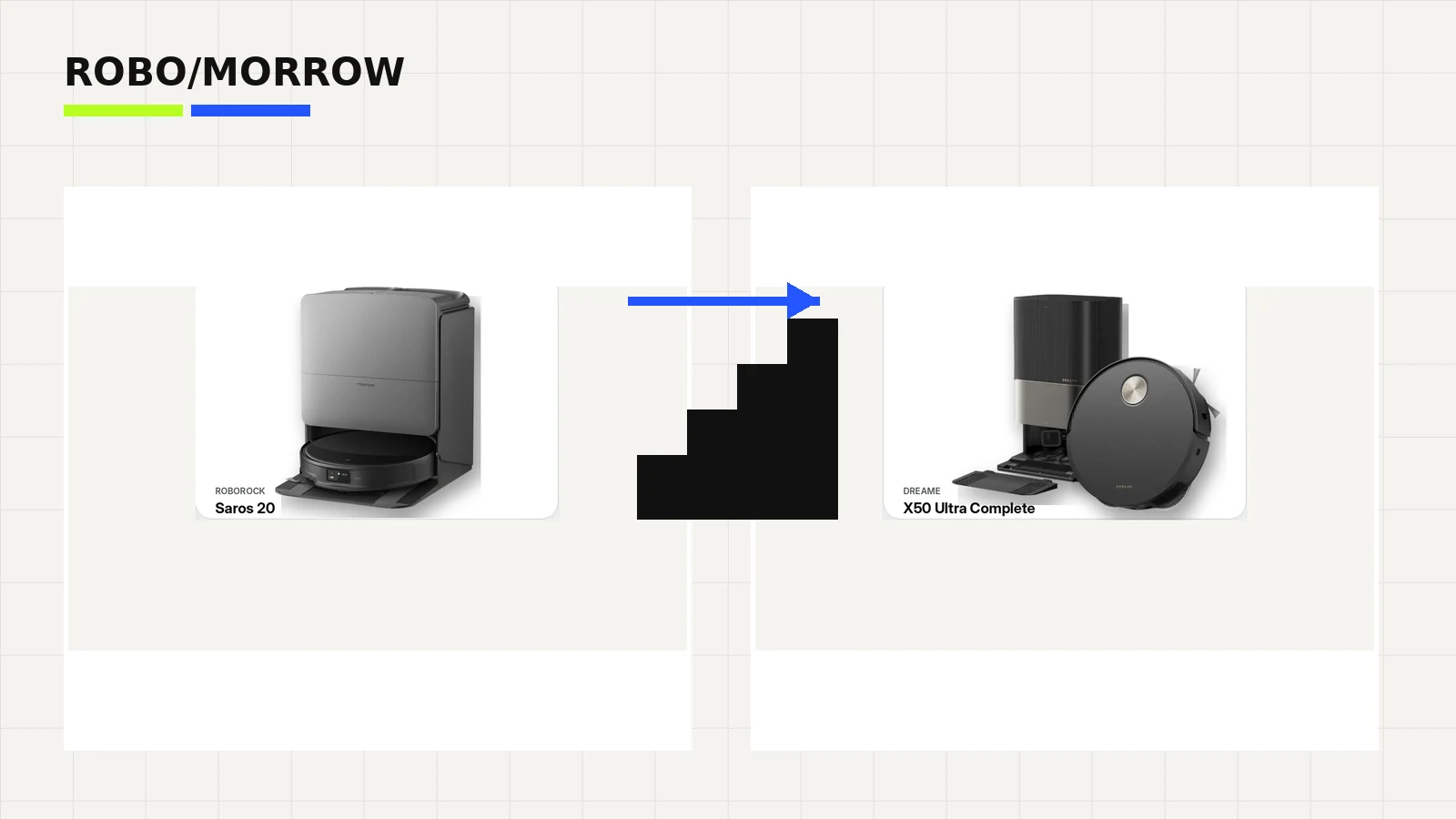
Author: Redakcja RoboMorrow. Advice and use-case selection are editorial analysis. Manufacturer claims are not RoboMorrow test results. The image illustrates a model or comparison; it does not document an editorial test.
Where to buy models from this article
We show only exact verified Amazon product pages. Before purchase, confirm the variant, seller, warranty and box contents.
Exact Amazon links. Where a verified RoboMorrow marketplace tracking ID is active, the link is an affiliate link and we may earn from qualifying purchases. Price and availability can change after you click.