Can robots be scary? 6 real projects straight out of a horror film
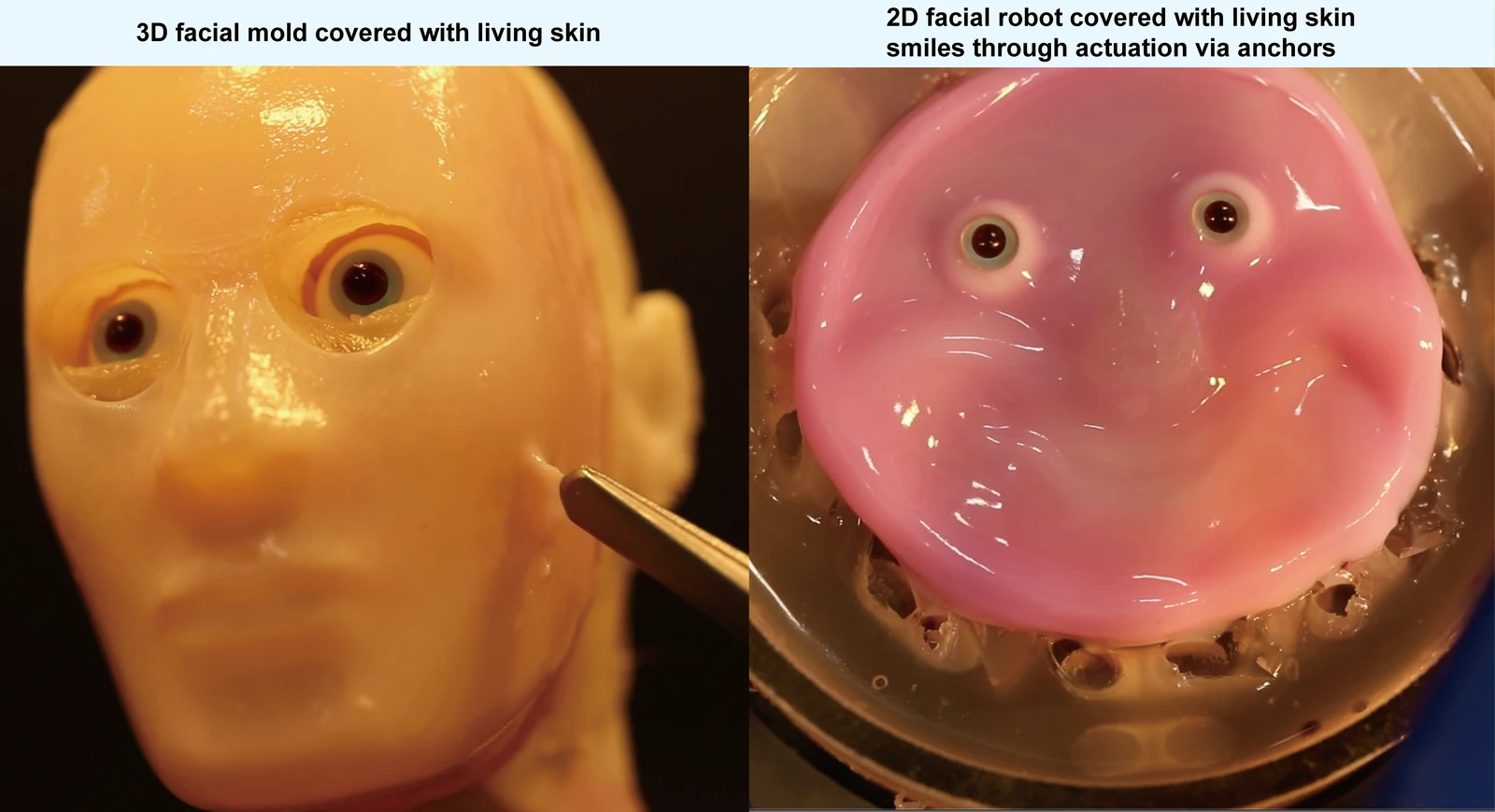
Pictured: two living-skin demonstrators — a 3D facial mold and a moving 2D face. ©2024 Takeuchi et al. · CC-BY-ND · University of Tokyo.
The lab has its own
horror-film cast.
Glowing eyes, exposed artificial muscles and a face covered in living skin. Robotics has its own Halloween cast — with some surprisingly sensible reasons for building it. Meet six real projects, from a mechanical wildlife deterrent to a laboratory gripper made from a spider.
At Halloween, it is easy to give a machine sinister intentions. An attentive gaze, a movement of the fingers or a slightly awkward smile can be enough. So let us look at the creations that make you think both “that is strange” and “how did they build it?”.
Every example below has an identifiable creator and a source. The research and demonstrations come from specific years, including 2018, 2020, 2022, 2024 and 2025. This is a Halloween selection assembled in October 2026; the dates beside the projects tell you when the work being discussed was published.
The collection includes robotic constructions, animatronics and individual components developed in laboratories. That distinction matters: a moving face is one part of a machine, while an impressive video says little on its own about whether a product is available. For each character in our cast, we look at the actual task and stage of development.
RESEARCH ANIMATRONICS · PAPER PUBLISHED: 23 OCTOBER 2020
1. Disney Research: the eyes looking back at you
A mechanical bust with an exposed structure and moving eyes has a peculiar talent: it is difficult to treat it as an ordinary object. In this Disney Research project, the system notices people nearby, selects someone to pay attention to and directs its gaze towards them. Small eye and head movements help make the behaviour feel natural.
Built for believable interaction with an animatronic character, this is a 2020 research demonstrator.
The everyday nature of the task makes it particularly interesting. Looking at someone sounds unremarkable. Yet watch for a few moments without skipping ahead: are you still seeing a mechanism, or someone waiting for you to answer? For our Halloween viewing, the chill sits in that brief moment of hesitation.
Source: Disney Research — Realistic and Interactive Robot Gaze.
WORKING PRODUCT · JAPAN · OFFER CHECKED: 21 OCTOBER 2026
2. Monster Wolf: being frightening is the job
If someone ordered a werewolf to guard a field, Monster Wolf would look like a plausible delivery. It has a wolf-shaped body, glowing eyes, a moving neck and a speaker. A sensor triggers light and sound intended to deter wild animals from crops and other protected locations.
This stationary device is offered commercially in Japan. Wolf Kamuy describes purchase and rental arrangements with individual quotations; availability and timing need confirmation. The company also states that effectiveness depends on the surroundings.
Our Halloween casting director should appreciate the honest job description: frightening visitors is part of the role. You can smile at its theatrical appearance and then ask a practical question: would that signal persuade an animal to turn back in this particular location? That is a more interesting test than a competition for the most convincing artificial fur.
Sources: Wolf Kamuy — how the device works and current purchase and rental information.
HUMANOID PROTOTYPE · VIDEO PUBLISHED: 19 FEBRUARY 2025
3. Protoclone: a human shape with a decidedly unfamiliar presence
A pale body, visible muscle-like structures and a head without human facial features. Clone Robotics' Protoclone moves its limbs while suspended from a test rig. In the description of its 19 February 2025 video, Clone lists more than a thousand artificial Myofiber muscles. That figure is the developer's claim.
The most useful detail in the footage is above the robot: the suspension. We are watching a prototype movement demonstration. This video alone does not establish independent walking or household skills. Reservations for the proposed Clone Alpha also do not demonstrate that the featured Protoclone has become a normally available product.
Try a small thought experiment: hide the video's title and describe only what you can see. How much does your imagination add when the machine has a human shape? It is excellent Halloween viewing because real engineering and our associations with science fiction meet in the same frame.
Sources: Clone's original video and the company's android programme.
RESEARCH DEMONSTRATOR · FESTO · 2018
4. BionicWheelBot: the spider with another way to get around
Festo's eight-legged BionicWheelBot walks on six legs. To roll, it folds three legs on each side into wheels. The remaining two, folded away while walking, extend to push it off the ground and keep it moving. It was inspired by the real spider Cebrennus rechenbergi, which can also roll.
This is a research project exploring ways of moving. Festo's brochure describes radio control using a tablet. The demonstration does not show an autonomous spider “hunting” anything.
The transition from walking to rolling deserves a second look. At first you might think: another mechanical spider, understood. Then the legs rearrange themselves and the whole structure takes on a different meaning. This is our entry for “I meant to take a quick look and watched it twice”. It also invites a useful question: how much more could we do with the parts we already have, before adding another mechanism?
Sources: Festo — BionicWheelBot and the March 2018 technical brochure.
LABORATORY FACE · UNIVERSITY OF TOKYO · JUNE 2024
5. A smile made from living skin: a small face with big questions
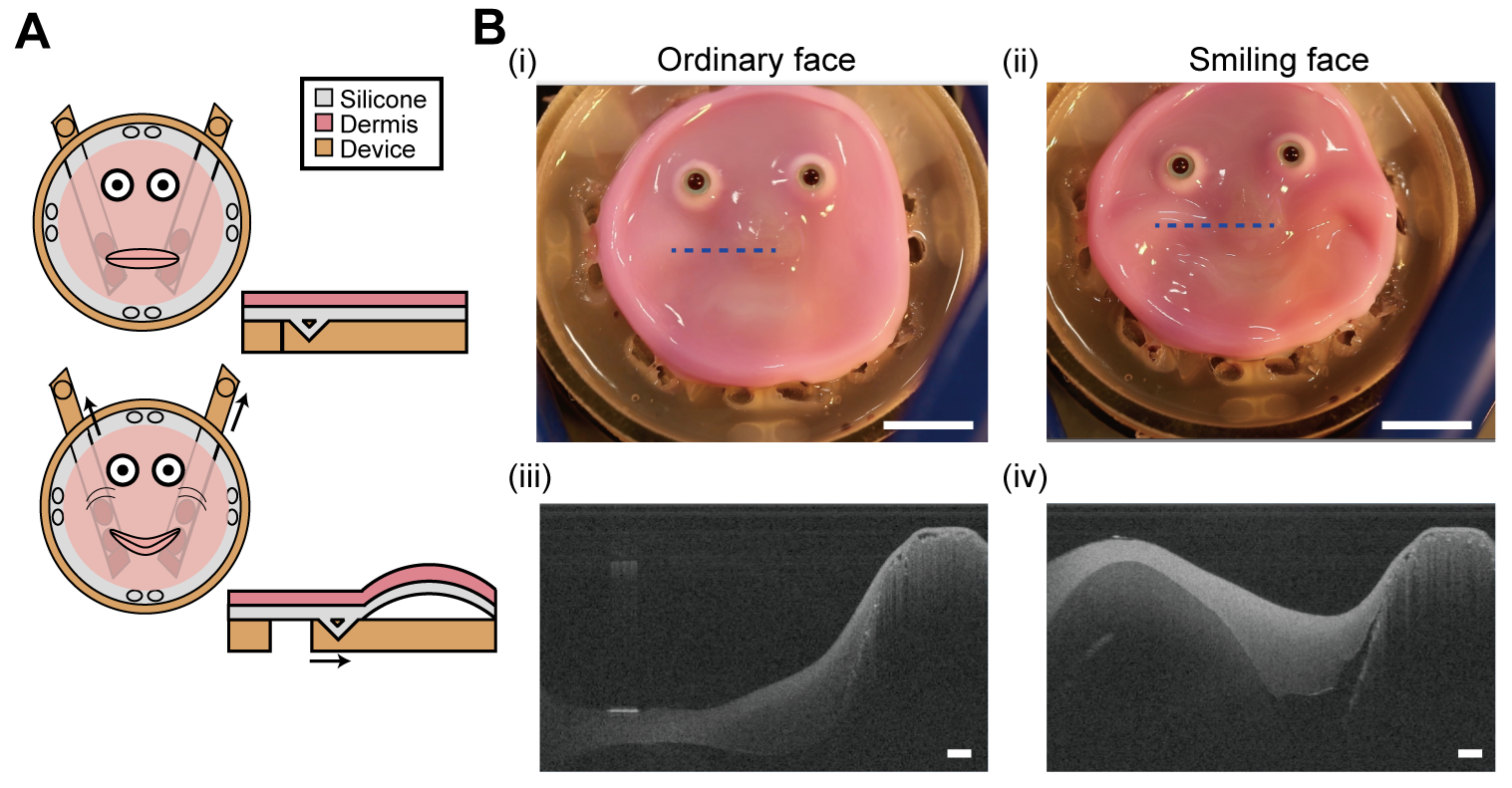
A pink face stretches into a smile. Shoji Takeuchi's team at the University of Tokyo attached cultured skin tissue to a mechanism using small anchoring perforations.
The paper appeared on 25 June 2024. This is a laboratory face, with possible applications in skin and cosmetics research. The presence of living tissue does not make the machine a feeling being.
Perhaps the best question to ask while watching is: what do we recognise as a face? The form can be remarkably simple, yet we start looking for emotion. You might find it endearing or a little unsettling; either response belongs in this collection. The useful distinction is between your own impression and what the laboratory has actually built.
Source: University of Tokyo — Robots face the future.
LABORATORY GRIPPER · RICE UNIVERSITY · JULY 2022
6. Necrobotics: a spider becomes a gripper
This example uses an actual dead spider. In 2022, researchers at Rice University used its body as a small gripper. By changing pressure, they opened and closed its legs to move objects. They called the field of research necrobotics.
The result is a laboratory gripping mechanism; the animal has not been brought back to life. The team explored using biological structures as ready-made technical components.
It is the most literally Halloween-like idea in this collection. You may find it fascinating, or prefer to skip the close-up. There is still a question worth asking beyond that first reaction: when does using an existing structure make more sense than manufacturing an equivalent? Follow that with questions about durability, consistency and how the material is obtained. The initial surprise is a good place to start a conversation, but it cannot answer those questions for us.
Source: Rice University — research on necrobotic grippers.

Which ones are products, and which are experiments?
Appearance tells us little about a machine's maturity. Here is how the six projects compare.
| Project | Stage of the featured project | Actual purpose |
|---|---|---|
| Disney gaze | Research bust | Believable gaze for a character |
| Monster Wolf | Commercial device, supplied by arrangement | Wildlife deterrence |
| Protoclone | Suspended prototype in the 2025 video | Developing a humanoid structure |
| BionicWheelBot | Research demonstrator | Exploring locomotion |
| Living-skin face | Laboratory experiment | Joining tissue to mechanics |
| Necrobotic spider | Laboratory gripper | Using biological structures |
Two real incidents with ready-made Halloween headlines
Sometimes the unsettling part is a machine's appearance; sometimes it is the situation in which someone encounters it. These two incidents have documented, down-to-earth explanations.
A stranger's voice from the vacuum — 2024
On 11 October 2024, ABC reported takeovers of Ecovacs Deebot X2 vacuums in the US that had occurred in May that year. Interviewees described strangers controlling the machines and using their speakers to abuse household members. Ecovacs' response cited attempts to access accounts using other people's credentials and security fixes. This is a story about device access; attributing malicious intentions to the vacuum obscures it. The practical lesson concerns account security and updates. We are describing events from 2024, without assessing the current security of every device in the brand's range.
Sources: ABC's reporting and Ecovacs' statement of 11 October 2024.
Own a robot with a camera? Read our guide to privacy, maps and cloud data.
The security robot that ended its patrol in a fountain — 2017
On 17 July 2017, a Knightscope K5 entered a water feature at a Washington, DC, development. The manufacturer's subsequent report attributed the incident to an undetected skid on the surface that compromised edge protection, and said the software had been changed. The “robot fed up with work” storyline belongs to the memes: the available explanation concerns navigation. There is something reassuringly ordinary about that. Even the star of a futuristic security patrol needs to handle the ground beneath its wheels.
Source: Knightscope's report reproduced by Security.World, 1 August 2017.
Questions after the screening
Why can an almost human robot feel unsettling?
The uncanny valley offers a way of discussing that reaction. In his 1970 essay, Masahiro Mori proposed that, as a machine approaches a human appearance, affinity can suddenly give way to unease. It is a useful hypothesis for talking about impressions, rather than a scale requiring everyone to react identically. The same smile may strike you as funny, disturbing or simply interesting. Read the authorised English translation of Mori's essay.
Are animatronics and robots always the same thing?
The terms can overlap, but they emphasise different things. Animatronics primarily brings a physical character to life through movement. With a robot, we also ask about its task, control and response to its surroundings. A more useful question than debating the label is: what does this device actually do, and which decisions does a person make? That is why we identify cases involving a face, gripper or mechanism demonstration.
Can any of these projects be bought?
Monster Wolf has a commercial offer. It is specialist equipment supplied by arrangement. The other featured examples are presented here as particular research projects or demonstrations. A reservation button, an impressive trailer or a future model name does not establish delivery. If you are shopping for a gift, check the seller, timing, product version and what the purchase actually includes.
How can I check whether an extraordinary robot video shows a real project?
Start with the creators' original channel, the date and the demonstration's description. Then look for a paper, documentation and a longer view of the scene. Notice any suspension, operator and test setup. Those details help explain the scope of the demonstration. A good question is: “What does this footage establish?” The answer can be much narrower than the story suggested by a sensational caption.
Which robot gets your leading role?
Our Halloween verdict? Disney's gaze wins for subtlety, Monster Wolf for commitment to the role, and Protoclone for its entrance. The spiders and laboratory face show just how unusual the route to a practical idea can be.
Pick your favourite and tell us what made the biggest impression: the appearance, the movement or the idea itself. Then explore another side of robotics — real deployments and machines you can already put to use. A good story can begin with a small shiver and end with simple curiosity.
ROBOTICS AFTER HALLOWEEN
Now meet their other side.
A robot you want to meet: Microduck →
Sources and materials
Editorial analysis based on the creators’ publications and the attributed reporting. Sources checked on 21 October 2026. Historical demonstrations retain their dates; this is not a hands-on product test.
- Realistic and Interactive Robot Gaze
- Realistic and Interactive Robot Gaze
- Monster Wolf — official English description
- Monster Wolf — current purchase and rental offer
- Monster Wolf — field videos
- Protoclone: Bipedal Musculoskeletal Android V1
- Android — Clone Alpha programme
- BionicWheelBot
- BionicWheelBot — Walk and roll like a flic-flac spider
- Festo — BionicWheelBot (English/Deutsch)
- Robots face the future
- Perforation-type anchors inspired by skin ligament for the robotic face covered with living skin
- Rice engineers get a grip with ‘necrobotic’ spiders
- Necrobotics: Biotic Materials as Ready-to-Use Actuators
- Hackers take control of robot vacuums in multiple cities, yell racial slurs
- Ecovacs statement to ABC News
- Knightscope Delivers Incident Report On DC ‘Drowning’
- The Uncanny Valley: The Original Essay by Masahiro Mori