Roborock RockNeo Q105 vs Q110: 500 or 1,000 m²?
BUYING IN YOUR MARKET
Availability in your country
Sales, delivery and support can differ by country and exact model. Choose your market to see the evidence we have checked.
Roborock RockMow Z150: price, AWD and 5,000 m² specs
Germany
Local store offer — check checkout availability
- Seller / sales channel
- Roborock Deutschland specialist dealer
- Price
- See the local offer for the current price and exact bundle
- Delivery
- Confirm stock and the delivery date for your address with the seller
- Warranty and service
- Confirm written warranty terms, parts and service coverage for your address
Roborock Deutschland specialist dealer lists this exact model for this market. A listing is evidence of a buying route, not a delivery commitment.
Evidence checked: · Not a live stock feed
Roborock Deutschland specialist dealer: check local offer ↗No verified local offer in this dataset
No country-specific offer for this exact model has been established in our current sources. This is a gap in our research, not a statement that the robot cannot be bought here. Use the manufacturer’s sales contact to request a supplier serving your address; confirm configuration, imports, warranty and service.
- Price
- No verified local price in this dataset
- Delivery
- No confirmed date for your address
- Warranty and service
- Local coverage not verified
Roborock RockNeo Q105: price, specs and 500 m² lawn class
Germany
Local store offer — check checkout availability
- Seller / sales channel
- Roborock Garden Germany
- Price
- See the local offer for the current price and exact bundle
- Delivery
- Confirm stock and the delivery date for your address with the seller
- Warranty and service
- Confirm written warranty terms, parts and service coverage for your address
Roborock Garden Germany lists this exact model for this market. A listing is evidence of a buying route, not a delivery commitment.
Evidence checked: · Not a live stock feed
Roborock Garden Germany: check local offer ↗No verified local offer in this dataset
No country-specific offer for this exact model has been established in our current sources. This is a gap in our research, not a statement that the robot cannot be bought here. Use the manufacturer’s sales contact to request a supplier serving your address; confirm configuration, imports, warranty and service.
- Price
- No verified local price in this dataset
- Delivery
- No confirmed date for your address
- Warranty and service
- Local coverage not verified
Roborock RockNeo Q110: price, specs and 1,000 m²
Germany
Local store offer — check checkout availability
- Seller / sales channel
- Roborock Garden Germany
- Price
- See the local offer for the current price and exact bundle
- Delivery
- Confirm stock and the delivery date for your address with the seller
- Warranty and service
- Confirm written warranty terms, parts and service coverage for your address
Roborock Garden Germany lists this exact model for this market. A listing is evidence of a buying route, not a delivery commitment.
Evidence checked: · Not a live stock feed
Roborock Garden Germany: check local offer ↗No verified local offer in this dataset
No country-specific offer for this exact model has been established in our current sources. This is a gap in our research, not a statement that the robot cannot be bought here. Use the manufacturer’s sales contact to request a supplier serving your address; confirm configuration, imports, warranty and service.
- Price
- No verified local price in this dataset
- Delivery
- No confirmed date for your address
- Warranty and service
- Local coverage not verified
“Listed” confirms a product page or sales route, not stock, delivery to every address or local service. “Pre-order” is not immediate availability. Unverified means we lack evidence; it does not mean unavailable. Prices belong to the named market and currency. Confirm the exact version, tax, shipping and support before ordering.
Short answer: choose RockNeo Q105 for lawns around 500 m² or below, and Q110 when you genuinely need the 1,000 m² class. Q110 has a larger 4.6 Ah battery, longer claimed mowing time and faster charging, but on 2 September 2026 it was about €350 more in our rounded Approximate price: roughly €1,100 versus €750. Cutting width, drivetrain, maximum claimed slope and the broader Q1 platform are otherwise much closer.
This is a specification-led buying comparison, not a RoboMorrow field test. If you are still choosing the right size class, start with our robot mower up to 500 m² guide and best robot mowers of 2026 ranking.
Q105 vs Q110 at a glance
| Feature | RockNeo Q105 | RockNeo Q110 |
|---|---|---|
| Recommended lawn size | up to 500 m² | up to 1,000 m² |
| Battery | 4.0 Ah | 4.6 Ah |
| Claimed mowing time | about 100 min | about 130 min |
| Claimed charging time | about 95 min | about 75 min |
| Cutting width | 22 cm | 22 cm |
| Cutting height | 20–60 mm, manual adjustment | 20–60 mm, manual adjustment |
| Drive | 2WD / rear-wheel drive | 2WD / rear-wheel drive |
| Maximum claimed slope | 45% (24°) | 45% (24°) |
| Obstacle capability | up to 4 cm — manufacturer claim | up to 4 cm — manufacturer claim |
| Rounded EU price context, 02 Sep 2026 | about €750 | about €1,100 |
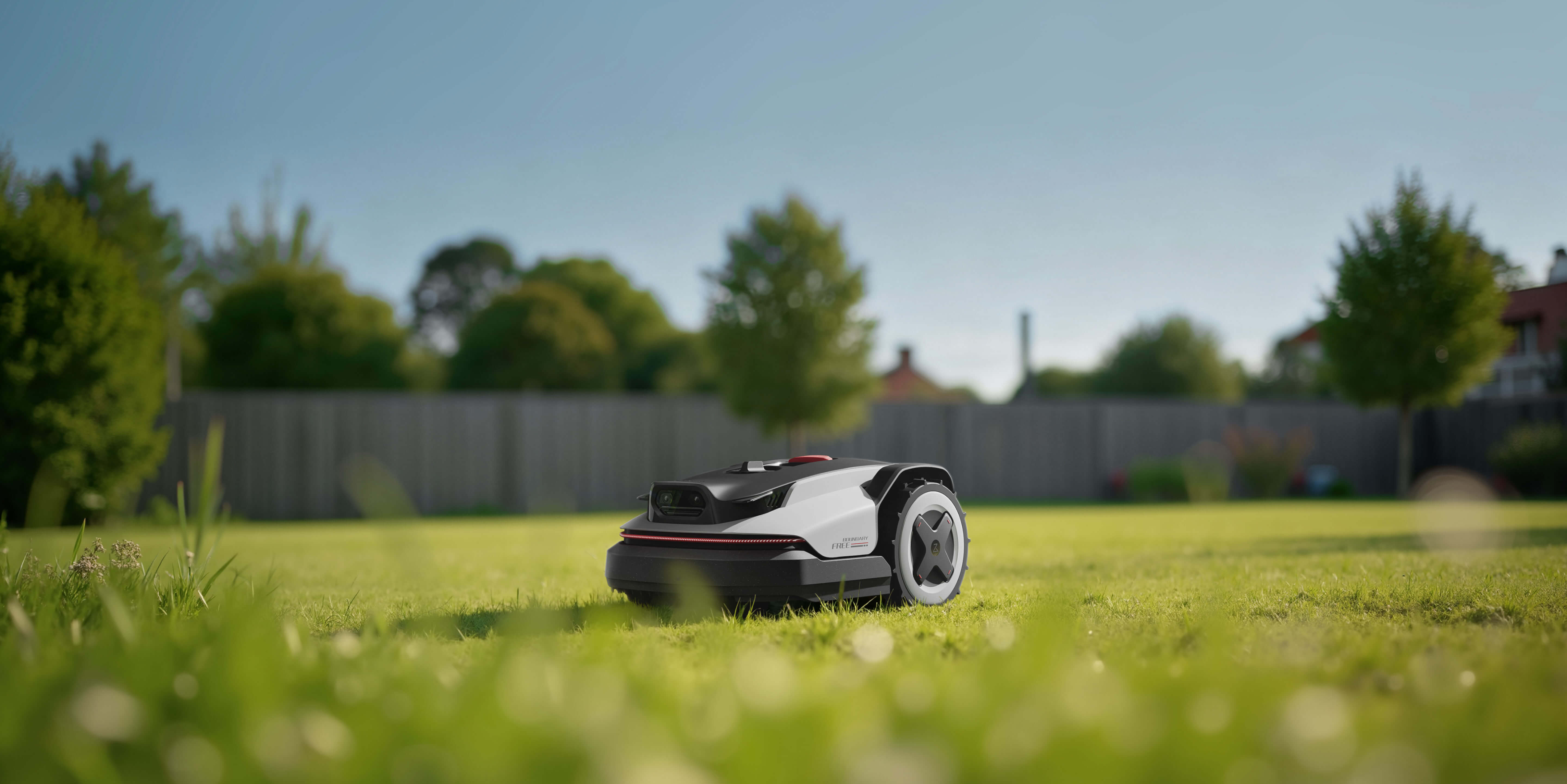
The main difference is capacity, not a completely different technology stack
Q105 and Q110 are mechanically closer than the price gap might suggest. Both use a 22 cm cutting disc with three blades, a 20–60 mm manual height range, rear-wheel drive and a 45% manufacturer slope rating. Roborock positions both as wire-free mowers with automatic mapping and environmental perception. For a small, straightforward lawn, paying more for Q110 does not buy an entirely different platform.
What it buys is more energy and area headroom. Q110 moves from a 4.0 Ah to a 4.6 Ah battery, with Roborock listing roughly 130 minutes of mowing versus 100 minutes. This matters when a lawn sits close to 500 m² but is inefficient to traverse because of narrow passages, multiple zones, trees, furniture or repeated turns. Nominal lawn area is only one part of workload.
Q105: the logical choice for a real 300–500 m² lawn
If your grass area is 250, 350 or 450 m² and you do not expect it to expand, Q105 is much easier to justify economically. At a rounded level of about €750, the gap to Q110 was roughly 47% of the Q105 purchase price. That is a large premium for extra capacity while keeping the same 22 cm cutting width and broadly the same platform concept.
A bigger battery also does not solve poor garden layout, extremely narrow corridors or a bad map. In a compact lawn, perception, sensible zone definition and route quality often matter more than excess battery. If 500 m² is a hard ceiling, the price difference can be retained for accessories, service or a future upgrade rather than spent on unused capacity.
Q110: pay for margin on a larger or more complex lawn
Q110 starts to make sense once the lawn moves beyond roughly 500–600 m² or when the nominal area understates complexity. Longer operation per cycle can reduce dock returns, and the larger battery provides more margin for multi-zone routing.
There is also an interesting manufacturer-spec difference: Q110 has the larger battery but a shorter listed charging time, around 75 minutes versus 95 minutes for Q105. That can improve throughput over a full mowing schedule even though cutting width is unchanged. It does not mean Q110 will mow exactly twice the area in half the time; route efficiency and terrain still matter.
Navigation: do not invent a difference that Roborock does not clearly establish
Roborock's Q1 materials use the Sentisphere branding and emphasise automatic mapping and wire-free operation. Across current manufacturer pages, the positioning stack can be described at different levels of detail. We therefore do not manufacture a Q105-versus-Q110 advantage from one technology acronym. The clearly confirmed differences are lawn class, battery, runtime, charging and price.
Both models use environmental perception and manufacturer-listed automatic boundary/mapping functions. If your lawn has difficult reception, high walls or dense trees, real behaviour on the property matters more than a single navigation label on a specification page.
What about slope and obstacles?
Roborock lists 45% (24°) maximum slope and obstacles up to 4 cm for both Q105 and Q110. These are boundary manufacturer figures. They should not be interpreted as a guarantee of continuous operation on a wet 45% slope or the ability to climb every 4 cm kerb. Traction, approach angle, surface and obstacle geometry all matter.
If your property is substantially steeper or rougher, both Q models may be the wrong class. In that case move up to an AWD platform such as RockMow Z150 or the Z120 LiDAR vs Z150 comparison included in this sprint.
Price and warranty strengthen the Q105 value case
On 2 September 2026, Roborock's official Polish store showed Polish offer levels that we localise to about €750 for Q105 and about €1,100 for Q110. These are dated snapshots and can change. Roborock's official garden warranty policy lists two years for the main Q105/Q110 unit and two years for the battery.
For a 400 m² lawn, Q105 therefore has a strong value argument. For an 800 m² lawn, Q110 is not merely the expensive option; it is the appropriate capacity class. The worst trade-off would be buying Q105 only because it is cheaper and then running permanently at the edge of its intended workload.
Verdict: which one should you buy?
- Up to 400–500 m²: Q105. Q110 headroom usually does not justify the premium.
- 500–700 m², simple layout: Q110 gives safer margin; measure the actual grass area first.
- 700–1,000 m²: Q110 is the natural choice of the pair.
- Steep or rough terrain: consider AWD rather than paying more for Q110.
- Lowest-cost entry into Roborock wire-free mowing: Q105 at roughly €750 is materially more attractive.
Sources and methodology
Verified 2 September 2026. Specifications and prices come from Roborock's official materials. Slope, runtime and obstacle figures are manufacturer claims, not RoboMorrow field-test results.
- Roborock RockNeo Q1 / Q105 / Q110 — official product page
- Roborock Garden — official warranty policy
- RoboMorrow: RockNeo Q105 profile
- RoboMorrow: RockNeo Q110 profile
How should you measure the lawn before choosing the variant?
A common mistake is using total property size rather than actual grass area. Subtract the house, patio, driveway, beds and paths. At the same time, avoid sizing a mower exactly to the limit: a complex garden with islands and narrow connectors can consume more route time than a simple rectangle with the same number of square metres.
A practical rule is therefore more useful than the 500 m² headline alone. With roughly 350–450 m² of real grass, Q105 has comfortable headroom. If measurement lands around 550–650 m², or the mower will spend significant time moving between zones, Q110 becomes the safer choice. At 800–900 m², saving money by dropping to Q105 would be difficult to justify.
Verified offers
We link only to a manually verified exact product-detail page. Price, seller, variant and availability can change after you click. We do not use Amazon search links or substitute models.
- RockNeo Q105 — official Roborock store — official manufacturer channel, non-affiliate link.
- RockNeo Q110 — official Roborock store — official manufacturer channel, non-affiliate link.
Amazon: we did not verify an exact Amazon product-detail page for the European Q105/Q110 variants. An independent Q105 review also states that the model is not sold on Amazon. We therefore do not insert a search link or substitute the US Q110H model.