Which Segway Navimow i2 in 2026? AWD, LiDAR or LiDAR Pro
BUYING IN YOUR MARKET
Availability in your country
Sales, delivery and support can differ by country and exact model. Choose your market to see the evidence we have checked.
Segway Navimow i208 LiDAR
Germany
Local store offer — check checkout availability
- Seller / sales channel
- Navimow Germany
- Price
- See the local offer for the current price and exact bundle
- Delivery
- Confirm stock and the delivery date for your address with the seller
- Warranty and service
- Confirm written warranty terms, parts and service coverage for your address
Navimow Germany lists this exact model for this market. A listing is evidence of a buying route, not a delivery commitment.
Evidence checked: · Not a live stock feed
Navimow Germany: check local offer ↗No verified local offer in this dataset
No country-specific offer for this exact model has been established in our current sources. This is a gap in our research, not a statement that the robot cannot be bought here. Use the manufacturer’s sales contact to request a supplier serving your address; confirm configuration, imports, warranty and service.
- Price
- No verified local price in this dataset
- Delivery
- No confirmed date for your address
- Warranty and service
- Local coverage not verified
Segway Navimow i210 LiDAR Pro
Germany
Local store offer — check checkout availability
- Seller / sales channel
- Navimow Germany
- Price
- See the local offer for the current price and exact bundle
- Delivery
- Confirm stock and the delivery date for your address with the seller
- Warranty and service
- Confirm written warranty terms, parts and service coverage for your address
Navimow Germany lists this exact model for this market. A listing is evidence of a buying route, not a delivery commitment.
Evidence checked: · Not a live stock feed
Navimow Germany: check local offer ↗No verified local offer in this dataset
No country-specific offer for this exact model has been established in our current sources. This is a gap in our research, not a statement that the robot cannot be bought here. Use the manufacturer’s sales contact to request a supplier serving your address; confirm configuration, imports, warranty and service.
- Price
- No verified local price in this dataset
- Delivery
- No confirmed date for your address
- Warranty and service
- Local coverage not verified
Segway Navimow i215 LiDAR
Germany
Local store offer — check checkout availability
- Seller / sales channel
- Navimow Germany
- Price
- See the local offer for the current price and exact bundle
- Delivery
- Confirm stock and the delivery date for your address with the seller
- Warranty and service
- Confirm written warranty terms, parts and service coverage for your address
Navimow Germany lists this exact model for this market. A listing is evidence of a buying route, not a delivery commitment.
Evidence checked: · Not a live stock feed
Navimow Germany: check local offer ↗No verified local offer in this dataset
No country-specific offer for this exact model has been established in our current sources. This is a gap in our research, not a statement that the robot cannot be bought here. Use the manufacturer’s sales contact to request a supplier serving your address; confirm configuration, imports, warranty and service.
- Price
- No verified local price in this dataset
- Delivery
- No confirmed date for your address
- Warranty and service
- Local coverage not verified
“Listed” confirms a product page or sales route, not stock, delivery to every address or local service. “Pre-order” is not immediate availability. Unverified means we lack evidence; it does not mean unavailable. Prices belong to the named market and currency. Confirm the exact version, tax, shipping and support before ordering.
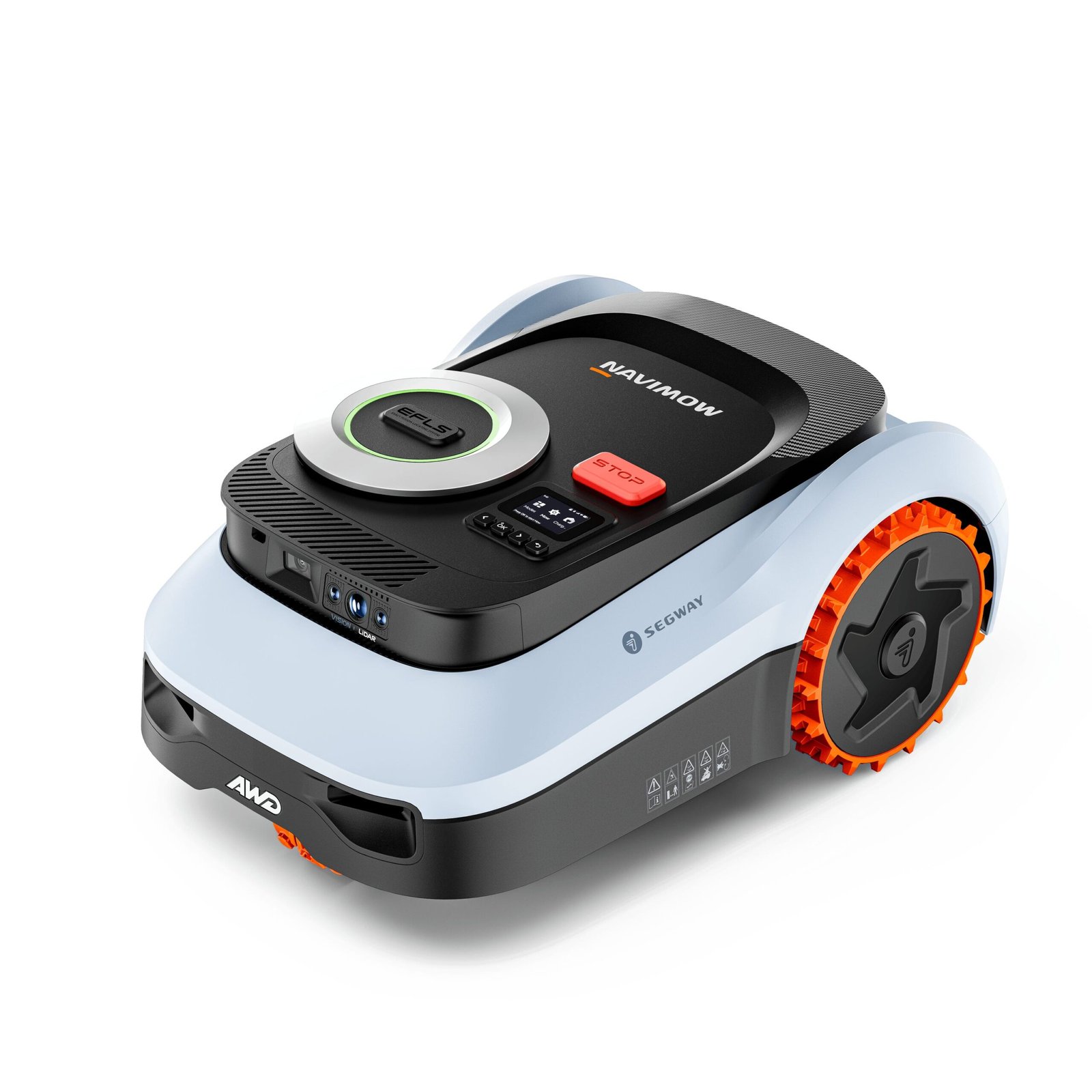
Segway Navimow i208 LiDAR, i210 LiDAR Pro and i215 LiDAR look like three simple steps in one range, but the model numbers can be misleading. The most expensive i210 Pro does not cover the largest stated lawn. In Segway Navimow’s European lineup, i208 LiDAR is rated for up to 800 m², i210 LiDAR Pro for 1,000 m² and i215 LiDAR for up to 1,500 m².
The buying decision therefore is not “higher number equals better”. i215 is the capacity/value choice for a larger but moderately difficult lawn, while i210 LiDAR Pro is mainly about tougher terrain and positioning conditions. i208 is the lower-cost entry into the Smart LiDAR family. This guide compares the use cases without pretending RoboMorrow has run all three machines in one controlled garden test.
Choose for your garden, not the model number
Separate three checks: actual grass area, difficult slopes and passages, and positioning under your trees. Ask the dealer to confirm the exact model and installation requirements for your country. A coverage label is not the area mown on one charge.
Use the existing i2 selection guide, i210 versus i208 comparison and i210 versus i215 comparison to check the same assumptions.
Quick answer: i208 vs i210 Pro vs i215
| Model | Recommended area | EU price checked 24 Aug 2026 | Terrain positioning | Best fit |
|---|---|---|---|---|
| Navimow i208 LiDAR | up to 800 m² | €1,199 | Smart LiDAR; lighter landscaping | small/medium lawn and budget control |
| Navimow i210 LiDAR Pro | up to 1,000 m² | €1,599 regular; official promo page showed €1,299 | Pro; up to 55% / 29° | steeper, narrow, shaded, complex zones |
| Navimow i215 LiDAR | up to 1,500 m² | €1,399 | Smart LiDAR; up to 45% / 24° | larger lawn without Pro-level terrain needs |
Prices are from Segway Navimow’s European store and promotions can change quickly. The i210 LiDAR Pro in particular appeared at a regular €1,599 while an official promotional collection showed €1,299. Always verify the checkout price for your country.
The key difference: area is not the whole product
i215 LiDAR has a higher stated lawn limit than i210 LiDAR Pro and is cheaper at regular list pricing. That only looks strange if square metres are treated as the only capability. The Pro premium is aimed at mobility and positioning in a more demanding garden rather than simply maximising nominal daily coverage.
Segway positions the standard i2 LiDAR line for more lightly landscaped gardens and publishes a maximum slope figure of 45% (24°). The i2 LiDAR Pro family is marketed for up to 55% (29°) and more complex layouts, including multiple zones, narrow passages and shaded corners. That distinction should drive the i210 Pro decision.
i208 LiDAR — the rational entry model
i208 LiDAR is rated for up to 800 m² and is listed at €1,199. If your actual grass area is roughly 400–750 m², slopes are moderate and you want LiDAR-based boundary-free navigation without paying for the Pro tier, it is the logical place to start.
Do not buy i215 “just in case” solely because the number is larger. A mower with sufficient capacity can be the better fit if it already has comfortable headroom over the actual grass area. Measure mowable lawn, not the total plot including the house, driveway, terraces and beds.
i215 LiDAR — strongest area-per-euro proposition
i215 LiDAR is especially interesting because Segway lists up to 1,500 m² at €1,399. That is only €200 above i208 while materially increasing the published area ceiling. For a larger lawn that does not need the Pro family’s terrain capability, i215 can be the most economical of these three.
But “m² per euro” is not enough. A larger area rating does not solve a very steep slope, a narrow corridor between zones or difficult positioning around buildings and tree cover. In that garden, the i210 Pro specification can be more valuable despite the lower area number.
i210 LiDAR Pro — paying for the difficult garden
i210 LiDAR Pro is rated for 1,000 m², yet Segway gives the Pro family a higher slope limit of up to 55% (29°) and positions it for more demanding terrain. Navimow’s materials describe the Pro tier around stronger positioning and mobility for places where a simpler layout cannot be assumed.
It is the model to investigate when real slopes exceed the standard line’s comfort zone, several mowing zones are connected by narrow routes, buildings create deep shade, or the mower must work along constrained passages. In those cases, paying for fewer manual rescues can matter more than buying a bigger nominal area rating.
What about RTK, LiDAR and a base antenna?
The new Navimow family is notable because it reduces dependence on the traditional private RTK antenna setup. Segway’s comparison material discusses Network RTK and antenna-free positioning on relevant versions alongside LiDAR and vision. Network services and coverage are still location-dependent, however.
Before purchase, confirm Network RTK availability for the exact address in the Navimow ecosystem or with the dealer. LiDAR provides local environmental perception, but it cannot make every garden trivial. Dense obstacles, steep edges, wet grass and very tight connectors still demand sensible map setup and safe physical boundaries.
How much area headroom should you leave?
Buying exactly on the published limit is rarely ideal. For 790 m² of real grass, i208 may be within specification, but i215 provides more headroom for fast spring growth, repeated passes and future lawn expansion. Conversely, on 550 m² of relatively simple lawn the extra capacity may add no practical value.
In topographically difficult gardens the rule changes: terrain capability comes first, area second. If part of the lawn approaches a 50% slope, the larger 1,500 m² i215 rating does not make it the more appropriate product than a Pro model designed for steeper terrain.
Which one should you buy?
- i208 LiDAR: up to about 800 m² when the garden is moderately straightforward and budget matters.
- i215 LiDAR: up to about 1,500 m² when you need more area but do not have extreme slopes or highly complex geometry.
- i210 LiDAR Pro: up to about 1,000 m² when slopes, narrow connectors, shade and complex zones are the priority — even though the nominal area is smaller.
What the specification cannot settle
RoboMorrow has not yet run all three models in one controlled garden. We therefore do not name a winner for cut quality, wet-grass behaviour, noise, small-object avoidance or real runtime. Area, slope and price figures are manufacturer data, not an independent lab benchmark.
The best pre-purchase test is a map of your own property: calculate actual grass area, mark the steepest sections, narrowest connectors, tree canopy, tall walls and places where GNSS reception is weak. Once those constraints are visible, the i208-versus-i215-versus-i210 Pro choice is much clearer.
Related RoboMorrow pages
- Navimow i208 LiDAR database card
- Navimow i210 LiDAR Pro database card
- Navimow i215 LiDAR database card
- Best robot mowers 2026
Manufacturer sources
Why we are not creating a separate i208 vs i210 Pro vs i215 URL
Those three models form a very useful buying set, but they do not need another standalone page. RoboMorrow already has a broad i2 family guide and a direct i210 LiDAR Pro vs i208 LiDAR comparison. Splitting almost the same intent across a third URL would create a real risk of our own pages competing for the same searches. This guide therefore absorbs the i208 vs i210 Pro vs i215 cluster and remains the main family-level buying URL.
Where do i205 AWD, i208 AWD and i220 LiDAR Pro fit?
i205 AWD remains the sensible entry point for smaller lawns around 500 m² when uneven ground and traction are the main issues rather than tree canopy. i208 AWD extends the same philosophy to around 800 m² with more battery headroom, while still using Network RTK + Vision rather than LiDAR. In practice, i208 AWD is the alternative to i208 LiDAR when sky view is relatively good but slopes, roots and slippery transitions matter more.
i220 LiDAR Pro becomes logical when actual grass area approaches 1,500–2,000 m² or when a large multi-zone property needs more scheduling headroom. Buying it merely because it is the highest model in the range is poor value. On a 700–900 m² lawn, i210 Pro can provide the same core sensor architecture and AWD without paying for unused capacity.
The key three-way decision: i208 LiDAR vs i210 LiDAR Pro vs i215 LiDAR
These are the most interesting variants for buyers dealing with trees or trying to avoid a local RTK antenna. i208 LiDAR is the lowest-cost route into LiDAR + Vision and an 800 m² class. i215 LiDAR raises the area label to 1,500 m² for a relatively modest premium, but it does not add AWD or Network RTK. i210 Pro supports a smaller nominal area than i215, yet adds AWD, Xero-Turn and LiDAR + Network RTK + Vision sensor fusion.
That is why a larger model number does not automatically mean “better”. On a flat 1,200 m² lawn under trees, i215 may be the rational choice. On an 800–1,000 m² property with canopy, a narrow connector and a steep section, i210 Pro has a much stronger case. On a 600–750 m² shaded lawn without traction problems, i208 LiDAR preserves the core LiDAR benefit at a lower cost.
How to read Navimow pricing in 2026
Segway’s European store frequently shows both regular prices and short promotions, sometimes separated by several hundred euros. Record two figures when buying: the live checkout price and the regular reference price. RoboMorrow’s 24 August 2026 verification showed roughly €1,199 for i208 LiDAR, €1,399 for i215 LiDAR and €1,599 regular price for i210 LiDAR Pro, while promotions can push Pro to around €1,299. In that situation, Pro can temporarily cost less than i215 and the value equation changes completely.
Updated GSC-led verdict
For a simple shortlist: choose i208 LiDAR for a medium shaded garden without major traction problems, i215 LiDAR for a larger tree-covered lawn with moderate terrain, and i210 LiDAR Pro for genuinely difficult ground where positioning and grip are both constraints. That decision framework is more useful than sorting models by number alone.
Where to buy models from this article
We show only exact verified Amazon product pages. Before purchase, confirm the variant, seller, warranty and box contents.
Exact Amazon links. Where a verified RoboMorrow marketplace tracking ID is active, the link is an affiliate link and we may earn from qualifying purchases. Price and availability can change after you click.