Robot vacuum stations: what they really do and what you are paying for
BUYING IN YOUR MARKET
Availability in your country
Sales, delivery and support can differ by country and exact model. Choose your market to see the evidence we have checked.
ECOVACS DEEBOT X11 OmniCyclone
United States
Local store offer — check checkout availability
- Seller / sales channel
- ECOVACS US
- Price
- See the local offer for the current price and exact bundle
- Delivery
- Confirm stock and the delivery date for your address with the seller
- Warranty and service
- Confirm written warranty terms, parts and service coverage for your address
ECOVACS US lists this exact model for this market. A listing is evidence of a buying route, not a delivery commitment.
Evidence checked: · Not a live stock feed
ECOVACS US: check local offer ↗No verified local offer in this dataset
No country-specific offer for this exact model has been established in our current sources. This is a gap in our research, not a statement that the robot cannot be bought here. Use the manufacturer’s sales contact to request a supplier serving your address; confirm configuration, imports, warranty and service.
- Price
- No verified local price in this dataset
- Delivery
- No confirmed date for your address
- Warranty and service
- Local coverage not verified
“Listed” confirms a product page or sales route, not stock, delivery to every address or local service. “Pre-order” is not immediate availability. Unverified means we lack evidence; it does not mean unavailable. Prices belong to the named market and currency. Confirm the exact version, tax, shipping and support before ordering.
A robot-vacuum station can be a simple charging base or something close to a small service centre: it can empty dust, wash and dry the mop, refill water, dose detergent, clean its own tray and, in some systems, collect debris without a disposable bag. The gap between these designs is much larger than the generic phrase “self-cleaning station” suggests.
The useful question is therefore not “does the robot have a dock?” but which weekly chores does the dock actually remove, and which ones does it merely move somewhere else? Even a highly automated station still has filters, air passages, tanks, a wash tray and mop components that need periodic attention. Paying for the right dock means automating the tasks you dislike most rather than collecting the most icons on a product page.
What can a modern dock automate?
| Function | What it saves | What remains |
|---|---|---|
| Automatic dust emptying | No need to empty the robot after every run. | Bag replacement or cleaning the bagless bin/cyclone and filters. |
| Mop washing | The robot can resume with a cleaner mop during and after a run. | Periodic tray, roller/pad and dirty-water cleaning. |
| Drying | Reduces the time wet material sits inside the dock. | Odour and hygiene checks. |
| Water refill | Reduces manual refilling of the robot. | Filling the large clean-water tank or installing plumbing. |
| Detergent dosing | Automates a small repeatable dose. | Detergent cost and compatibility. |
| Tray self-cleaning | Reduces residue in the wash area. | Periodic inspection and descaling. |
Level 1: a basic charging base
The simplest dock has one job: guide the robot onto its charging contacts. It is small, inexpensive and easy to place. It remains a perfectly sensible choice for a small apartment, especially if the robot only vacuums or uses a basic mop that you already wash by hand after every session.
Long-term simplicity is another advantage. There are no pumps, large tanks, heaters or complex air channels. Fewer subsystems mean fewer parts to clean and potentially service. The trade-off is that almost all maintenance stays with the owner.
Level 2: automatic dust emptying
An auto-empty dock pulls debris from the robot’s small bin into a larger bag or container. This is one of the most noticeable upgrades, particularly in homes with pets. Hair can fill a compact robot bin quickly; without a station the owner may need to empty it every one or two runs. With a dock, the task changes to replacing a large bag every few weeks or emptying a bagless container.
Not every auto-empty system is equally hands-off. A disposable bag is hygienic and simple: close it and throw it away, but buy consumables for the life of the product. A bagless system removes that recurring purchase but brings direct contact with dust and requires cleaning the cyclone and filter.
Disposable bag or bagless cyclone?
A bag changes dust disposal: you replace the bag as instructed instead of tipping out a container. Its downside is recurring cost. If the manufacturer uses a proprietary format, check the price of original bags and the quality/availability of compatible alternatives.
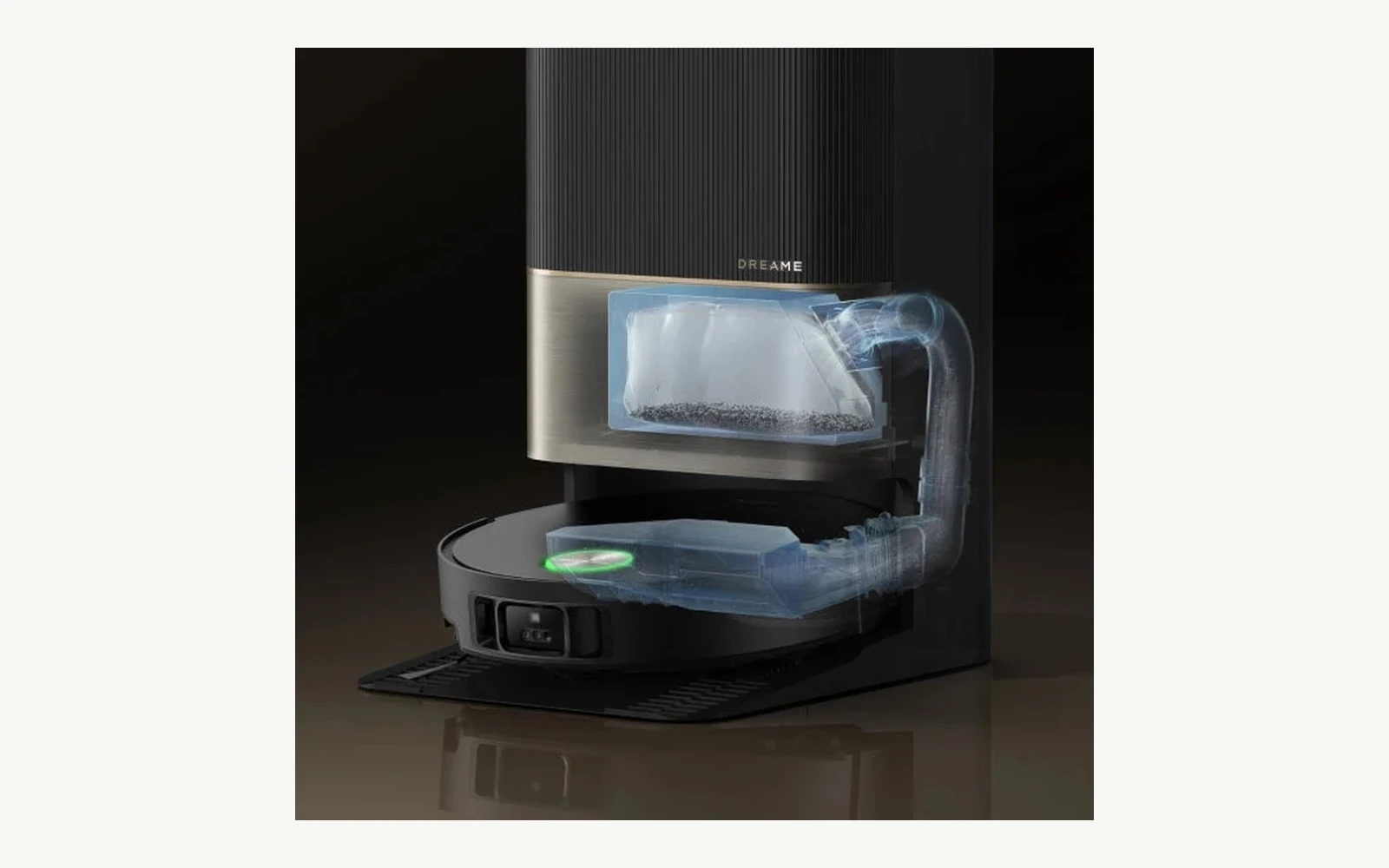
A bagless cyclone reduces disposable materials. ECOVACS X11 OmniCyclone is a current flagship example: its station collects debris in a cyclone container rather than a conventional dust bag. That is a meaningful ownership difference, but it is not “maintenance-free”. The bin, separator and filters still need cleaning, and fine dust can coat them.
See the updated ECOVACS DEEBOT X11 OmniCyclone database card.
Level 3: washing the mop
Mop washing is what turned modern docks from oversized vacuum bins into service centres. A robot with rotating pads or a roller returns to the station, rinses the cleaning material and can continue with a fresher surface. This matters on larger hard-floor areas: carrying one increasingly dirty mop over 150 m² can simply redistribute part of the dirt.
The station does not make the dirt disappear. Soil ends up in the wash tray and dirty-water tank. If that water sits for several days, odour can develop. Hair and residue collect around the tray. Maintenance frequency therefore depends not only on tank capacity but also on how often the robot mops and what it picks up.
Hot-water washing: useful, but °C is not a ranking
Flagship docks increasingly advertise mop-wash temperatures. Roborock states up to 100°C hot-water cleaning in the current RockDock system for Saros 20 under defined conditions, while Dreame markets hot-water mop washing up to 80°C on X50 Ultra Complete. Those values are not an independent cleaning comparison. Temperature at a particular stage, contact time, water volume, mechanical action and soil type all matter.
The practical idea is straightforward: warmer water can help loosen greasy residue and refresh the cleaning material. We would not choose between two robots solely because one headline says 80°C and another says 100°C. The more important ownership questions are how clean the mop returns to the floor and how easy the dock is to keep clean after a week.
Mop drying
After washing, wet pads or rollers should dry. Docks use airflow, often heated, to reduce the time damp material remains in a warm enclosed space. That matters for smell and hygiene, particularly in summer.
Drying is not cost-free or silent. A long drying cycle uses electricity and can produce a low continuous sound. If the dock sits near a bedroom, check whether drying times and schedules can be adjusted in the app.
Clean- and dirty-water tanks
A typical premium dock has two sizeable water tanks. One supplies wash water, the other receives dirty water. The larger the home and the more frequent the mopping, the more useful capacity becomes. Litres alone do not predict refill frequency because robots use different amounts of water depending on mop type, intensity and how often they return to wash.
The practical rule is not to leave dirty water sitting unnecessarily. Water collected after cleaning a kitchen and entrance area can smell before the app says the tank is technically full. Rinse seals and surfaces occasionally as well, because residue can build up above the normal water line.
Direct water and drain connection
Some docks or optional kits can connect directly to household water and drainage. This is the most appliance-like approach: the station fills itself and removes dirty water. In a large home it can genuinely reduce routine interaction.
The trade-offs are installation, placement and another plumbing system that must be fitted correctly. Not every model or regional variant supports the same kit. Verify the exact product, required pressure, drain position and warranty conditions. We would not improvise an unofficial water connection on a device that runs unattended every day.
Automatic detergent dosing
A dosing system is convenient, but it can create a proprietary consumables ecosystem. Manufacturers may specify their own solution because of foaming behaviour, seals and pump calibration. Pouring ordinary floor cleaner into the tank can produce excess foam, residue or pump issues.
Check the price and realistic consumption rather than just ticking “automatic detergent” on a feature list. If you use very little cleaning agent or have flooring that requires a specific product, manual control can be equally appropriate.
“Self-cleaning dock” does not mean “never clean the dock”
Manufacturers add scrapers, wash cycles and tray flushing to reduce residue. These are valuable, but hair, sand and greasy film can still collect in corners. Every few weeks, remove the parts the manual permits and inspect the wash area by hand.
In a dog household, wet hair and grit can be a bigger issue than dry dust. No dock should be treated as a sealed black box that can be ignored for six months.
PowerBoost and charging during service stops
ECOVACS X11 adds another dock-related idea: PowerBoost. ECOVACS states that the robot can recover about 6% battery in three minutes during routine mop-service stops. The aim is to reduce separate long charging pauses and maintain coverage on very large floors. It is a dock feature focused on time management rather than hygiene.
In a 60 m² apartment that has little value. In a large home running an aggressive mop schedule it can be more relevant. It shows why the dock should be evaluated against the use case rather than by total feature count.
Measure the dock before buying
A flagship station is much larger than a basic charger. Measure not only cabinet width but also the clearance required for the robot to enter, lids to open and water tanks to be lifted vertically. A niche under a cabinet can look perfect until you discover that a four-litre tank cannot be removed.
Consider the floor surface as well. A water-handling dock is best placed on a stable, level hard floor. Thick carpet underneath can interfere with levelling and makes any spill more troublesome.
Noise
Dust emptying is normally the loudest dock operation. It is brief but can sound like a powerful vacuum cleaner. Washing and drying tend to be quieter but last longer. If the robot works at night, configure schedules so the auto-empty blast does not happen at 2 a.m.
Apps differ in how independently those functions can be scheduled, so check controls before putting a dock next to a bedroom.
Station emptying and dust handling
Compare the complete dust-disposal procedure: removing a bag or container, closing it, disposing of its contents and cleaning filters and airways. Neither arrangement eliminates all hands-on work. Station construction alone does not establish a health benefit; this comparison concerns handling, access and consumables.
Three-year cost: what is easy to forget?
When comparing docks, estimate bags, detergent, filters, pads or rollers, descaling consumables and energy for drying. The goal is not a perfectly accurate number—prices change—but understanding the cost model. A bagless design removes one recurring item but adds manual cleaning. Automatic detergent removes a decision but locks some users into a specific consumable.
How do Roborock, Dreame and ECOVACS stations differ?
Roborock Saros 20 with RockDock emphasizes broad mop/dock automation and high-temperature washing according to the manufacturer. Dreame X50 Ultra Complete with PowerDock combines hot-water mop washing, drying, dust emptying and dosing with a robot platform also designed around high threshold crossing. ECOVACS X11 OmniCyclone stands out through bagless dust handling, PowerBoost and the OZMO Roller 2.0 cleaning architecture.
We are not naming a “best station” without a controlled physical test. The differences are primarily architectural: bag versus cyclone, pads versus roller, wash process and runtime management. See also Roborock vs Dreame 2026 and Best robot vacuums of 2026 by use case.
Dock checklist before purchase
- Does dust go into a disposable bag or bagless container?
- What is the annual cost of bags and filters?
- Does the dock wash the mop during the run or only afterwards?
- Does it dry the mop, and for how long?
- How easy is it to remove and clean the tray and dirty-water tank?
- Is detergent dosing automatic, and is proprietary solution required?
- Is a direct water/drain kit available for this exact regional version?
- How much space is required above and in front of the station?
- Can auto-empty be scheduled or reduced at night?
- Are dock parts and seals supported in Poland/EU?
FAQ
Can a modern dock really run for a month without being touched?
Rarely in the literal sense. You may avoid emptying the robot after every cycle, but brushes, hair, dirty water, the wash tray and filters still need checks. More mud, pet hair and mopping means more frequent attention.
Is hot-water washing worth paying for?
It can be valuable if you mop kitchens and greasy soils frequently. Do not buy on maximum temperature alone. Mechanical washing, rinse frequency and dock cleanability matter just as much.
Which is cheaper: bags or a bagless cyclone?
A cyclone removes regular bag purchases but needs cleaning. A bag costs money but is cleaner and easier to dispose of. For many owners the difference is more about convenience and dust exposure than a huge total saving.
Can a water dock sit on a wooden floor?
It can when the manufacturer allows it and the floor is level, but there is always some spill risk when handling tanks. Follow the manual and inspect seals and the wash area regularly.
RoboMorrow verdict
The best dock is not the one with the longest feature list. It is the one that removes the chores that annoy you most. In a pet household, dust auto-empty may be the priority. On a large hard-floor area, frequent mop washing and drying can matter more. For emptying, compare the complete bag or container procedure. If you want fewer disposable materials, a cyclone may appeal. In a very large house, charging strategy and direct plumbing can become relevant too.
Before paying for a flagship dock, measure the space, estimate consumables and decide what you actually want to stop doing by hand. That turns the station from an impressive accessory into a useful automation tool.
Manufacturer sources
- Roborock — Saros 20 / RockDock.
- Dreame — X50 Ultra Complete / PowerDock.
- ECOVACS — DEEBOT X11 OmniCyclone / PowerBoost / OZMO Roller 2.0.
Station automation: which chores actually disappear?
Mark each automatic action separately from the user work that remains. “Self-maintaining” does not describe every care task.
| Function | What still needs checking |
|---|---|
| Dust emptying | Bag or container servicing and airflow-path care |
| Pad or roller washing | Dirt in washing components and part condition |
| Drying | Cycle completion, result and energy for the whole routine |
| Automatic water supply | Installation, connection requirements and quoted equipment |
Keep a seven-day record of station visits, their reasons and hands-on minutes. Compare that result with the extra cost. A bag or bagless container alone does not establish a health benefit; the comparison concerns emptying procedure and dust contact, not a medical outcome.
Where to buy models from this article
We show only exact verified Amazon product pages. Before purchase, confirm the variant, seller, warranty and box contents.
Exact Amazon links. Where a verified RoboMorrow marketplace tracking ID is active, the link is an affiliate link and we may earn from qualifying purchases. Price and availability can change after you click.